

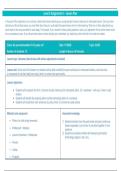
Level 3 Assignment A – Lesson Plan
In this part of the assignment, you must plan a face-to-face lesson teaching your young learners the past continuous for interrupted actions. Once you have
planned your face-to-face lesson, you must think about how you could adapt that same lesson plan for online teaching. Write two or three adjustments you
would make in the boxes provided for each stage. For example, if your warmer involves putting students in pairs, your adjustment for the online lesson would
be to use breakout rooms. If your face-to-face lesson involves handing out a worksheet, you might drop a link to the file in the chat box instead.
Class: A2 pre-intermediate 10-12 years old Date: 11/06/26 Topic: XXXX
Number of students: 12 Length of lesson: 60 minutes
Lesson type: Grammar (face-to-face with online adjustments included)
Lesson aim: By the end of the lesson my students will be able to identify the past continuous for interrupted actions, and know how
to incorporate it into their daily lives using ‘when’ to connect two past events.
Lesson objectives:
● Students will recognize the form / structure of past continuous for interrupted action. (S + was/were + verb–ing + when + past
simple)
● Students will identify the ongoing action and the interrupting action in a sentence.
● Students will create their own sentences by using ‘when’ to connect two past actions.
Materials and equipment: Assumed knowledge:
• Photo of a child doing homework. 1) Students already know the past simple and past continuous
tenses separately, but not how to use them together in one
• Whiteboard + Markers sentence.
• Lesson Worksheet + Workbooks 2) Students are already familiar with relevant grammatical
terminology (subject, verb, etc.).
• Pencils
• Laptop
• Projector
, Anticipated problems: Solutions:
1) Students may confuse when to use was/were. 1) Highlight the difference in the presentation and practice in the
2) The students all speak the same L1 and so may be reluctant to controlled practice task.
speak English. 2) Remind students to only speak English in class as needed.
3) Running out of time for the plenary. 3) Watch the time throughout the lesson and make minor
adjustments as required.
In this part of the assignment, you must plan a face-to-face lesson teaching your young learners the past continuous for interrupted actions. Once you have
planned your face-to-face lesson, you must think about how you could adapt that same lesson plan for online teaching. Write two or three adjustments you
would make in the boxes provided for each stage. For example, if your warmer involves putting students in pairs, your adjustment for the online lesson would
be to use breakout rooms. If your face-to-face lesson involves handing out a worksheet, you might drop a link to the file in the chat box instead.
Class: A2 pre-intermediate 10-12 years old Date: 11/06/26 Topic: XXXX
Number of students: 12 Length of lesson: 60 minutes
Lesson type: Grammar (face-to-face with online adjustments included)
Lesson aim: By the end of the lesson my students will be able to identify the past continuous for interrupted actions, and know how
to incorporate it into their daily lives using ‘when’ to connect two past events.
Lesson objectives:
● Students will recognize the form / structure of past continuous for interrupted action. (S + was/were + verb–ing + when + past
simple)
● Students will identify the ongoing action and the interrupting action in a sentence.
● Students will create their own sentences by using ‘when’ to connect two past actions.
Materials and equipment: Assumed knowledge:
• Photo of a child doing homework. 1) Students already know the past simple and past continuous
tenses separately, but not how to use them together in one
• Whiteboard + Markers sentence.
• Lesson Worksheet + Workbooks 2) Students are already familiar with relevant grammatical
terminology (subject, verb, etc.).
• Pencils
• Laptop
• Projector
, Anticipated problems: Solutions:
1) Students may confuse when to use was/were. 1) Highlight the difference in the presentation and practice in the
2) The students all speak the same L1 and so may be reluctant to controlled practice task.
speak English. 2) Remind students to only speak English in class as needed.
3) Running out of time for the plenary. 3) Watch the time throughout the lesson and make minor
adjustments as required.


