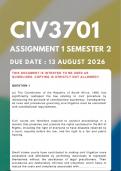
, CIV3701 ASSIGNMENT 1 SEMESTER 2
DUE DATE: 13 AUGUST 2026
QUESTION 1
(a) The Constitution of the Republic of South Africa, 1996, has significantly reshaped the law
relating to civil procedure by introducing the principle of constitutional supremacy.
Consequently, all rules and procedures governing civil litigation must be consistent with
constitutional requirements.1
Civil courts are therefore required to conduct proceedings in a manner that promotes and
protects the rights contained in the Bill of Rights, including the right of everyone to have
disputes resolved by a court, equality before the law, and the right to a fair and public
hearing.2
(b) Small claims courts have contributed to making civil litigation more accessible and
affordable by permitting individuals to represent themselves without the assistance of legal
practitioners.3 Their procedures are deliberately informal and simplified, which helps to
reduce the costs and complexity associated with ordinary civil litigation. Commissioners also
play an active role during proceedings by assisting litigants and guiding the process, thereby
promoting the speedy, fair and effective resolution of disputes.4
1
Constitution of the Republic of South Africa, 1996 s 2.
2
Constitution of the Republic of South Africa, 1996 ss 9 and 34.
3
Small Claims Courts Act 61 of 1984 s 7.
4
Small Claims Courts Act 61 of 1984 ss 26–27.
DUE DATE: 13 AUGUST 2026
QUESTION 1
(a) The Constitution of the Republic of South Africa, 1996, has significantly reshaped the law
relating to civil procedure by introducing the principle of constitutional supremacy.
Consequently, all rules and procedures governing civil litigation must be consistent with
constitutional requirements.1
Civil courts are therefore required to conduct proceedings in a manner that promotes and
protects the rights contained in the Bill of Rights, including the right of everyone to have
disputes resolved by a court, equality before the law, and the right to a fair and public
hearing.2
(b) Small claims courts have contributed to making civil litigation more accessible and
affordable by permitting individuals to represent themselves without the assistance of legal
practitioners.3 Their procedures are deliberately informal and simplified, which helps to
reduce the costs and complexity associated with ordinary civil litigation. Commissioners also
play an active role during proceedings by assisting litigants and guiding the process, thereby
promoting the speedy, fair and effective resolution of disputes.4
1
Constitution of the Republic of South Africa, 1996 s 2.
2
Constitution of the Republic of South Africa, 1996 ss 9 and 34.
3
Small Claims Courts Act 61 of 1984 s 7.
4
Small Claims Courts Act 61 of 1984 ss 26–27.