
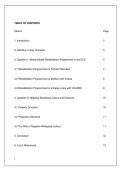
TABLE OF CONTENTS
Section Page
1. Introduction 2
2. Definition of Key Concepts 3
3. Question 1: Needs-Based Rehabilitation Programmes in the DCS 4
3.1 Rehabilitation Programmes for Female Offenders 4
3.2 Rehabilitation Programmes for Mothers with Infants 6
3.3 Rehabilitation Programmes for Inmates Living with HIV/AIDS 8
4. Question 2: Negative Workplace Culture and Deviance 10
4.1 Property Deviance 10
4.2 Production Deviance 11
4.3 The Role of Negative Workplace Culture 11
5. Conclusion 12
6. List of References 13
1
, 1. INTRODUCTION
The Department of Correctional Services (DCS) in South Africa is an important part of
the criminal justice system. Its job is not only to keep offenders safely in correctional
centres but also to help them change their behaviour and prepare to return to society.
The DCS uses different rehabilitation programmes to meet the different needs of
offenders (DCS Annual Report 2016:10–11). This assignment explains how the DCS
provides rehabilitation programmes for three vulnerable groups: female offenders,
mothers with babies, and offenders living with HIV/AIDS. It also explains how a negative
workplace culture can lead to property damage and poor work performance by
employees, using ideas from criminology and organisational behaviour.
2. DEFINITION OF KEY CONCEPTS
Needs-based rehabilitation refers to correctional programmes that are tailored to
address the individual needs of offenders rather than focusing solely on the nature of
the crime committed. This approach recognises that effective rehabilitation requires
interventions that target the underlying factors contributing to criminal behaviour, such
as trauma, substance abuse, mental health issues, and socio-economic disadvantage
(Herbig & Hesselink 2016). The DCS intends to offer needs-based rehabilitation
informed by a thorough assessment of each offender's needs, speaking to gender-
responsive based programmes.
Property deviance refers to unauthorised employee acquisition or damage of an
organisation's tangible property or assets. This includes acts such as theft of cash or
property, sabotage, and destruction of equipment (Hollinger & Clark 1983). Property
deviance represents instances where employees acquire or damage the work
organisation's property without authority.
2


