
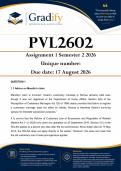
PVL2602 Assignment 1 (ANSWERS) Semester 2 2026 (281604) - DUE 17 August 2026
PVL2602 Assignment 1 (ANSWERS) Semester 2 2026 (281604) - DUE 17 August 2026 .... QUESTION 1 [15 Marks] Xolani, a practicing member of the AmaXhosa community, was married to Nomsa in terms of customary law in 2005. The marriage was never registered at the Department of Home Affairs. Out of their union, two children were born. Xolani was also the sole owner of a lucrative family farm to the value of R 2 100 000. On 14 May 2010, Xolani died peacefully without leaving a valid will. Following his funeral, Xolani’s eldest brother, Mandla, claimed that in terms of the traditional customary law rule of male primogeniture, he was the sole heir to Xolani’s estate, including the farm, and that Nomsa and the children had no claim to the property. Mandla further argues that the Reform of Customary Law of Succession Act 11 of 2009 (RCLSA) gives Nomsa inheritance rights, but because the Act only came into operation on 20 September 2010, she cannot rely on it to pursue her claim. 1.1. With reference to the provided facts above, the timeline of the RCLSA and relevant case law, advise Nomsa on whether Mandla’s claim to the estate is correct. (05) 1.2. Explain how Xolani’s estate is going to devolve and calculate how much each person will receive. Provide reasons for your calculations. Also, indicate which relatives will not inherit, with reasons to substantiate your answer. (10) _________________________________________________________ QUESTION 2 [10 Marks] Ben is murdered by his adopted son, Daniel, and dies intestate on 16 June 2026. He is survived by the following persons: - Wendy, his spouse. - Lerato and Thabo, his children from his marriage to Wendy. - Sophie and Veronica, children of Wendy’s predeceased daughter, Kopano (Kopano was born from Wendy’s previous marriage). - Daniel and Jane adopted children of Ben and Wendy. - Daniel’s son Matthew. Downloaded by Edge Tutor () lOMoARcPSD| PVL2602/102 3 Ben and Wendy were married in community of property, and their joint estate is worth R1 000 000. Calculate how this estate will devolve and give reasons for your calculations. Remember that your reasons are as important as your calculations. (10) _________________________________________________________ QUESTION 3 [10 Marks] Sipho, a 78-year-old widower, suffered a severe stroke that left him unable to write or sign his name. Wishing to ensure that his estate would pass to his two grandchildren, who had cared for him during his illness, Sipho instructed his attorney to prepare a will in accordance with his wishes. The attorney drafted the will, read its contents aloud to Sipho, and confirmed that Sipho understood and approved every provision. Because Sipho was unable to sign, he executed the will by placing his thumbprint on the final page of the document in the presence of two competent witnesses and a commissioner of oaths, Ms Jacobs. Ms Jacobs verified Sipho's identity, satisfied herself that the document was Sipho's will, and completed the certificate required by the Wills Act. She signed the certificate on the final page of the will but inadvertently failed to sign the preceding pages of the document. Sipho died three days later before the error could be discovered. When the executor lodged the will with the Master of the High Court, the Master refused to accept it on the ground that it did not comply with the formalities prescribed by the Wills Act 7 of 1953. Answer the following questions: 3.1. Evaluate whether the commissioner's failure to sign every page of Sipho's will constitutes non-compliance with section 2(1)(a)(v) of the Wills Act 7 of 1953 and discuss whether the Master was correct in refusing to accept the will. (04) 3.2. Assuming Sipho's beneficiaries approach the High Court for relief, critically discuss whether the court may order the Master to accept the will in terms of section 2(3) of the Wills Act 7 of 1953. In your answer, distinguish between compliance with the execution formalities in section 2(1) and the court's condonation powers under section 2(3), with reference to relevant case law. (06) _________________________________________________________ QUESTION 4 [10 Marks] In 2021, James, a retired accountant, executed a valid will in which he bequeathed his entire estate to his daughter, Emily. Two years later, after a deterioration in their relationship, James executed a second valid will. The 2023 will expressly revoked all previous wills and left his entire estate to his son, Matthew. In 2025, James informed his attorney that he regretted making the second will and preferred the provisions of his 2021 will. Before meeting with his attorney, James destroyed the original 2023 will by tearing it into pieces. On the same day, he wrote and signed a handwritten note stating: "I hereby revoke my 2023 will. My 2021 will reflects my true wishes and should apply to my estate." Downloaded by Edge Tutor () lOMoARcPSD| 4 The handwritten note was not witnessed and James took no further steps to re-execute the 2021 will or incorporate it into another validly executed will. James died unexpectedly one week later. Following James' death, Emily claims that the 2021 will was revived and should regulate the distribution of the estate. Matthew argues that the 2021 will was revoked by the execution of the 2023 will and was never validly revived. He further argues that the handwritten note cannot revive the earlier will. Answer the following questions: 4.1. Discuss whether James validly revived his 2021 will. In your answer, make reference to the prescribed statutory requirements for a valid revival of a revoked will as well as the relevant case law. (05) 4.2. Advise whether the High Court may grant relief in terms of section 2A of the Wills Act 7 of 1953. In your answer, distinguish between the revocation of a will and the revival of a revoked will, with reference to relevant statutory provisions and applicable case law. (05) _________________________________________________________ QUESTION 5 [15 Marks] Answer the following questions: 5.1. A testator leaves a house to his son on condition that he never sells it. The will does not stipulate what happens if the son sells the house. Evaluate whether this provision will be enforceable in law and substant your answer. (02) 5.2. In a joint will, two spouses leave their combined estate to their children, requiring the surviving spouse to transfer their own assets into the massed estate. Evaluate the legal position of the surviving spouse and explain the role of the doctrine of election in this situation. (02) 5.3. A testator leaves his farm to A, but provides that upon his (i.e., A’s) death the farm must pass to B. A argues that he has ownership and may dispose of the farm freely. Evaluate A’s legal position with reference to the nature of the substitution created in this instance. (02) 5.4. In a will, a testator leaves an estate to three beneficiaries jointly, but one of them dies before the testator. The will is silent on substitution. Discuss whether the remaining beneficiaries are entitled to the deceased beneficiary’s share, with reference to the right of accrual. (02) 5.5. A testator creates a testamentary trust in his will and appoints a trustee who later uses trust property for personal benefit. Evaluate the legal position of the trustee and explain the consequences of such conduct in terms of trust law. (02) 5.6. A testator gave one of his heirs an asset during his lifetime but did not mention anything about it in his will. The other heirs argue that the asset must be taken into account when the estate is divided. Use the provided information to evaluate whether the asset should be subject to collation and justify your answer. (02) 5.7. A testator’s will contains unclear wording regarding who should inherit a specific asset. The beneficiaries disagree on the meaning and ask the court to interpret the provision. Downloaded by Edge Tutor () lOMoARcPSD| PVL2602/102 5 Discuss how the court will determine the testator’s intention with reference to the golden rule of interpretation. (02) 5.8. A person enters into an agreement with another during his lifetime, promising to leave all his property to that person in his will. After his death, the agreement is challenged by the family. Determine whether this agreement is legally valid and justify your answer. (01)
Document information
- Uploaded on
- August 3, 2026
- Number of pages
- 15
- Written in
- 2026/2027
- Type
- Exam (elaborations)
- Contains
- Questions & answers


