
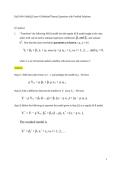
ISyE 6414 (A&Q) Exam #1 (Method/Theory) Questions with Verified Solutions
[15 points]
1. “Transform” the following AR(1) model into the regular SLR model taught in the class
where LSE can be used to estimate regression coefficients, β0 and β1, and variance
σ2. Note that the (auto-correlation) parameter ρ is known, e.g., ρ = 0.6.
Yt = β0 + β1 xt + ut, where ut = ρ ut-1 + εt, for t = 1, 2, … and u0 = 0.
where εt’s are iid normal random variables with mean zero and variance σ2.
Solution:
Step-1) Shift time index from t to t – 1 and multiply the model by ρ. We have
ρ Yt-1 = ρ β0 + β1 ρ xt-1 + ρ ut-1.
Step-2) Take a difference between the models for Yt and ρ Yt-1. We have
Yt − ρ Yt-1 = β0 (1 – ρ) + β1 (xt − ρ xt-1) + (ut − ρ ut-1).
Step-3) Define the following to represent the model given in Step (2) as a regular SLR model.
Yt * = Yt − ρ Yt-1, β0* = β 0 (1 – ρ), x t* = (xt − ρ xt- ).
1
The resulted model is
Yt* = β0* + β1 xt* + εt, for t = 1, 2, …
1
, [65 points]
2. Apply the regular LSE to estimate the regression coefficient β in the following model.
Yi = exp( β − 4xi + εi ), for i = 1, 2, …, 10,
and the errors εi’s are independent and have mean zero and variance σi 2’s, which are
known, e.g., σ1 2 = 2, σ2 2 = 5, ….
a) Formulate the model into the one-parameter SLR model with an equal variance. [15
points]
b) Apply the LSE method to estimate β. [10 points]
c) Derive the expectation and variance of this LSE. [25 points]
d) Construct a T-statistic to test whether the LSE = 0 = true value of β. [5 points]
e) Assume that the errors have normal distributions. What is the distribution of the
T-statistic. Provide justification of your answer. [10 points]
Solution:
a) Define εi = εi / σi such that Var(ε i ε ) / σ 2 = 1.
* *
i ) = Var(
i
Take a natural logarithm to both sides of the data model and divide them by σi to
transform the nonlinear and non-equal-variance model to a linear and equal-variance
model. Define the following quantities to simplify the notations.
Yi# = (loge Yi) / σi, x0i* = 1/σi, x1 * = − xi /σi and
i
Yi* = Yi # + 4 x * (note that the slope “4” is known).
Then, we have a simple linear regression model with an equal-variance structure.
Yi* = β x0i* + ε i*, for i = 1, 2, …, 10 = n.
b) Define Q(β) = ∑i=1n (Yi* − β x0i*)2. The goal is to minimize Q(β) with respect to β. The
resulted β will be the least squares estimate β_hat of β.
2
[15 points]
1. “Transform” the following AR(1) model into the regular SLR model taught in the class
where LSE can be used to estimate regression coefficients, β0 and β1, and variance
σ2. Note that the (auto-correlation) parameter ρ is known, e.g., ρ = 0.6.
Yt = β0 + β1 xt + ut, where ut = ρ ut-1 + εt, for t = 1, 2, … and u0 = 0.
where εt’s are iid normal random variables with mean zero and variance σ2.
Solution:
Step-1) Shift time index from t to t – 1 and multiply the model by ρ. We have
ρ Yt-1 = ρ β0 + β1 ρ xt-1 + ρ ut-1.
Step-2) Take a difference between the models for Yt and ρ Yt-1. We have
Yt − ρ Yt-1 = β0 (1 – ρ) + β1 (xt − ρ xt-1) + (ut − ρ ut-1).
Step-3) Define the following to represent the model given in Step (2) as a regular SLR model.
Yt * = Yt − ρ Yt-1, β0* = β 0 (1 – ρ), x t* = (xt − ρ xt- ).
1
The resulted model is
Yt* = β0* + β1 xt* + εt, for t = 1, 2, …
1
, [65 points]
2. Apply the regular LSE to estimate the regression coefficient β in the following model.
Yi = exp( β − 4xi + εi ), for i = 1, 2, …, 10,
and the errors εi’s are independent and have mean zero and variance σi 2’s, which are
known, e.g., σ1 2 = 2, σ2 2 = 5, ….
a) Formulate the model into the one-parameter SLR model with an equal variance. [15
points]
b) Apply the LSE method to estimate β. [10 points]
c) Derive the expectation and variance of this LSE. [25 points]
d) Construct a T-statistic to test whether the LSE = 0 = true value of β. [5 points]
e) Assume that the errors have normal distributions. What is the distribution of the
T-statistic. Provide justification of your answer. [10 points]
Solution:
a) Define εi = εi / σi such that Var(ε i ε ) / σ 2 = 1.
* *
i ) = Var(
i
Take a natural logarithm to both sides of the data model and divide them by σi to
transform the nonlinear and non-equal-variance model to a linear and equal-variance
model. Define the following quantities to simplify the notations.
Yi# = (loge Yi) / σi, x0i* = 1/σi, x1 * = − xi /σi and
i
Yi* = Yi # + 4 x * (note that the slope “4” is known).
Then, we have a simple linear regression model with an equal-variance structure.
Yi* = β x0i* + ε i*, for i = 1, 2, …, 10 = n.
b) Define Q(β) = ∑i=1n (Yi* − β x0i*)2. The goal is to minimize Q(β) with respect to β. The
resulted β will be the least squares estimate β_hat of β.
2


