
📜 Law of Property
Section 1: Property and Things – Foundations of South
African Property Law
⚖️ Key Case Law for Discussion and Illustration
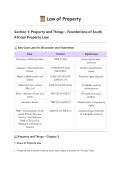
Case Citation Significance
Pretorius v Nefdt and Glas 1908 TS 854 Early classification
authority
Claassen v Quenstedt and (1199/2011) 2014 Modern classification
Others ZAECPEHC issues
Mbalo v Makhosonke and (21021/2013) 2015 Property rights disputes
Others ZAWCHC 91
Telkom SA Ltd v Xsinet 2003 (5) SA 309 (SCA) Fungibility and tax
(Pty) Ltd consequences
Khan v Minister of Law and 1991 (3) SA 439 (T) Principal-accessory
Order analysis
Senekal v Roodt 1983 (2) SA 602 (T) Classification and property
rights
FNB v Commissioner of the 2002 (4) SA 768 (CC) Constitutional protection
South African Revenue of intangible property
Service; First National
Bank of SA Ltd t/a
Westbank v Minister of
Finance
📖 Property and Things – Chapter 2
1. Scope of Property Law
Property law is determined by what legal objects qualify as "things" (res).
,Roman Law Foundation: Roman jurists divided private law into three categories:
1. Law relating to persons
2. Law relating to actions
3. Law relating to things (res)
Roman law embraced both physical and non-physical legal objects
South African law largely follows this approach
2. Characteristics of a "Thing"
Characteristic Explanation Examples
Corporeality & Tangible vs. intangible Tangible: chair, car;
Incorporeality objects Intangible: lease, usufruct
Impersonal nature Humans are not things; Exception: renewable parts
body parts generally non- (hair for wigs)
negotiable
Independent legal Must exist independently House not independent of
existence as a legal object land it sits on; key merely
provides access
Appropriability Must be susceptible to Air = not a thing;
human control compressed air in cylinder
= thing
Use & value Must have economic or Market value or personal
sentimental value significance
Working Definition: Any independent object, whether corporeal or incorporeal, which
does not form part of a human being, may be controlled by humans, and is of
use/value to them.
3. Relationship Between Things, Rights & Property
Key Relationships:
Things can be the object of rights (real or personal)
Rights over assets in a person's estate are patrimonial rights
Patrimonial value is the common denominator (tangible assets + immaterial
property/performances)
,Estate Structure Diagram:
PERSON'S ESTATE
|
|--- THINGS
| |
| |--- PERFORMANCES
| |--- IMMATERIAL PROPERTY
|
|--- REAL RIGHTS
|--- PERSONAL RIGHTS
|--- IMMATERIAL PROPERTY RIGHTS
|
OWNERSHIP
|
LIMITED REAL RIGHTS
Constitutional Dimension (Section 25):
Expands "property" to include intangible interests
Can reach statutory claims against the state
Conceptual Severance:
Intangible property interests receive protection as separate parts of a
property right
Limits State's ability to impair them
South African jurisprudence remains unsettled (e.g., FNB v Commissioner)
4. Classification of Things
Principle: Classification dictates the rules for acquisition, protection, and
enforcement of rights.
Two Principal Bases:
A. Classification by Negotiability (role in commerce)
Category Description
Res commercium Things that can be privately owned and
exchanged
, Res extra commercium Things that cannot be privately owned
Res nullius Ownerless things (e.g., wild animals)
Res derelictae Abandoned things
Res deperditae Lost things
Res singulorum Belongs to a particular group
Res universitatis Belongs to a university/corporation
Res alicuius Belongs to a specific person
Res omnium communes Common to all (e.g., air, sea)
Res publicae Public property (e.g., roads, rivers)
Res divini iuris Divine law property (e.g., sacred objects)
B. Classification by Nature
Nature Sub-categories & Key Points
Corporeal vs. Incorporeal Corporeal: perceivable by senses (book,
land)
Incorporeal: cannot be touched (lease,
usufruct, servitude)
Movable vs. Immovable Movable: can be moved without loss of
identity (furniture, car)
Immovable: cannot be moved (land,
buildings, fixtures)
Single vs. Composite Single: independent things (grain of sand)
Composite: principal +
accessory/auxiliary (house + key, car +
spare tire)
Divisible vs. Indivisible Divisible: can be split while retaining
same nature (shares, money)
Indivisible: cannot be split (crucial for co-
ownership disputes)
Consumable vs. Non-consumable Consumable: used up, loses value (food,
fuel)
Non-consumable: retains value after use
Section 1: Property and Things – Foundations of South
African Property Law
⚖️ Key Case Law for Discussion and Illustration
Case Citation Significance
Pretorius v Nefdt and Glas 1908 TS 854 Early classification
authority
Claassen v Quenstedt and (1199/2011) 2014 Modern classification
Others ZAECPEHC issues
Mbalo v Makhosonke and (21021/2013) 2015 Property rights disputes
Others ZAWCHC 91
Telkom SA Ltd v Xsinet 2003 (5) SA 309 (SCA) Fungibility and tax
(Pty) Ltd consequences
Khan v Minister of Law and 1991 (3) SA 439 (T) Principal-accessory
Order analysis
Senekal v Roodt 1983 (2) SA 602 (T) Classification and property
rights
FNB v Commissioner of the 2002 (4) SA 768 (CC) Constitutional protection
South African Revenue of intangible property
Service; First National
Bank of SA Ltd t/a
Westbank v Minister of
Finance
📖 Property and Things – Chapter 2
1. Scope of Property Law
Property law is determined by what legal objects qualify as "things" (res).
,Roman Law Foundation: Roman jurists divided private law into three categories:
1. Law relating to persons
2. Law relating to actions
3. Law relating to things (res)
Roman law embraced both physical and non-physical legal objects
South African law largely follows this approach
2. Characteristics of a "Thing"
Characteristic Explanation Examples
Corporeality & Tangible vs. intangible Tangible: chair, car;
Incorporeality objects Intangible: lease, usufruct
Impersonal nature Humans are not things; Exception: renewable parts
body parts generally non- (hair for wigs)
negotiable
Independent legal Must exist independently House not independent of
existence as a legal object land it sits on; key merely
provides access
Appropriability Must be susceptible to Air = not a thing;
human control compressed air in cylinder
= thing
Use & value Must have economic or Market value or personal
sentimental value significance
Working Definition: Any independent object, whether corporeal or incorporeal, which
does not form part of a human being, may be controlled by humans, and is of
use/value to them.
3. Relationship Between Things, Rights & Property
Key Relationships:
Things can be the object of rights (real or personal)
Rights over assets in a person's estate are patrimonial rights
Patrimonial value is the common denominator (tangible assets + immaterial
property/performances)
,Estate Structure Diagram:
PERSON'S ESTATE
|
|--- THINGS
| |
| |--- PERFORMANCES
| |--- IMMATERIAL PROPERTY
|
|--- REAL RIGHTS
|--- PERSONAL RIGHTS
|--- IMMATERIAL PROPERTY RIGHTS
|
OWNERSHIP
|
LIMITED REAL RIGHTS
Constitutional Dimension (Section 25):
Expands "property" to include intangible interests
Can reach statutory claims against the state
Conceptual Severance:
Intangible property interests receive protection as separate parts of a
property right
Limits State's ability to impair them
South African jurisprudence remains unsettled (e.g., FNB v Commissioner)
4. Classification of Things
Principle: Classification dictates the rules for acquisition, protection, and
enforcement of rights.
Two Principal Bases:
A. Classification by Negotiability (role in commerce)
Category Description
Res commercium Things that can be privately owned and
exchanged
, Res extra commercium Things that cannot be privately owned
Res nullius Ownerless things (e.g., wild animals)
Res derelictae Abandoned things
Res deperditae Lost things
Res singulorum Belongs to a particular group
Res universitatis Belongs to a university/corporation
Res alicuius Belongs to a specific person
Res omnium communes Common to all (e.g., air, sea)
Res publicae Public property (e.g., roads, rivers)
Res divini iuris Divine law property (e.g., sacred objects)
B. Classification by Nature
Nature Sub-categories & Key Points
Corporeal vs. Incorporeal Corporeal: perceivable by senses (book,
land)
Incorporeal: cannot be touched (lease,
usufruct, servitude)
Movable vs. Immovable Movable: can be moved without loss of
identity (furniture, car)
Immovable: cannot be moved (land,
buildings, fixtures)
Single vs. Composite Single: independent things (grain of sand)
Composite: principal +
accessory/auxiliary (house + key, car +
spare tire)
Divisible vs. Indivisible Divisible: can be split while retaining
same nature (shares, money)
Indivisible: cannot be split (crucial for co-
ownership disputes)
Consumable vs. Non-consumable Consumable: used up, loses value (food,
fuel)
Non-consumable: retains value after use


