
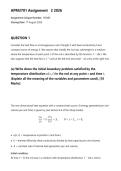
APM3701 Assignment 2 2026
Assignment Unique Number: 192483
Closing Date: 17 August 2026
QUESTION 1
Consider the heat flow in a homogeneous rod of length L with heat conductivity k and
constant source of energy A. We assume that initially the rod was submerged in a medium
where the temperature at each point x of the rod is described by the function 1 − sin x. We
also suppose that the heat flux is e−t units at the left end and cos(t − π) units at the right end.
(a) Write down the initial-boundary problem satisfied by the
temperature distribution u(x, t) in the rod at any point x and time t.
(Explain all the meaning of the variables and parameters used). [10
Marks]
The one-dimensional heat equation with a constant heat source A (energy generated per unit
volume per unit time) is given by (see Section 4.4 of the Study Guide):
∂u ∂2u
= k 2 + A, 0 < x < L, t > 0,
∂t ∂x
u(x, t) = temperature at position x and time t,
k = thermal diffusivity (heat conductivity divided by heat capacity per unit volume),
A = constant rate of internal heat generation per unit volume.
Initial condition:
At time t = 0, the rod was in a medium with temperature distribution 1 − sin x, hence
, u(x, 0) = 1 − sin x, 0 ≤ x ≤ L.
Boundary conditions:
Fourier's law of heat conduction states that the heat flux (rate of heat flow per unit area) is
∂u
ϕ(x, t) = −k (x, t).
∂x
At the left end x = 0, the flux is given as e−t :
∂u
−k (0, t) = e−t .
∂x
At the right end x = L, the flux is given as cos(t − π). Since cos(t − π) = − cos t, we have
∂u
−k (L, t) = cos(t − π) = − cos t,
∂x
or equivalently,
∂u
k (L, t) = cos t.
∂x
Thus the complete initial-boundary value problem is
2
⎧ ∂u = k ∂ u + A, 0 < x < L, t > 0,
∂t ∂x2
u(x, 0) = 1 − sin x, 0 ≤ x ≤ L,
⎨
∂u
−k (0, t) = e−t , t > 0,
∂x
⎩ −k ∂u
(L, t) = cos(t − π), t > 0.
∂x
Meaning of the variables and parameters:
u(x, t): temperature at point x and time t.
x: spatial coordinate along the rod (0 ≤ x ≤ L).
t: time variable (t > 0).
k : thermal diffusivity; determines how fast heat spreads in the material.
, A: constant internal heat source (e.g., from chemical reactions, electrical resistance, or
radioactive decay).
e−t : heat flux at the left end, decaying exponentially with time.
cos(t − π): heat flux at the right end, an oscillatory function of time with period 2π .
(b) Use the energy method to show that the solution of the
initial-boundary value problem found in (a) is unique. [15 Marks]
apply the energy method as discussed in Section 5.4.2 of the Study Guide.
Suppose that u1 and u2 are two solutions of the IBVP. Define their difference
w(x, t) = u1 (x, t) − u2 (x, t).
Since both u1 and u2 satisfy the same linear PDE and the same boundary and initial conditions,
the function w satisfies the homogeneous problem:
⎧ ∂w ∂2w
=k 2, 0 < x < L, t > 0,
∂t ∂x
w(x, 0) = 0, 0 ≤ x ≤ L,
⎨
∂w
−k (0, t) = 0, t > 0,
∂x
⎩ −k ∂w (L, t) = 0, t > 0.
∂x
Define the energy functional
L
E(t) = ∫ w2 (x, t) dx ≥ 0.
0
Differentiate E(t) with respect to t:
Assignment Unique Number: 192483
Closing Date: 17 August 2026
QUESTION 1
Consider the heat flow in a homogeneous rod of length L with heat conductivity k and
constant source of energy A. We assume that initially the rod was submerged in a medium
where the temperature at each point x of the rod is described by the function 1 − sin x. We
also suppose that the heat flux is e−t units at the left end and cos(t − π) units at the right end.
(a) Write down the initial-boundary problem satisfied by the
temperature distribution u(x, t) in the rod at any point x and time t.
(Explain all the meaning of the variables and parameters used). [10
Marks]
The one-dimensional heat equation with a constant heat source A (energy generated per unit
volume per unit time) is given by (see Section 4.4 of the Study Guide):
∂u ∂2u
= k 2 + A, 0 < x < L, t > 0,
∂t ∂x
u(x, t) = temperature at position x and time t,
k = thermal diffusivity (heat conductivity divided by heat capacity per unit volume),
A = constant rate of internal heat generation per unit volume.
Initial condition:
At time t = 0, the rod was in a medium with temperature distribution 1 − sin x, hence
, u(x, 0) = 1 − sin x, 0 ≤ x ≤ L.
Boundary conditions:
Fourier's law of heat conduction states that the heat flux (rate of heat flow per unit area) is
∂u
ϕ(x, t) = −k (x, t).
∂x
At the left end x = 0, the flux is given as e−t :
∂u
−k (0, t) = e−t .
∂x
At the right end x = L, the flux is given as cos(t − π). Since cos(t − π) = − cos t, we have
∂u
−k (L, t) = cos(t − π) = − cos t,
∂x
or equivalently,
∂u
k (L, t) = cos t.
∂x
Thus the complete initial-boundary value problem is
2
⎧ ∂u = k ∂ u + A, 0 < x < L, t > 0,
∂t ∂x2
u(x, 0) = 1 − sin x, 0 ≤ x ≤ L,
⎨
∂u
−k (0, t) = e−t , t > 0,
∂x
⎩ −k ∂u
(L, t) = cos(t − π), t > 0.
∂x
Meaning of the variables and parameters:
u(x, t): temperature at point x and time t.
x: spatial coordinate along the rod (0 ≤ x ≤ L).
t: time variable (t > 0).
k : thermal diffusivity; determines how fast heat spreads in the material.
, A: constant internal heat source (e.g., from chemical reactions, electrical resistance, or
radioactive decay).
e−t : heat flux at the left end, decaying exponentially with time.
cos(t − π): heat flux at the right end, an oscillatory function of time with period 2π .
(b) Use the energy method to show that the solution of the
initial-boundary value problem found in (a) is unique. [15 Marks]
apply the energy method as discussed in Section 5.4.2 of the Study Guide.
Suppose that u1 and u2 are two solutions of the IBVP. Define their difference
w(x, t) = u1 (x, t) − u2 (x, t).
Since both u1 and u2 satisfy the same linear PDE and the same boundary and initial conditions,
the function w satisfies the homogeneous problem:
⎧ ∂w ∂2w
=k 2, 0 < x < L, t > 0,
∂t ∂x
w(x, 0) = 0, 0 ≤ x ≤ L,
⎨
∂w
−k (0, t) = 0, t > 0,
∂x
⎩ −k ∂w (L, t) = 0, t > 0.
∂x
Define the energy functional
L
E(t) = ∫ w2 (x, t) dx ≥ 0.
0
Differentiate E(t) with respect to t:


