
Page 1 of 225
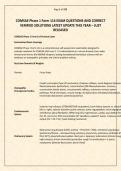
COMSAE Phase 1 Form 114 EXAM QUESTIONS AND CORRECT
VERIFIED SOLUTIONS LATEST UPDATE THIS YEAR – JUST
RELEASED
COMSAE Phase 1 Form 114 Practice Exam
Summarized Exam Coverage
COMSAE Phase 1 Form 114 is a comprehensive self-assessment examination designed to
evaluate readiness for COMLEX-USA Level 1. It is administered on a secure browser (non-video
format) and mirrors the NBOME blueprint, testing foundational biomedical sciences with an
emphasis on osteopathic principles and clinical problem-solving .
Key Exam Domains & Weights:
Domain Focus Areas
Fryette's principles (Type I/II mechanics), Chapman reflexes, sacral diagnosis (torsions
flexion/extension dysfunction), cranial motion (SBS flexion/extension, torsions),
Osteopathic
counterstrain tender points, viscerosomatic reflexes, autonomic nervous system
Principles & Practice
pathways, HVLA techniques, muscle energy, rib dysfunctions (inhalation/exhalation),
innominate dysfunctions (anterior/posterior)
Ischemic heart disease (STEMI/NSTEMI localization), heart failure (systolic vs. diastolic
left vs. right), valvular disorders (aortic stenosis, aortic regurgitation, mitral regurgitati
Cardiovascular
arrhythmias (atrial fibrillation, WPW, long QT), hypertension, cardiac auscultation find
System
(S3, S4, murmurs), ECG interpretation (ST elevations, peaked T waves, U waves), cardi
output (CO = HR × SV), Frank-Starling mechanism
Obstructive lung disease (COPD, asthma – FEV1/FVC <70%), restrictive lung disease
(pulmonary fibrosis – decreased lung volumes), pneumonia, pulmonary embolism (PE
Pulmonary System from DVT), pneumothorax (sudden chest pain + dyspnea), tuberculosis (chronic cough
night sweats), chronic bronchitis (productive cough ≥3 months/year × 2 years),
emphysema (alveolar destruction, barrel chest)
, Page 2 of 225
Domain Focus Areas
Acute kidney injury (prerenal, intrarenal, postrenal), chronic kidney disease,
Renal & Electrolytes glomerulonephritis, nephrotic syndrome, fluid/electrolyte disorders, acid-base balanc
/ Acid-Base (respiratory acidosis – hypoventilation, respiratory alkalosis – hyperventilation),
metabolic acidosis/alkalosis, hyperkalemia (peaked T waves), hypokalemia (U waves)
Thyroid disorders (hypo/hyper), adrenal disorders (Cushing's syndrome vs. Addison's
Endocrine System disease), diabetes mellitus (Type 1 vs. Type 2, complications), parathyroid disorders
(hyperparathyroidism), pituitary disorders
Stroke (ischemic vs. hemorrhagic, artery localization – LAD occlusion → anterior MI, V
Neurology V4), seizures, meningitis, multiple sclerosis, Parkinson's disease, Alzheimer's disease,
neuromuscular junction disorders (myasthenia gravis)
EBV (mononucleosis – posterior cervical lymphadenopathy, splenomegaly), HIV (ART
initiation regardless of CD4 count, PCP prophylaxis when CD4 <200), TB (chronic coug
Infectious Disease
night sweats, hemoptysis), pneumonia (community-acquired), septic arthritis (hot,
swollen joint), osteomyelitis
Counterstrain: treating tender points by positioning into comfort (90 sec), ligamentou
articular strain, balanced ligamentous tension (BLT), facilitated positional release (FPR
OMM Techniques & HVLA thrust techniques, muscle energy (isometric contraction → relaxation →
Anatomical reposition), rib raising (sympathetic inhibition), Galbreath technique (eustachian tube
Landmarks Spencer technique (shoulder, especially adhesive capsulitis), Chapman reflexes
(anterior/posterior maps – e.g., kidney at tip of 12th rib posteriorly, cecum at tip of ri
12th rib, appendix at right 2nd intercostal space parasternal)
ACE inhibitors (decrease aldosterone, decrease bradykinin breakdown → cough), beta
blockers (block β-receptors → decreased HR/contractility, decreased renin), DOACs
Pharmacology (apixaban, rivaroxaban – no routine INR monitoring), warfarin (INR target 2.0-3.0 for
AF/DVT), heparin (HIT risk), statins (myopathy, rhabdomyolysis, hepatotoxicity),
metformin (GI side effects, metallic taste, no hypoglycemia alone), insulin (rapid-actin
lispro, peak 1-2 hr), levothyroxine (empty stomach, 30-60 min before breakfast),
, Page 3 of 225
Domain Focus Areas
clozapine (agranulocytosis – monitor ANC), lithium (nephrogenic DI – monitor Cr and
TSH)
150 Randomized Practice Questions with Answers & Rationales
Section 1: Osteopathic Principles & Practice (OPP)
Question 1
A 45-year-old male presents with low back pain after lifting. Standing flexion test shows superior
movement of the right PSIS. Which somatic dysfunction is most likely?
A) Right anterior innominate
B) Left posterior innominate
C) Right sacral torsion on a left oblique axis
D) Bilateral innominate rotation
Answer: A
Rationale: A positive standing flexion test on the right suggests iliosacral dysfunction. Superior
, Page 4 of 225
PSIS movement often correlates with a right anterior innominate, where the right ASIS is
inferior, creating a functional short leg .
Question 2
According to Fryette's first principle (Type I mechanics), sidebending and rotation occur:
A) To the same side
B) To opposite sides
C) Without rotation
D) Only in the lumbar spine
Answer: B
Rationale: Fryette's first principle states that in the neutral spine, sidebending and rotation
occur to opposite sides. For example, sidebending right leads to rotation left. This applies to the
mid to lower lumbar spine (L2-L5) .
Question 3
A patient has a somatic dysfunction "left fibular head, posterior." What motion is restricted?
COMSAE Phase 1 Form 114 EXAM QUESTIONS AND CORRECT
VERIFIED SOLUTIONS LATEST UPDATE THIS YEAR – JUST
RELEASED
COMSAE Phase 1 Form 114 Practice Exam
Summarized Exam Coverage
COMSAE Phase 1 Form 114 is a comprehensive self-assessment examination designed to
evaluate readiness for COMLEX-USA Level 1. It is administered on a secure browser (non-video
format) and mirrors the NBOME blueprint, testing foundational biomedical sciences with an
emphasis on osteopathic principles and clinical problem-solving .
Key Exam Domains & Weights:
Domain Focus Areas
Fryette's principles (Type I/II mechanics), Chapman reflexes, sacral diagnosis (torsions
flexion/extension dysfunction), cranial motion (SBS flexion/extension, torsions),
Osteopathic
counterstrain tender points, viscerosomatic reflexes, autonomic nervous system
Principles & Practice
pathways, HVLA techniques, muscle energy, rib dysfunctions (inhalation/exhalation),
innominate dysfunctions (anterior/posterior)
Ischemic heart disease (STEMI/NSTEMI localization), heart failure (systolic vs. diastolic
left vs. right), valvular disorders (aortic stenosis, aortic regurgitation, mitral regurgitati
Cardiovascular
arrhythmias (atrial fibrillation, WPW, long QT), hypertension, cardiac auscultation find
System
(S3, S4, murmurs), ECG interpretation (ST elevations, peaked T waves, U waves), cardi
output (CO = HR × SV), Frank-Starling mechanism
Obstructive lung disease (COPD, asthma – FEV1/FVC <70%), restrictive lung disease
(pulmonary fibrosis – decreased lung volumes), pneumonia, pulmonary embolism (PE
Pulmonary System from DVT), pneumothorax (sudden chest pain + dyspnea), tuberculosis (chronic cough
night sweats), chronic bronchitis (productive cough ≥3 months/year × 2 years),
emphysema (alveolar destruction, barrel chest)
, Page 2 of 225
Domain Focus Areas
Acute kidney injury (prerenal, intrarenal, postrenal), chronic kidney disease,
Renal & Electrolytes glomerulonephritis, nephrotic syndrome, fluid/electrolyte disorders, acid-base balanc
/ Acid-Base (respiratory acidosis – hypoventilation, respiratory alkalosis – hyperventilation),
metabolic acidosis/alkalosis, hyperkalemia (peaked T waves), hypokalemia (U waves)
Thyroid disorders (hypo/hyper), adrenal disorders (Cushing's syndrome vs. Addison's
Endocrine System disease), diabetes mellitus (Type 1 vs. Type 2, complications), parathyroid disorders
(hyperparathyroidism), pituitary disorders
Stroke (ischemic vs. hemorrhagic, artery localization – LAD occlusion → anterior MI, V
Neurology V4), seizures, meningitis, multiple sclerosis, Parkinson's disease, Alzheimer's disease,
neuromuscular junction disorders (myasthenia gravis)
EBV (mononucleosis – posterior cervical lymphadenopathy, splenomegaly), HIV (ART
initiation regardless of CD4 count, PCP prophylaxis when CD4 <200), TB (chronic coug
Infectious Disease
night sweats, hemoptysis), pneumonia (community-acquired), septic arthritis (hot,
swollen joint), osteomyelitis
Counterstrain: treating tender points by positioning into comfort (90 sec), ligamentou
articular strain, balanced ligamentous tension (BLT), facilitated positional release (FPR
OMM Techniques & HVLA thrust techniques, muscle energy (isometric contraction → relaxation →
Anatomical reposition), rib raising (sympathetic inhibition), Galbreath technique (eustachian tube
Landmarks Spencer technique (shoulder, especially adhesive capsulitis), Chapman reflexes
(anterior/posterior maps – e.g., kidney at tip of 12th rib posteriorly, cecum at tip of ri
12th rib, appendix at right 2nd intercostal space parasternal)
ACE inhibitors (decrease aldosterone, decrease bradykinin breakdown → cough), beta
blockers (block β-receptors → decreased HR/contractility, decreased renin), DOACs
Pharmacology (apixaban, rivaroxaban – no routine INR monitoring), warfarin (INR target 2.0-3.0 for
AF/DVT), heparin (HIT risk), statins (myopathy, rhabdomyolysis, hepatotoxicity),
metformin (GI side effects, metallic taste, no hypoglycemia alone), insulin (rapid-actin
lispro, peak 1-2 hr), levothyroxine (empty stomach, 30-60 min before breakfast),
, Page 3 of 225
Domain Focus Areas
clozapine (agranulocytosis – monitor ANC), lithium (nephrogenic DI – monitor Cr and
TSH)
150 Randomized Practice Questions with Answers & Rationales
Section 1: Osteopathic Principles & Practice (OPP)
Question 1
A 45-year-old male presents with low back pain after lifting. Standing flexion test shows superior
movement of the right PSIS. Which somatic dysfunction is most likely?
A) Right anterior innominate
B) Left posterior innominate
C) Right sacral torsion on a left oblique axis
D) Bilateral innominate rotation
Answer: A
Rationale: A positive standing flexion test on the right suggests iliosacral dysfunction. Superior
, Page 4 of 225
PSIS movement often correlates with a right anterior innominate, where the right ASIS is
inferior, creating a functional short leg .
Question 2
According to Fryette's first principle (Type I mechanics), sidebending and rotation occur:
A) To the same side
B) To opposite sides
C) Without rotation
D) Only in the lumbar spine
Answer: B
Rationale: Fryette's first principle states that in the neutral spine, sidebending and rotation
occur to opposite sides. For example, sidebending right leads to rotation left. This applies to the
mid to lower lumbar spine (L2-L5) .
Question 3
A patient has a somatic dysfunction "left fibular head, posterior." What motion is restricted?


