

Written by students who passed Immediately available after payment Read online or as PDF Wrong document? Swap it for free 4,6 TrustPilot
logo-home
Document preview thumbnail
Preview 2 out of 10 pages
Exam (elaborations)

AGE3702 Assignment 2 (ANSWERS) 2026 - Due 8 June 2026

Document preview thumbnail
Preview 2 out of 10 pages

AGE3702 Assignment 2 (ANSWERS) 2026 - Due 8 June 2026. Guaranteed distinction quality with trusted academic solutions, clear explanations, professional formatting, and reliable support.Assessment 2 will require you to write a blog that analyses the relationship between the history, archaeology, and heritage of a chosen archaeological or cultural heritage site. The blog should consider the following: • Background to the heritage site • Archaeological research and AHM at the site • Values and Significance of the site • Pluralism and stakeholder engagement at the site • Top-down and bottom-up approaches generally in Africa and at the site The final Assessment 2 activity and rubric will be provided before 4 May 2026. The Assessment 2 portal opens on Monday 4 May 2026 at 14:00. AGE Assessment 2 Scope 2 LEARNING MATERIAL You should explicitly refer to the concepts, terms, examples, and e-reserves discussed in the Learning Units and Lessons and explain how they apply to the site you have chosen. Assessment 2 requires you to remember, understand and apply what you may have learnt about archaeology and heritage in LUs 1 to 3 to a case study. E-RESERVES You may also find the following readings useful in preparing for the blog: Chirikure, C. & Pwiti, G. 2008. Community involvement in Archaeology and cultural heritage management: as assessment for case studies in southern Africa and elsewhere. Current Anthropology 49(3):1–13. Chirikure, S., Manyanga, M., Ndoro, W. & Pwiti, G. 2010. Unfulfilled promises? Heritage management and community participation at some of Africa’s cultural heritage sites. International Journal of Heritage Studies 16(1-2):30–44. Chirikure, S. 2013. Heritage conservation in Africa. The good, the bad, and the challenges. South African Journal of Science 109(1-2):1–3. Deacon, H.J. & Deacon, J. 1999. Human beginnings in South Africa: uncovering the secrets of the Stone Age. Cape Town: David Philip. de Jesus Jopela, A.P. 2011. Traditional custodianship: A useful framework for heritage management in southern Africa? Conservation and Management of Archaeological Sites 13(2-3):103–122. Mumma, A. 2005. The link between traditional and formal legal systems. In Ndoro, W. & Pwiti, G. (Eds). Legal frameworks for the protection of immovable cultural heritage in Africa 22–24. Rome: ICCROM. Munjeri, D. 2005. Legislation and practices: implications and the way forward. In: Ndoro, W. & Pwiti. G. (Eds). Legal frameworks for the protection of immovable cultural heritage in Africa 2–4. Rome: ICCROM. Ndoro, W. & Pwiti, G. 2001. Heritage management in southern Africa: Local, national and international discourse. Public Archaeology 2(1):21–34. Ndoro, W. 2021. Heritage and/or development – Which way for Africa? In: Baillie, B. and Sørensen, M.L.S. (Eds). African Heritage Challenges, 103–124. Singapore: Palgrave-Macmillan Orton. J. 2016. Prehistoric cultural landscapes in South Africa: A typology and discussion. South African Archaeological Bulletin 71(204):119–129. Pikirayi, I. & Magoma, M. 2021. Retrieving intangibility, stemming biodiversity loss: The case of sacred places in Venda, Northern South Africa. Heritage 4(4):4524–4541. AGE Assessment 2 Scope 3 Robertshaw, P. (Ed). 1990. A history of African archaeology. London. James Currey. South Africa. 1999. National Heritage Resources Act 25 of 1999. Pretoria: Government Printer. ACADEMIC INTEGRITY AND USE OF AI Referencing Although this is a blog, your arguments must be supported by credible sources. You should use in-text references and hyperlinks to sources. In-text references should follow the Harvard referencing style as prescribed by the South African Archaeological Bulletin (SAAB). A full reference list, formatted in the Harvard referencing style as prescribed by the SAAB, should be included at the end of the blog (after the Reflection). Only credible sources such as peer-reviewed journal articles and academic books may be used. Wikipedia and South Africa History Online (SAHO) or other generic sources are not permitted. Use of AI You may use AI tools only for: • Spelling and grammar checking • Brainstorming and idea generation • Locating relevant literature • Clarifying theories and concepts • Summarising sources for understanding only You may not use AI tools to: • Generate paragraphs or full sections of text • Provide heritage analysis, arguments, or conclusions • Rewrite your draft to sound more academic Even when AI content is factually correct or properly referenced, it may not be used in assessments. Misuse of AI falls under plagiarism and academic dishonesty. AGE Assessment 2 Scope 4 TECHNICAL GUIDELINES Prepare your blog in Microsoft (MS) Word, or another word processing programme (not using AI tools). When you are ready to submit the blog, you can copy and paste the text from your MS Word document into Assessment 2 on myModules (see step-by-step instructions below). Use the image function to upload images. The blog tool also allows you to create hyperlinks and upload other media. Blogs typically make use of images and other media that are relevant and properly referenced. You must make use of images and hyperlinks in your blog (see the marking rubric). Before submitting: • Read your blog carefully and edit your work. • Ensure that you have not plagiarised. • Familiarise yourself with the blog tool well in advance of the due date, so that you have sufficient time to resolve any technical issues that may arise. Blogging on myModules • Select Assessment 2 on the AGE3702 myModules site. • In Assessment 2, click on ADD NEW DISCUSSION TOPIC. • Create your own discussion topic. Use your surname and student number as the topic title. • In the SUBJECT line, type in your “surname” and “student number”. • Copy and paste the text from your Microsoft Word document into the message box. • Add images, hyperlinks, and other media using the appropriate tools in the MESSAGE BOX. • When using images, ensure that all sources are correctly referenced. • Read your blog again and make any final edits. • Click POST TO FORUM to submit the blog. DO NOT submit your blog in any of the discussion forums other than Assessment 2. DO NOT submit your blog in another student’s discussion topic. REMINDER: ASS2 will only open on Monday 4 May 2026 at 14:00 (SAST) AGE Assessment 2 Scope 5 WRITING GUIDANCE Refer to the guides below Academic Blog Walkthrough, available in Additional Resources. Adding images to a blog Editing a blog post on myModules Link: An Unsolicited Guide to Writing an Archaeology Blog Post – Bones, Stones, and Books Useful tips • Write for an educated public audience (clear, engaging, but academic) • Use headings and a logical structure • Support your discussion with relevant sources • Avoid only descriptive writing Use a professional voice You are writing as a developing heritage professional. Your blog must reflect ethical awareness, responsibility, and respect for communities and heritage resources. RESEARCH GUIDANCE Do not waste time: Assessment 2 is not designed to be completed in one sitting. Strong submissions typically involve drafting, revising, and reflecting over time. Conduct desktop and field research on your chosen site to investigate its history and heritage significance. For desktop research, consult: • Library resources • Online journal articles • eBooks Keep a clear record of all references because these will be required for your blog. The Technical Guidelines in Additional Resources provides a guide on summarising and tracking references. AGE Assessment 2 Scope 6 If conducting field research: • Visit the site to document it and your observations and reflect on your experience. • Take photographs where appropriate. • Always request permission before taking photographs.

Content preview

AGE3702
Assignment 2 2026
Unique number:
Due date: 8 June 2026
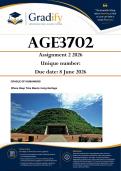
CRADLE OF HUMANKIND

Where Deep Time Meets Living Heritage

, CRADLE OF HUMANKIND

Where Deep Time Meets Living Heritage


1. Introduction: Background to the Heritage Site

I chose the Cradle of Humankind because it connects South African archaeology to
the wider story of human origins in a way that feels close to home and important to
the world. The site is situated mainly in Gauteng, near the Muldersdrift area, about
40 kilometres northwest of Johannesburg, and it forms part of the wider Fossil
Hominid Sites of South Africa (SAHRA, 2025). UNESCO first inscribed the site in
1999, and its boundaries were significantly modified in 2005 to include related fossil
areas such as Makapan Valley and the Taung Skull Fossil Site (UNESCO World
Heritage Centre, 2025). The site is historically important because places such as
Sterkfontein, Swartkrans and Kromdraai have produced fossils, stone tools and other
evidence linked to early human evolution over millions of years (South African
History Online, 2023).


Connected book
 image
Unknown Archaeology
Publisher: 1970 ISBN: 9780191653346 Edition: Unknown

Document information

Uploaded on
June 7, 2026
Number of pages
10
Written in
2025/2026
Type
Exam (elaborations)
Contains
Questions & answers
R75,00

Wrong document? Swap it for free Within 14 days of purchase and before downloading, you can choose a different document. You can simply spend the amount again.
Written by students who passed
Immediately available after payment
Read online or as PDF

Seller avatar
Reputation scores are based on the amount of documents a seller has sold for a fee and the reviews they have received for those documents. There are three levels: Bronze, Silver and Gold. The better the reputation, the more your can rely on the quality of the sellers work.
Gradify
4,3
(41)
Sold
210
Followers
0
Items
100
Last sold
4 days ago


Why students choose Stuvia

Created by fellow students, verified by reviews

Quality you can trust: written by students who passed their exams and reviewed by others who've used these notes.

Didn't get what you expected? Choose another document

No worries! You can immediately select a different document that better matches what you need.

Pay how you prefer, start learning right away

No subscription, no commitments. Pay the way you're used to via credit card or EFT and download your PDF document instantly.

Student with book image

“Bought, downloaded, and aced it. It really can be that simple.”

Alisha Student

Working on your references?

Create accurate citations in APA, MLA and Harvard with our free citation generator.

Working on your references?

Frequently asked questions
