Question for Cos2611 Assignment1 for 2026
Warehouse Order Dispatch System
Scenario
As a second-year IT student, you have been requested by a warehouse manager to develop a simulation system that demonstrates how orders are received, queued, processed, and dispatched in trucks. The warehouse handles three types of orders:
Small (S)
Medium (M)
Bulk (B)
Orders arrive randomly during the day. Each truck has a capacity of five orders. Once full, a truck is dispatched. The manager wants to see a clear simulation of how orders are queued, processed, and dispatched.
Project Objective
Using C++ and linear data structures (queues and stacks), develop a simulation that:
Generates random orders without using external files.
Assigns each order to a queue based on its type.
Processes orders in first-in-first-out (FIFO) order for each queue.
Uses stacks to represent dispatched trucks, showing last dispatched trucks on top (LIFO order).
Tracks processing time for each order.
Provides a record of all generated orders (time step, order type, processing time).
Presents output clearly::
Queues with order types and processing times
Dispatched trucks stack with numbering
New arrivals at each time step
Final table of all generated orders
[To help you visualise the project - see the attached pseudocode]
Simulation Details
Queues
Three queues represent each order type: S, M, B.
Orders are added to the queue based on type.
Each order has a processing time (randomly generated).
Orders are processed in FIFO order.
Trucks / Stack
Each truck can hold 5 orders.
Once full, the truck is dispatched.
Dispatched trucks are placed in a stack, showing LIFO order.
Each truck is numbered per type: Truck1[S], Truck2[M], Truck3[B], etc.
Random Order Generation
At each time step, 0–3 new orders arrive randomly.
Each order type is chosen randomly.
Each order is assigned a random processing time (1–4 time units).
Output Format
At each time step, display:
New arrivals: list of order types arriving.
Queue state: each queue with order types and remaining processing times.
Stack of dispatched trucks: last dispatched on top with numbering.
At the end of the simulation, display a table of all generated orders, in the format:
time_step,type,processing_time
1,S,3
1,B,2
2,M,4
3,S,1
3,S,2
5,B,3
Example Expected Output (partial)
Time Step 1:
New Orders: S, B
Queue S: [S(3)]
Queue M: []
Queue B: [B(2)]
Stack: empty
Time Step 2:
New Orders: M
Queue S: [S(2)]
Queue M: [M(4)]
Queue B: [B(1)]
Stack: empty
Dispatched Trucks Stack (example at end):
Top - Truck1[S]
Truck1[B]
Truck1[M]
Bottom
Final Generated Orders Table:
time_step,type,processing_time
1,S,3
1,B,2
2,M,4
3,S,1
3,S,2
5,B,3
...
Technical and coding requirements
Must use latest C++ standard (C++20 or later).
Only standard libraries (iostream, queue, stack, vector, algorithm, etc.) are allowed.
Submission Requirements
Single C++ file only: _AS
First three lines: student number and name.
Must use latest C++ standard and standard libraries only.
Output must follow format described above.
Content preview
COS2611 ASSIGNMENT 1 2026 SOLUTION
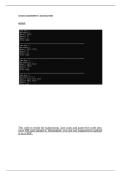
OUTPUT
The code is ready for submission. Just copy and paste the code into
your IDE and submit it. Remember, you are not supposed to upload
it as a PDF.