© Warona Lekoko, 2024
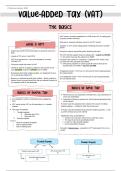
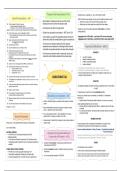
VAT Vendor: business registered for VAT& levies VAT on selling price
of goods (renders services)
Enterprise: business activities carried on by VAT vendor
Supplier: a VAT vendor selling goods (rendering services) to another
person
Indirect tax levied on the consumption on goods & services in Recipient: person buying the goods (acquiring services)
RSA
The VAT that the supplier levies on selling price = output tax (RAISE)
Levied at 15% since 1 April 2018
the vendor must pay the output tax to SARS
VAT is an inclusive tax – any price charged by a vendor If recipient also carries on a business + registered VAT vendor, they
includes VAT can claim the VAT paid back from SARS
VAT paid by recipient on certain goods & services that can be
Consumer bears the burden of VAT
claimed back from SARS = input tax (CLAIM)
Vendor is used as an agent to collect the tax & at the end of
each tax period, submits a VAT 201 form to SARS
If registered vendor = VAT does not form part of cost of expense/asset
Businesses that make taxable supplies, are registered & carry (it’s claimed back)
on an enterprise charge VAT
If not registered vendor = VAT will form part of cost of expense/asset
Based on a subtractive/credit input method – allows vendors to (it’s not claimed back)
deduct the tax incurred (input) from the tax collected (output) on
the supplies made by the enterprise
Not all input tax can deductible: entertainment, club subscription &
motor car expenditure
♦ Tax charged by vendor on goods/services supplied by Important to determine purpose for which acquired goods/services
them will be utilised
♦ VAT vendor levies VAT on all transactions i.r.o. taxable If vendor uses the goods/services wholly in the course of making
supplies taxable supplies → entitled to claim the full input tax
♦ Two types of supplies: If vendor uses the goods/services partly for taxable purposes → only
1. Taxable supplies a portion of input tax can be claimed
Standard-rate (15%)
Zero-rate (0%) WHEN DO YOU CLAIM INPUT?
2. Exempt supplies ✓ Vendors can only claim if they have a valid tax invoice
Levied on:
✓ The input must not be specifically denied
o Services rendered /supplied ✓ In order to make taxable supplies
o Sale of capital assets ✓ On the importation of goods
o Sale of trading stock
Exception: Notional input – acquisition of 2nd hand goods from a non-
vendor
Taxable Supply Exempt Supply
s7(1)
Standard-rated supply = 15% Zero-rated supply = 0%
s11
No Applicable VAT
Including deemed supplies s12
s8
,© Warona Lekoko, 2024
VAT Payable / (Refundable) = Output Tax – Input Tax ± Adjustments
𝟏𝟓
100 Tax fraction =
𝟏𝟏𝟓
11
Vendor (s1) – any person required to be registered under the Act
“Person” includes any –
✓ public authority
✓ municipality
✓ company
✓ body of persons (corporate/unincorporated)
✓ estate of deceased/insolvent
✓ trust fund
–
▪ Allows vendor to claim input tax If person carries 2 distinct types of businesses – must register when joint
▪ Not always beneficial to register – nature clients & goods/services taxable supplies >R1 million (anti-avoidance)
rendered will determine if one should register “person” that carries enterprise is who registers
▪ If purchases an enterprise as a going concern, value of supplier’s Value of taxable supplies excludes VAT
taxable supplies made > R50 000 during prior 12-month Onus is on person to register within 21 days on VAT 101 form
▪ If supplies commercial accommodation, in 12 months must make Disregard tax periods, as SARS looks at consecutive 12-month periods
supplies > R120 000
A person must register if they are carrying an enterprise and:
A person can register if they are carrying an enterprise and:
Aggregate value of taxable supplies from all enterprises during 12- at the end of the month, total value of taxable supplies in prior 12 months
month period > R50 000, or > R1 million, or
at the beginning of the month, if contractually anticipated that total value
Aggregate value of taxable supplies < R50 000, but can be of taxable supplies for all businesses > R1 million next 12-month period,
reasonably expected to exceed R50 000 within 12 months from or
date of registration, or at the end of the month, total value of taxable supplies by foreign
Person continuously & regularly carrying on an activity electronic service supplier in prior 12 months > R1 million
Different branches/divisions must add together taxable supplies to
determine whether the threshold has been met
When activities are split between different persons to avoid threshold,
Commissioner may deem separate persons to be single person, and thus
carrying 1 enterprise & required to register (anti-avoidance - s50A)
A group of companies can’t register as one vendor - each subsidiary
(person) registers separately
Branches/divisions can register separately if each:
➢ can be separately identified (activities/location), and
➢ maintains own independent accounting system
-
❖ VAT invoices must be issued within 21 days of supply being made
❖ A supplier (being a registered vendor) cannot issue more than 1 tax invoice for each taxable supply
❖ If vendor claims to have lost the original tax invoice, the supplier/recipient can provide a copy, clearly labelled “copy”
❖ No input tax can be claimed unless the vendor has the tax invoice
❖ Tax invoices issues are only compulsory when they exceed R50
❖ When the supply exceeds R5 000, tax invoice must be issued in ZAR currency – except if the info relates to zero-rated
supplies
, © Warona Lekoko, 2024
Supply ≤ R50 Supply > R50 and ≤ R5 000 (incl. VAT) Supply > R5 000 (incl. VAT)
”Tax Invoice”, “VAT invoice” or “Invoice”
Name, address of supplier, VAT registration number of supplier
Tax invoice optional
Date & individualised serialised number
Supplier must issue within 21 days if
Description of goods (indicating if 2nd hand) or services supplied
required by purchaser
Value of the supply, amount of VAT charged and consideration for supply or…
Consideration & statement that VAT is included @ 15% (or amount of VAT)
And…
Name, address + VAT registration number of
recipient
Quantity/volume of goods/services supplied
–
Category Tax Periods (submission of returns) Requirements
A 2 months
Ending last day: Jan, Mar, May, Jul, Sept, Nov Taxable supplies ≤ R30m
B 2 months Farmer’s taxable supplies > R1.5m
Ending last day: Feb, Apr, Jun, Aug, Oct, Dec
Taxable supplies 12 months > R30m or
C 1 month Vendor applied in writing to be placed in category, or
Last day of each of the 12 months
Repeatedly failing to comply with Act
6 months Farmer’s taxable supplies during 12 months ≤ R1.5m
D Ending last day: 28/29 Feb and 31 Aug Micro business applied through written application
12 months Company or trust that supplies to connected persons, the letting of fixed property, renting
E Ending last day of the YOA (as defined ITA) of movable property or admin of companies
–
❖ Vendors shall account for tax payable on invoice basis*
❖ Accounting basis determines Time of Supply (s9)
ACCOUNT FOR VAT WHEN
i. PAYMENT IS MADE (purchases)
ii. PAYMENT IS RECEIVED (sales)
A vendor, upon written application, can be directed to use the payment basis
by the Commissioner if they are: ACCOUNT FOR VAT ON THE EARLIER OF
i. ISSUING OF AN INVOICE OR
Public authorities ii. RECEIVING OF PAYMENT
Water board or any other institutions alike
“municipal entity” that supplies: Any supply of R100 000 (incl VAT) or more (excl fixed property) must be
o Electrical, gas or water accounted for on the invoice basis
o Drainage, removal or disposal of sewage or garbage services
A municipality
Associations not for gain
SABC
Person voluntarily registered & value of taxable supplies ≤ R50 000
(reasonable expectation to exceed within 12 months)
OR
a natural person (other than trustee of a trust fund) or an incorporated
body of natural persons and
total value of taxable supplies ≤ R2.5 million in 12-month period
–
A vendor must complete a VAT 201 return form and make payment to SARS on/before:
→ 25th of the month – manual submission, or
→ End of month following end of tax period – E-filing
If not on a business day, then:
▪ business day before the 25th or
▪ last business day
Late payments are subject to:
a penalty of 10% of the tax due
interest at prescribed rate calculated from 1st day of the month following the month from which payment was due
The Commissioner can prescribe time at which payment must be made
VAT Vendor: business registered for VAT& levies VAT on selling price
of goods (renders services)
Enterprise: business activities carried on by VAT vendor
Supplier: a VAT vendor selling goods (rendering services) to another
person
Indirect tax levied on the consumption on goods & services in Recipient: person buying the goods (acquiring services)
RSA
The VAT that the supplier levies on selling price = output tax (RAISE)
Levied at 15% since 1 April 2018
the vendor must pay the output tax to SARS
VAT is an inclusive tax – any price charged by a vendor If recipient also carries on a business + registered VAT vendor, they
includes VAT can claim the VAT paid back from SARS
VAT paid by recipient on certain goods & services that can be
Consumer bears the burden of VAT
claimed back from SARS = input tax (CLAIM)
Vendor is used as an agent to collect the tax & at the end of
each tax period, submits a VAT 201 form to SARS
If registered vendor = VAT does not form part of cost of expense/asset
Businesses that make taxable supplies, are registered & carry (it’s claimed back)
on an enterprise charge VAT
If not registered vendor = VAT will form part of cost of expense/asset
Based on a subtractive/credit input method – allows vendors to (it’s not claimed back)
deduct the tax incurred (input) from the tax collected (output) on
the supplies made by the enterprise
Not all input tax can deductible: entertainment, club subscription &
motor car expenditure
♦ Tax charged by vendor on goods/services supplied by Important to determine purpose for which acquired goods/services
them will be utilised
♦ VAT vendor levies VAT on all transactions i.r.o. taxable If vendor uses the goods/services wholly in the course of making
supplies taxable supplies → entitled to claim the full input tax
♦ Two types of supplies: If vendor uses the goods/services partly for taxable purposes → only
1. Taxable supplies a portion of input tax can be claimed
Standard-rate (15%)
Zero-rate (0%) WHEN DO YOU CLAIM INPUT?
2. Exempt supplies ✓ Vendors can only claim if they have a valid tax invoice
Levied on:
✓ The input must not be specifically denied
o Services rendered /supplied ✓ In order to make taxable supplies
o Sale of capital assets ✓ On the importation of goods
o Sale of trading stock
Exception: Notional input – acquisition of 2nd hand goods from a non-
vendor
Taxable Supply Exempt Supply
s7(1)
Standard-rated supply = 15% Zero-rated supply = 0%
s11
No Applicable VAT
Including deemed supplies s12
s8
,© Warona Lekoko, 2024
VAT Payable / (Refundable) = Output Tax – Input Tax ± Adjustments
𝟏𝟓
100 Tax fraction =
𝟏𝟏𝟓
11
Vendor (s1) – any person required to be registered under the Act
“Person” includes any –
✓ public authority
✓ municipality
✓ company
✓ body of persons (corporate/unincorporated)
✓ estate of deceased/insolvent
✓ trust fund
–
▪ Allows vendor to claim input tax If person carries 2 distinct types of businesses – must register when joint
▪ Not always beneficial to register – nature clients & goods/services taxable supplies >R1 million (anti-avoidance)
rendered will determine if one should register “person” that carries enterprise is who registers
▪ If purchases an enterprise as a going concern, value of supplier’s Value of taxable supplies excludes VAT
taxable supplies made > R50 000 during prior 12-month Onus is on person to register within 21 days on VAT 101 form
▪ If supplies commercial accommodation, in 12 months must make Disregard tax periods, as SARS looks at consecutive 12-month periods
supplies > R120 000
A person must register if they are carrying an enterprise and:
A person can register if they are carrying an enterprise and:
Aggregate value of taxable supplies from all enterprises during 12- at the end of the month, total value of taxable supplies in prior 12 months
month period > R50 000, or > R1 million, or
at the beginning of the month, if contractually anticipated that total value
Aggregate value of taxable supplies < R50 000, but can be of taxable supplies for all businesses > R1 million next 12-month period,
reasonably expected to exceed R50 000 within 12 months from or
date of registration, or at the end of the month, total value of taxable supplies by foreign
Person continuously & regularly carrying on an activity electronic service supplier in prior 12 months > R1 million
Different branches/divisions must add together taxable supplies to
determine whether the threshold has been met
When activities are split between different persons to avoid threshold,
Commissioner may deem separate persons to be single person, and thus
carrying 1 enterprise & required to register (anti-avoidance - s50A)
A group of companies can’t register as one vendor - each subsidiary
(person) registers separately
Branches/divisions can register separately if each:
➢ can be separately identified (activities/location), and
➢ maintains own independent accounting system
-
❖ VAT invoices must be issued within 21 days of supply being made
❖ A supplier (being a registered vendor) cannot issue more than 1 tax invoice for each taxable supply
❖ If vendor claims to have lost the original tax invoice, the supplier/recipient can provide a copy, clearly labelled “copy”
❖ No input tax can be claimed unless the vendor has the tax invoice
❖ Tax invoices issues are only compulsory when they exceed R50
❖ When the supply exceeds R5 000, tax invoice must be issued in ZAR currency – except if the info relates to zero-rated
supplies
, © Warona Lekoko, 2024
Supply ≤ R50 Supply > R50 and ≤ R5 000 (incl. VAT) Supply > R5 000 (incl. VAT)
”Tax Invoice”, “VAT invoice” or “Invoice”
Name, address of supplier, VAT registration number of supplier
Tax invoice optional
Date & individualised serialised number
Supplier must issue within 21 days if
Description of goods (indicating if 2nd hand) or services supplied
required by purchaser
Value of the supply, amount of VAT charged and consideration for supply or…
Consideration & statement that VAT is included @ 15% (or amount of VAT)
And…
Name, address + VAT registration number of
recipient
Quantity/volume of goods/services supplied
–
Category Tax Periods (submission of returns) Requirements
A 2 months
Ending last day: Jan, Mar, May, Jul, Sept, Nov Taxable supplies ≤ R30m
B 2 months Farmer’s taxable supplies > R1.5m
Ending last day: Feb, Apr, Jun, Aug, Oct, Dec
Taxable supplies 12 months > R30m or
C 1 month Vendor applied in writing to be placed in category, or
Last day of each of the 12 months
Repeatedly failing to comply with Act
6 months Farmer’s taxable supplies during 12 months ≤ R1.5m
D Ending last day: 28/29 Feb and 31 Aug Micro business applied through written application
12 months Company or trust that supplies to connected persons, the letting of fixed property, renting
E Ending last day of the YOA (as defined ITA) of movable property or admin of companies
–
❖ Vendors shall account for tax payable on invoice basis*
❖ Accounting basis determines Time of Supply (s9)
ACCOUNT FOR VAT WHEN
i. PAYMENT IS MADE (purchases)
ii. PAYMENT IS RECEIVED (sales)
A vendor, upon written application, can be directed to use the payment basis
by the Commissioner if they are: ACCOUNT FOR VAT ON THE EARLIER OF
i. ISSUING OF AN INVOICE OR
Public authorities ii. RECEIVING OF PAYMENT
Water board or any other institutions alike
“municipal entity” that supplies: Any supply of R100 000 (incl VAT) or more (excl fixed property) must be
o Electrical, gas or water accounted for on the invoice basis
o Drainage, removal or disposal of sewage or garbage services
A municipality
Associations not for gain
SABC
Person voluntarily registered & value of taxable supplies ≤ R50 000
(reasonable expectation to exceed within 12 months)
OR
a natural person (other than trustee of a trust fund) or an incorporated
body of natural persons and
total value of taxable supplies ≤ R2.5 million in 12-month period
–
A vendor must complete a VAT 201 return form and make payment to SARS on/before:
→ 25th of the month – manual submission, or
→ End of month following end of tax period – E-filing
If not on a business day, then:
▪ business day before the 25th or
▪ last business day
Late payments are subject to:
a penalty of 10% of the tax due
interest at prescribed rate calculated from 1st day of the month following the month from which payment was due
The Commissioner can prescribe time at which payment must be made