
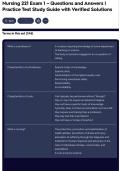
Nursing 221 Exam 1 – Questions and Answers |
Practice Test Study Guide with Verified Solutions
Save
Terms in this set (245)
What is a profession? A vocation requiring knowledge of some department
of learning or science.
The body of persons engaged in an occupation of
calling.
Characteristics of a Profession: Specific body of knowledge.
Specific skills.
Administration of the highest quality care.
Performing care/duties safely.
Responsibility.
Accountability.
Characteristics of a Job: Can typically be performed without "thought".
May or may not require an advanced degree.
May not have a specific body of knowledge.
Typically, does not have an association such as ANA.
May require less training than a profession.
May pay less than a profession.
May not have a "scope of practice".
What is nursing? The protection, promotion, and optimization of
health abilities, prevention of illness and injury,
alleviation of suffering through the diagnosis and
treatment of human response and advocacy in the
care of individuals, families, communities, and
populations.
It is an art and a science.
,Nursing as a profession: Requires an extended education.
characteristics Requires a body of knowledge.
Provides a specific service.
Has autonomy.
Incorporates a code of ethics.
Principals of Practice: Assessment.
Diagnosis.
Establishing outcomes.
Planning.
Implementation > evaluation
Advanced Practice Nurses can: Consult.
Prescribe.
Evaluate.
Standards of Professional Continuing evaluation of own practice.
Performance: Collegiality.
Collaboration.
Ethics.
Research/EBP
Resource utilization.
Safety, cost, effectiveness.
Nursing is both an art and a science: Artfully care for patients through compassion, caring,
and respect for individual dignity and personal
values.
Scientifically care for patients through the nursing
body of knowledge which is constantly changing
through new discoveries and innovations which result
in changing standards of care.
Clinical Judgements based on: Body of knowledge, experience, standards of care.
ANA Standards of Professional the RN practices ethically
Performance:
Ethics
,ANA Standards of Professional the RN attains knowledge competency that reflects
Performance: current nursing practice.
Education
ANA Standards of Professional the RN integrates evidence and research findings
Performance: into practice.
Evidence-based Practice and
Research
ANA Standards of Professional the RN contributes to quality nursing practice
Performance:
Quality of Practice
ANA Standards of Professional the RN communicates effectively in all areas of
Performance: practice
Communication
ANA Standards of Professional the RN demonstrates leadership in the professional
Performance: setting and the profession
Leadership
ANA Standards of Professional the RN collaborates with health care consumer,
Performance: family, and others in the conduct of nursing practice
Collaboration
ANA Standards of Professional the RN evaluates her or his own nursing practice in
Performance: relation to professional practice standards and
Professional Practice Evaluation guidelines, relevant statutes, rules, and regulations.
ANA Standards of Professional the RN uses appropriate resources to plan and
Performance: provide nursing services that are safe, effective, and
Resources financially responsible.
ANA Standards of Professional the RN practices in an environment mentally safe and
Performance: healthy manner.
Environmental Health
, Rewards of Nursing: Making a difference in patient's lives.
Helping your patient to remain independent.
Teaching your patient to care for themselves.
Educating the public about the role of a professional
nurse.
Providing public health information.
Disaster relief.
Comfort for the dying.
Roles of the professional nurse: autonomy (independence).
accountability.
Advocate.
Educator.
Communicator.
Manager.
Why study history? History helps us to understand how we arrived at
where we are now.
It helps us to see mistakes and make improvements.
It helps us to see trends and modify practice.
It helps us to understand the social and intellectual
origins of the discipline of nursing.
Nursing leaders of the past are powerful influences
of nursing practice today.
Historical Perspectives of Nursing: Nurses have always been committed to meet the
needs of patients, families, and communities.
Nurses constantly respond and adapt to new
challenges.
Nurses affect change by participating in policy
making.
Nursing roles have changed to meet the changing
healthcare landscape.
Practice Test Study Guide with Verified Solutions
Save
Terms in this set (245)
What is a profession? A vocation requiring knowledge of some department
of learning or science.
The body of persons engaged in an occupation of
calling.
Characteristics of a Profession: Specific body of knowledge.
Specific skills.
Administration of the highest quality care.
Performing care/duties safely.
Responsibility.
Accountability.
Characteristics of a Job: Can typically be performed without "thought".
May or may not require an advanced degree.
May not have a specific body of knowledge.
Typically, does not have an association such as ANA.
May require less training than a profession.
May pay less than a profession.
May not have a "scope of practice".
What is nursing? The protection, promotion, and optimization of
health abilities, prevention of illness and injury,
alleviation of suffering through the diagnosis and
treatment of human response and advocacy in the
care of individuals, families, communities, and
populations.
It is an art and a science.
,Nursing as a profession: Requires an extended education.
characteristics Requires a body of knowledge.
Provides a specific service.
Has autonomy.
Incorporates a code of ethics.
Principals of Practice: Assessment.
Diagnosis.
Establishing outcomes.
Planning.
Implementation > evaluation
Advanced Practice Nurses can: Consult.
Prescribe.
Evaluate.
Standards of Professional Continuing evaluation of own practice.
Performance: Collegiality.
Collaboration.
Ethics.
Research/EBP
Resource utilization.
Safety, cost, effectiveness.
Nursing is both an art and a science: Artfully care for patients through compassion, caring,
and respect for individual dignity and personal
values.
Scientifically care for patients through the nursing
body of knowledge which is constantly changing
through new discoveries and innovations which result
in changing standards of care.
Clinical Judgements based on: Body of knowledge, experience, standards of care.
ANA Standards of Professional the RN practices ethically
Performance:
Ethics
,ANA Standards of Professional the RN attains knowledge competency that reflects
Performance: current nursing practice.
Education
ANA Standards of Professional the RN integrates evidence and research findings
Performance: into practice.
Evidence-based Practice and
Research
ANA Standards of Professional the RN contributes to quality nursing practice
Performance:
Quality of Practice
ANA Standards of Professional the RN communicates effectively in all areas of
Performance: practice
Communication
ANA Standards of Professional the RN demonstrates leadership in the professional
Performance: setting and the profession
Leadership
ANA Standards of Professional the RN collaborates with health care consumer,
Performance: family, and others in the conduct of nursing practice
Collaboration
ANA Standards of Professional the RN evaluates her or his own nursing practice in
Performance: relation to professional practice standards and
Professional Practice Evaluation guidelines, relevant statutes, rules, and regulations.
ANA Standards of Professional the RN uses appropriate resources to plan and
Performance: provide nursing services that are safe, effective, and
Resources financially responsible.
ANA Standards of Professional the RN practices in an environment mentally safe and
Performance: healthy manner.
Environmental Health
, Rewards of Nursing: Making a difference in patient's lives.
Helping your patient to remain independent.
Teaching your patient to care for themselves.
Educating the public about the role of a professional
nurse.
Providing public health information.
Disaster relief.
Comfort for the dying.
Roles of the professional nurse: autonomy (independence).
accountability.
Advocate.
Educator.
Communicator.
Manager.
Why study history? History helps us to understand how we arrived at
where we are now.
It helps us to see mistakes and make improvements.
It helps us to see trends and modify practice.
It helps us to understand the social and intellectual
origins of the discipline of nursing.
Nursing leaders of the past are powerful influences
of nursing practice today.
Historical Perspectives of Nursing: Nurses have always been committed to meet the
needs of patients, families, and communities.
Nurses constantly respond and adapt to new
challenges.
Nurses affect change by participating in policy
making.
Nursing roles have changed to meet the changing
healthcare landscape.


