
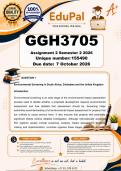
GGH3705
Assignment 2 Semester 2 2026
Unique number: 155490
Due date: 7 October 2026
QUESTION 1
Environmental Screening in South Africa, Zimbabwe and the United Kingdom
Introduction
Environmental screening is an early stage of the environmental impact assessment
process used to decide whether a proposed development requires environmental
assessment and how detailed that assessment should be. Screening helps
authorities avoid demanding a full environmental impact assessment for projects that
are unlikely to cause serious harm. It also ensures that projects with potentially
significant effects receive detailed investigation. Although internationally accepted
EIA systems usually include screening, scoping, impact assessment, decision-
making and implementation, countries organise these stages differently (Aucamp,
, QUESTION 1
J Question 1: Evaluation of Five Social Impact Assessments in South Africa
Introduction
A Social Impact Assessment examines the intended and unintended social
consequences that may result from a proposed development. It should identify how
different groups may experience changes in their livelihoods, health, safety, social
relationships, access to resources and general quality of life. Primary research is
important because statistical information alone cannot explain how people
understand or feel about a proposed development. Common primary methods
include interviews, focus groups, questionnaires, public meetings, participatory rural
appraisal and direct observation during site visits (Aucamp, 2008, p. 115). The
method selected should match the physical setting, literacy levels, accessibility and
social characteristics of the affected community (Aucamp, 2008, pp. 114–115).
1. Tongaat Seawater Desalination Project
Company and document reference
The SIA was conducted by ACER Africa Environmental Consultants, represented
by Duncan Kael, for the Council for Scientific and Industrial Research. The document
may be referenced as follows:
Kael, D. (2018). Social impact assessment specialist study for the proposed 150 Ml
seawater reverse osmosis plant and associated infrastructure in Tongaat, KwaZulu-
Natal. ACER Africa Environmental Consultants and Council for Scientific and
Industrial Research.
Project and methods used
The proposed development involved constructing and operating a seawater reverse
osmosis desalination plant in the Tongaat area, approximately 30 kilometres north of
Durban. The facility would take in approximately 333 megalitres of seawater daily
and produce about 150 megalitres of freshwater. The SIA was required because the
proposed site included market gardens, permanent houses and land used for local
livelihood activities. Concerns about possible loss of land, housing, agricultural
Assignment 2 Semester 2 2026
Unique number: 155490
Due date: 7 October 2026
QUESTION 1
Environmental Screening in South Africa, Zimbabwe and the United Kingdom
Introduction
Environmental screening is an early stage of the environmental impact assessment
process used to decide whether a proposed development requires environmental
assessment and how detailed that assessment should be. Screening helps
authorities avoid demanding a full environmental impact assessment for projects that
are unlikely to cause serious harm. It also ensures that projects with potentially
significant effects receive detailed investigation. Although internationally accepted
EIA systems usually include screening, scoping, impact assessment, decision-
making and implementation, countries organise these stages differently (Aucamp,
, QUESTION 1
J Question 1: Evaluation of Five Social Impact Assessments in South Africa
Introduction
A Social Impact Assessment examines the intended and unintended social
consequences that may result from a proposed development. It should identify how
different groups may experience changes in their livelihoods, health, safety, social
relationships, access to resources and general quality of life. Primary research is
important because statistical information alone cannot explain how people
understand or feel about a proposed development. Common primary methods
include interviews, focus groups, questionnaires, public meetings, participatory rural
appraisal and direct observation during site visits (Aucamp, 2008, p. 115). The
method selected should match the physical setting, literacy levels, accessibility and
social characteristics of the affected community (Aucamp, 2008, pp. 114–115).
1. Tongaat Seawater Desalination Project
Company and document reference
The SIA was conducted by ACER Africa Environmental Consultants, represented
by Duncan Kael, for the Council for Scientific and Industrial Research. The document
may be referenced as follows:
Kael, D. (2018). Social impact assessment specialist study for the proposed 150 Ml
seawater reverse osmosis plant and associated infrastructure in Tongaat, KwaZulu-
Natal. ACER Africa Environmental Consultants and Council for Scientific and
Industrial Research.
Project and methods used
The proposed development involved constructing and operating a seawater reverse
osmosis desalination plant in the Tongaat area, approximately 30 kilometres north of
Durban. The facility would take in approximately 333 megalitres of seawater daily
and produce about 150 megalitres of freshwater. The SIA was required because the
proposed site included market gardens, permanent houses and land used for local
livelihood activities. Concerns about possible loss of land, housing, agricultural


