The problem of evil
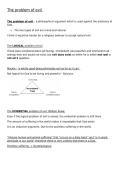
The problem of evil – a philosophical argument which is used against the existence of
God.
The two types of evil are moral and natural.
I think it would be harder for a religious believer to accept natural evil.
The LOGICAL problem of evil
If God were omnibenevolent (all loving), omnipotent (all powerful) and omniscient (all
seeing) then evil would not exist, but evil does exist so either he is either not real or
not all 3 qualities.
Mackie - ‘a wholly good being eliminates evil as far as it can’
Not logical for God to be loving and powerful – Epicurus
The EVIDENTIAL problem of evil: William Rowe:
Even if the logical problem of evil is solved, the evidential problem is still there
The amount of suffering in the world makes it improbable that God exists
It is an inductive argument. Due to the pointless suffering in the world.
“Intense human and animal suffering” that “occurs on a daily basis” and “is in great
plenitude in our world” therefore there is very unlikely that there is a God.
Pointless suffering -> Dysteleological
, Augustine's theodicy
A theodicy is an attempt to justify God in even though there is evil and suffering in the
world, they argue that God is fair.
Augustine's theodicy explained:
- God made the world to be good and perfect, this is true due to the bit in the bible
explaining how he made it perfect.
- God made the world with variety so it would be interesting, and this included
plants, animals but also the angels
- This means some angels had a privation of good (privatio boni) (lack of good) than
others, these angels fell from God and tempted Adam and eve.
- They ate the apple causing moral sin to enter the world/ privation of good.
- Natural evil is a consequence of moral evil due to the first humans disturbing the
order of God.
Augustine's theodicy on predestination:
- He believes that God has decided who will go to heaven and who will go to hell,
this is not based of God not giving us free will or being unjust, just that God is all
knowing and all powerful so knows we will do all those things based off our free
will. Some counters argue this by saying God has then predestined some people to
sin.
Augustine’s aesthetics argument
He uses the idea of a scorpion's poison, if someone gets bitten and poisoned that will
seem evil to the person who got hurt but to the scorpion it is not evil. This shows that
evil is all about perspective, so in this argument he is trying to say the world is not evil
we just see it as evil in our perspective and we segment sections of life as evil due to us
not knowing the full picture. However, God does see and know the full picture.
The problem of evil – a philosophical argument which is used against the existence of
God.
The two types of evil are moral and natural.
I think it would be harder for a religious believer to accept natural evil.
The LOGICAL problem of evil
If God were omnibenevolent (all loving), omnipotent (all powerful) and omniscient (all
seeing) then evil would not exist, but evil does exist so either he is either not real or
not all 3 qualities.
Mackie - ‘a wholly good being eliminates evil as far as it can’
Not logical for God to be loving and powerful – Epicurus
The EVIDENTIAL problem of evil: William Rowe:
Even if the logical problem of evil is solved, the evidential problem is still there
The amount of suffering in the world makes it improbable that God exists
It is an inductive argument. Due to the pointless suffering in the world.
“Intense human and animal suffering” that “occurs on a daily basis” and “is in great
plenitude in our world” therefore there is very unlikely that there is a God.
Pointless suffering -> Dysteleological
, Augustine's theodicy
A theodicy is an attempt to justify God in even though there is evil and suffering in the
world, they argue that God is fair.
Augustine's theodicy explained:
- God made the world to be good and perfect, this is true due to the bit in the bible
explaining how he made it perfect.
- God made the world with variety so it would be interesting, and this included
plants, animals but also the angels
- This means some angels had a privation of good (privatio boni) (lack of good) than
others, these angels fell from God and tempted Adam and eve.
- They ate the apple causing moral sin to enter the world/ privation of good.
- Natural evil is a consequence of moral evil due to the first humans disturbing the
order of God.
Augustine's theodicy on predestination:
- He believes that God has decided who will go to heaven and who will go to hell,
this is not based of God not giving us free will or being unjust, just that God is all
knowing and all powerful so knows we will do all those things based off our free
will. Some counters argue this by saying God has then predestined some people to
sin.
Augustine’s aesthetics argument
He uses the idea of a scorpion's poison, if someone gets bitten and poisoned that will
seem evil to the person who got hurt but to the scorpion it is not evil. This shows that
evil is all about perspective, so in this argument he is trying to say the world is not evil
we just see it as evil in our perspective and we segment sections of life as evil due to us
not knowing the full picture. However, God does see and know the full picture.