, 1. Contextual Paragraph
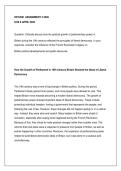
The nineteenth century witnessed the consolidation of a distinctly Eurocentric framework within
historical scholarship, shaped by imperial expansion, Enlightenment rationalism, and emerging
academic professionalisation. Historians such as Leopold von Ranke promoted empiricism and
archival research but largely centred European state formation as the normative model of historical
development. Influenced by philosophies of progress articulated by thinkers like G. W. F. Hegel,
many historians conceptualised world history as a linear progression culminating in European
modernity, relegating Africa, Asia, and the Americas to earlier “stages” of civilisation. Colonial
ideologies further reinforced this narrative, as imperial powers such as the British Empire and
French Empire produced ethnographies and administrative histories that framed non-European
societies as static, traditional, or dependent upon European intervention. For example,
representations of India often emphasised despotism and stagnation to justify British rule, while
African societies were frequently depicted as lacking political complexity prior to European contact.
This approach marginalised indigenous historiographical traditions, including oral histories and
non-Western archival practices, which were dismissed as unscientific or mythological.
Consequently, Eurocentric historiography did not merely privilege Europe as a subject but
constructed Europe as the universal standard against which all other societies were measured,
shaping educational curricula, public memory, and the institutional foundations of modern
historical study.¹
Critically evaluated, the Eurocentric paradigm significantly distorted historical accuracy and
constrained inclusivity. By imposing a teleological model of progress, it obscured the agency and
dynamism of non-European societies and minimised their contributions to global developments
such as trade, science, and governance. For instance, nineteenth-century portrayals of African
polities like the Kingdom of Benin ignored sophisticated political systems and artistic achievements,
while the complexity of the Mughal Empire was often reduced to narratives of decline preceding
British dominance. Such interpretations fostered racial hierarchies embedded in pseudo-scientific
theories, legitimising imperialism and the “civilising mission.” Moreover, the exclusion of
indigenous voices meant that subaltern perspectives—women, enslaved peoples, and colonised
intellectuals—remained largely absent from mainstream historical accounts. The long-term
consequences included entrenched stereotypes in academic and popular discourse, as well as
structural inequalities in knowledge production. However, postcolonial and revisionist historians in
the twentieth century challenged these assumptions, demonstrating that historical processes were
interconnected and multi-directional rather than Europe-centred.² Thus, while Eurocentrism
provided methodological rigour in certain respects, its narrow epistemological framework
compromised both historical comprehensiveness and representational justice, necessitating
ongoing efforts to decolonise historiography and integrate plural sources and perspectives.
1. Edward Said, Orientalism (New York: Pantheon Books, 1978); Georg G. Iggers, Historiography in the Twentieth Century (Middletown, CT: Wesleyan
University Press, 1997).
2. Dipesh Chakrabarty, Provincializing Europe: Postcolonial Thought and Historical Difference (Princeton: Princeton University Press, 2000); Frederick
Cooper, Colonialism in Question (Berkeley: University of California Press, 2005).
The nineteenth century witnessed the consolidation of a distinctly Eurocentric framework within
historical scholarship, shaped by imperial expansion, Enlightenment rationalism, and emerging
academic professionalisation. Historians such as Leopold von Ranke promoted empiricism and
archival research but largely centred European state formation as the normative model of historical
development. Influenced by philosophies of progress articulated by thinkers like G. W. F. Hegel,
many historians conceptualised world history as a linear progression culminating in European
modernity, relegating Africa, Asia, and the Americas to earlier “stages” of civilisation. Colonial
ideologies further reinforced this narrative, as imperial powers such as the British Empire and
French Empire produced ethnographies and administrative histories that framed non-European
societies as static, traditional, or dependent upon European intervention. For example,
representations of India often emphasised despotism and stagnation to justify British rule, while
African societies were frequently depicted as lacking political complexity prior to European contact.
This approach marginalised indigenous historiographical traditions, including oral histories and
non-Western archival practices, which were dismissed as unscientific or mythological.
Consequently, Eurocentric historiography did not merely privilege Europe as a subject but
constructed Europe as the universal standard against which all other societies were measured,
shaping educational curricula, public memory, and the institutional foundations of modern
historical study.¹
Critically evaluated, the Eurocentric paradigm significantly distorted historical accuracy and
constrained inclusivity. By imposing a teleological model of progress, it obscured the agency and
dynamism of non-European societies and minimised their contributions to global developments
such as trade, science, and governance. For instance, nineteenth-century portrayals of African
polities like the Kingdom of Benin ignored sophisticated political systems and artistic achievements,
while the complexity of the Mughal Empire was often reduced to narratives of decline preceding
British dominance. Such interpretations fostered racial hierarchies embedded in pseudo-scientific
theories, legitimising imperialism and the “civilising mission.” Moreover, the exclusion of
indigenous voices meant that subaltern perspectives—women, enslaved peoples, and colonised
intellectuals—remained largely absent from mainstream historical accounts. The long-term
consequences included entrenched stereotypes in academic and popular discourse, as well as
structural inequalities in knowledge production. However, postcolonial and revisionist historians in
the twentieth century challenged these assumptions, demonstrating that historical processes were
interconnected and multi-directional rather than Europe-centred.² Thus, while Eurocentrism
provided methodological rigour in certain respects, its narrow epistemological framework
compromised both historical comprehensiveness and representational justice, necessitating
ongoing efforts to decolonise historiography and integrate plural sources and perspectives.
1. Edward Said, Orientalism (New York: Pantheon Books, 1978); Georg G. Iggers, Historiography in the Twentieth Century (Middletown, CT: Wesleyan
University Press, 1997).
2. Dipesh Chakrabarty, Provincializing Europe: Postcolonial Thought and Historical Difference (Princeton: Princeton University Press, 2000); Frederick
Cooper, Colonialism in Question (Berkeley: University of California Press, 2005).