
English Grammar .com
Lesson 1
Grammar lesson 1
Present simple and continuous
1 The basics
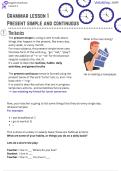
The present simple is using a verb to talk about What is the man doing?
things that happen in the present, like every day,
every week, or every month.
For most subjects, the present simple tense uses
the base form of the verb (e.g., "go," "eat," "play")
with the addition of "-s" or "-es" for third-person
singular subjects (he, she, it).
It’s used to describe routines, habits, daily
activities, and general truths
The present continuous tense is formed using the He is reading a newspaper.
present tense of the verb "to be" (am, is, are) + the
base verb + "-ing".
It is used to describe actions that are in progress,
temporary actions, and sometimes future plans.
-> I am meeting my friend for lunch tomorrow.
Now, your teacher is going to list some things that they do every single day.
(Present Simple)
For example:
I eat breakfast at 7.
I go to work at 9.
....
This is done on a daily or weekly basis; these are habitual actions.
What are some of your habits, or things you do on a daily basis?
Lets do a short role play:
Teacher: I live in ___. Where do you live?
Student: I live in ___.
Teacher: I live in ___. You live in ___.
, Lets try make more sentences like this
I have ___ hair. She has ___ hair. (Colour)
Try make a few sentences like this.
Let’s look at another scenario:
I watch TV before bed. Sarah reads a book.
Take note, in third person, like with Sarah, we add an “s”
to our verb, read->read
I read-> she reads -> Sarah reads
So what are the most important verbs for present continuous tense?
These are the verbs “to be”
AM I am Personal
She is
IS he is Singular
{name} is
They are
ARE We are Plural + you
You are
These are not all we use though...
Yes we can make a sentence with just these verbs-
I am tired. - But if we want to be more specific then we use 2 verbs.
I am reading a book. -> Do you see that we form this by adding -ing to our verb.
She is swimming.
Jake is cooking.
They are eating.
Now you make a few sentences, use all the different verbs “to be”.


