Semester 1
Assignment 01 (Multiple-choice questions)
Submission date 26 March 2021
Marks 100
Prescribed textbook Relevant sections according to the study
guide
Study guide Learning units 1-5
Unique number 613170
1.1 Amartya Sen’s argument is that a person may regard happiness as an important
functioning for their well-being. According to a report by Richard Layard, which
country is the least happy? (Looking at income relatively to happiness.)
[1] USA
[2] Zimbabwe
[3] Australia
[4] Czech Republic
[5] South Africa
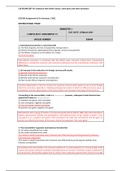
The figure above is adapted from Todaro and smith it shows Zimbabwe to be the
least happy
1.2 Development Economics is concerned with
, [1] the efficient allocation of productive resources.
[2] the production of an expanding range of goods and services.
[3] improvement in the levels of living.
[4] education and health provision.
[5] all of the above.
Development economics is a distinct yet very important extension of both
traditional economics and political economy. While necessarily also concerned
with efficient resource allocation and the steady growth of aggregate output over
time, development economics focuses primarily on the economic, social, and
institutional mechanisms needed to bring about rapid and large-scale
improvements in standards of living for the masses of poor people in developing
nations.
1.3 Kuznets’ inverted-U hypothesis
[1] implies that things must get worse before they get better.
[2] suggests that inequality will worsen and then improve as a country
grows.
[3] suggests that inequality will improve and then worsen as a country
grows.
[4] points out six characteristics of modern economic growth.
[5] all the above.
Simon Kuznets suggested that in the early stages of economic growth, the
distribution of income will tend to worsen; only at later stages will it improve. This
observation came to be characterized by the “inverted-U” Kuznets curve
1.4 Poverty is better studied with size distribution measures than those based on factor
distribution because
[1] labour income may be highly concentrated in well-paid modern sector
workers.
[2] some poor farmers may receive a sizable share of income in rent.
[3] income from non-market activities, such as foraging, may be important.
[4] all of the above.
[5] none of the above.
1.5 The Solow residual helps explain growth that derives from
Assignment 01 (Multiple-choice questions)
Submission date 26 March 2021
Marks 100
Prescribed textbook Relevant sections according to the study
guide
Study guide Learning units 1-5
Unique number 613170
1.1 Amartya Sen’s argument is that a person may regard happiness as an important
functioning for their well-being. According to a report by Richard Layard, which
country is the least happy? (Looking at income relatively to happiness.)
[1] USA
[2] Zimbabwe
[3] Australia
[4] Czech Republic
[5] South Africa
The figure above is adapted from Todaro and smith it shows Zimbabwe to be the
least happy
1.2 Development Economics is concerned with
, [1] the efficient allocation of productive resources.
[2] the production of an expanding range of goods and services.
[3] improvement in the levels of living.
[4] education and health provision.
[5] all of the above.
Development economics is a distinct yet very important extension of both
traditional economics and political economy. While necessarily also concerned
with efficient resource allocation and the steady growth of aggregate output over
time, development economics focuses primarily on the economic, social, and
institutional mechanisms needed to bring about rapid and large-scale
improvements in standards of living for the masses of poor people in developing
nations.
1.3 Kuznets’ inverted-U hypothesis
[1] implies that things must get worse before they get better.
[2] suggests that inequality will worsen and then improve as a country
grows.
[3] suggests that inequality will improve and then worsen as a country
grows.
[4] points out six characteristics of modern economic growth.
[5] all the above.
Simon Kuznets suggested that in the early stages of economic growth, the
distribution of income will tend to worsen; only at later stages will it improve. This
observation came to be characterized by the “inverted-U” Kuznets curve
1.4 Poverty is better studied with size distribution measures than those based on factor
distribution because
[1] labour income may be highly concentrated in well-paid modern sector
workers.
[2] some poor farmers may receive a sizable share of income in rent.
[3] income from non-market activities, such as foraging, may be important.
[4] all of the above.
[5] none of the above.
1.5 The Solow residual helps explain growth that derives from