

PUB1501 – THEME 3
Who receives public services?
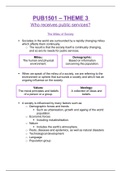
The Milieu of Society
Societies in the world are surrounded by a rapidly changing milieu
which affects them continually.
o The result is that the society itself is continually changing,
and so are its needs for public services.
Milieu: Demographic:
The human and physical Based on information
environment. concerning the population.
When we speak of the milieu of a society, we are referring to the
environment or sphere that surrounds a society and which has an
ongoing influence on the society.
Values: Ideology:
The moral principles and beliefs A collection of ideas and
of a person or a group. beliefs.
A society is influenced by many factors such as:
o Demographic forces and trends
Such as urbanisation, growth and ageing of the world
population.
o Economic forces
Including industrialisation.
o Nature
Includes the earth’s atmosphere.
o Pests, diseases and epidemics, as well as natural disasters
o Technological development
o Language
o Population group
, Demographic force growth of the world population:
o Better healthcare services (cause) are likely to have resulted
(effect) in:
Lower infant mortality rate
Increased life expectancy among adults
More people on the planet
Increased consumption of water and other natural
resources
An increase in air pollution
The process of urbanisation, which facilitated the
spread of diseases
A greater need for better and more healthcare and
welfare services, as well as
Increasing social ills with an increased demand and
need for protection
Urbanisation and an ageing population:
o Urbanisation takes place when the population of the world or
of a country moves or migrates from rural areas to urban
cities.
Such a migration will influence the needs of a society
as the recipient of public services.
o The average age of the population is increasing and this can
happen in 2 ways:
Fewer children are being born, and
Adults live longer because of good medical care which
results in the average age of people in society
becomes higher.
o The process of industrialisation was accompanied by
urbanisation.
Urbanisation, in turn, resulted in a chain reaction.
o The result of urbanisation has been that societies in urban
areas have greater needs for:
Access to healthcare services
Welfare services
Availability of drinking water
Educational services
Employment opportunities
Transport facilities
Who receives public services?
The Milieu of Society
Societies in the world are surrounded by a rapidly changing milieu
which affects them continually.
o The result is that the society itself is continually changing,
and so are its needs for public services.
Milieu: Demographic:
The human and physical Based on information
environment. concerning the population.
When we speak of the milieu of a society, we are referring to the
environment or sphere that surrounds a society and which has an
ongoing influence on the society.
Values: Ideology:
The moral principles and beliefs A collection of ideas and
of a person or a group. beliefs.
A society is influenced by many factors such as:
o Demographic forces and trends
Such as urbanisation, growth and ageing of the world
population.
o Economic forces
Including industrialisation.
o Nature
Includes the earth’s atmosphere.
o Pests, diseases and epidemics, as well as natural disasters
o Technological development
o Language
o Population group
, Demographic force growth of the world population:
o Better healthcare services (cause) are likely to have resulted
(effect) in:
Lower infant mortality rate
Increased life expectancy among adults
More people on the planet
Increased consumption of water and other natural
resources
An increase in air pollution
The process of urbanisation, which facilitated the
spread of diseases
A greater need for better and more healthcare and
welfare services, as well as
Increasing social ills with an increased demand and
need for protection
Urbanisation and an ageing population:
o Urbanisation takes place when the population of the world or
of a country moves or migrates from rural areas to urban
cities.
Such a migration will influence the needs of a society
as the recipient of public services.
o The average age of the population is increasing and this can
happen in 2 ways:
Fewer children are being born, and
Adults live longer because of good medical care which
results in the average age of people in society
becomes higher.
o The process of industrialisation was accompanied by
urbanisation.
Urbanisation, in turn, resulted in a chain reaction.
o The result of urbanisation has been that societies in urban
areas have greater needs for:
Access to healthcare services
Welfare services
Availability of drinking water
Educational services
Employment opportunities
Transport facilities


