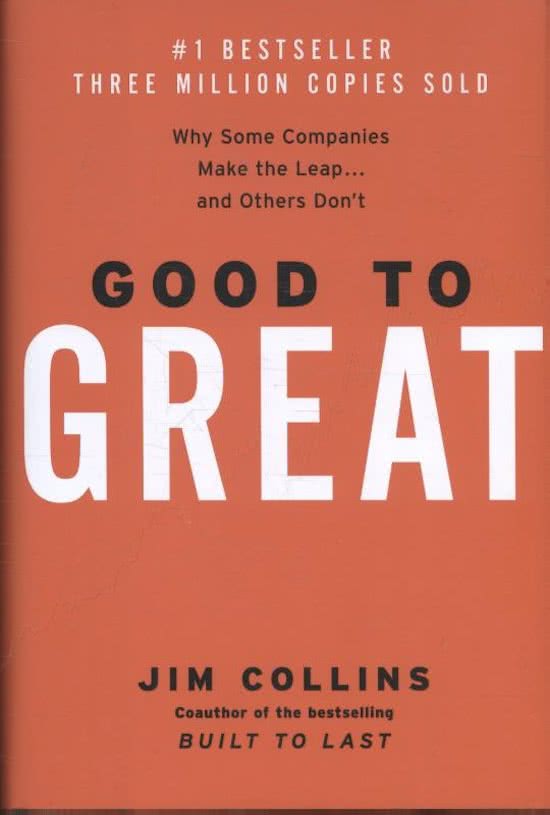
From Good to Great
(Deep Summary)
Statement
1. This summary was created through human judgment and
careful thought, not by AI. It was discussed with friends and
mentors and revised many times.
2. As I am not a native English speaker, I used AI only to check
grammar and improve clarity.
3. Feedback and suggestions are welcome to help make this
work better.
Contents
From Good to Great ................................................................................................................................................. 1
1. The timeless laws of moving from good to great ................................................................... 3
2. The unconventional Level 5 Leader ..................................................................................................7
3. Understanding yourself through the Three Circles ............................................................10
4. First choose people, or first decide what to do? .................................................................. 15
5. Pay the right employees ......................................................................................................................... 17
6. Layoffs during the good-to-great transition ............................................................................ 18
7. Building a great company and having a good life ............................................................. 20
8. Never give up in the face of brutal reality ................................................................................ 24
9. How to motivate employees in tough times?........................................................................ 26
10. How to align with the Hedgehog Concept?.......................................................................... 28
11. Creating a Culture of Discipline ....................................................................................................... 30
12. Beware of technology bubbles and traps ............................................................................... 32
13. Keep the flywheel turning .................................................................................................................. 33
1|By Whitestone
,Introduction
The author of this book, Jim Collins, together with his research
team, spent five years rigorously screening companies that had
appeared on the Fortune 500 list over a 30-year span. From these,
they selected 11 companies that had successfully made the leap
from good to great as the primary research objects. At the same
time, the research team selected two sets of comparison
companies: 11 “direct comparison companies” and 6 “comparison
companies that failed to sustain greatness.”
The overarching question of the entire study was: What key
factors determine whether a company can move from good to
great? In other words, what common traits do these
companies share that distinguish them from the comparison
companies?
Through extensive document research, data analysis, and
hundreds of interviews, the team conducted multi-dimensional
validation. Ultimately, they found that companies that made the
leap from good to great shared three key pillars and six major
factors: “Disciplined People (Level 5 Leadership and First Who
Then What), Disciplined Thought (Confront the Brutal Facts and
the Hedgehog Concept), and Disciplined Action (Culture of
Discipline and Technology Accelerators).”
The true research value of this book lies in the fact that it does not
set boundaries between old and new economies, and it is not
concerned with the specific companies you read about nor with
business trends themselves. It strips away all conventional
classifications and focuses solely on answering a single core
question: What are the timeless principles of moving from good
to great?
This concise and persuasive research outcome “solves one of the
most important problems in business” and has been hailed as a
classic “worth more than hundreds of millions of dollars.” Over the
years, it has become a “management bible” for CEOs.
2|By Whitestone
,1. The timeless laws of moving from good to
great
“Good is the enemy of great.” Can a good company become a
great company, and if so, how does that transformation occur?
The research team led by the author hoped to find answers that
are not limited by time or geography and that can be widely
applied to any type of organization.
The first question is: How do we define a great company?
The research team selected companies that appeared on the
Fortune 500 list between 1965 and 1995, and conducted
systematic searches and screening. Eventually, they identified 11
companies that had achieved the leap from good performance to
great performance.
These companies had to meet the following basic criteria:
First, their cumulative stock returns were at or below the market
average for 15 years, after which a clear inflection point occurred.
During the subsequent 15 years, their cumulative stock returns
were at least three times the market average. The 15-year period
was chosen in order to rule out temporary or accidental factors
such as short-term luck—“because you cannot be lucky for 15
consecutive years”—and also because a 15-year span exceeds the
typical tenure of most company CEOs.
Second, the operating pattern by which the company moved from
good to great had to be independent of its industry; it could not
simply be an industry-wide event. If the entire industry
experienced a similar turning point and development trajectory,
the company would not qualify as a great company.
Third, the company had to have at least 10 years of publicly listed
stock-return data available before the identified turning point, and
throughout the research period the company had to remain an
3|By Whitestone
, independently operated, continuously developing, publicly traded
company.
The final 11 selected good-to-great companies were: Abbott, Circuit
City, Fannie Mae, Gillette, Kimberly-Clark, Kroger, Nucor, Philip
Morris, Pitney Bowes, Walgreens, and Wells Fargo.
At the same time, in order to conduct comparative analysis with
the companies that achieved the leap, the research team selected
two sets of comparison companies: The first group consisted of 11
“direct comparison companies,” referring to companies in the
same industry as the good-to-great companies, with similar
resources and the same opportunities, but which did not achieve
the leap. The second group consisted of 6 “comparison companies
that failed to sustain greatness.” These companies did manage to
make a leap from good to great in the short term, but they failed
to sustain that momentum and therefore did not meet the
criterion of long-term greatness.
After determining the research objects, the team conducted
in-depth case analyses for each company. This included collecting
news reports covering the past 50 years or even earlier,
interviewing most of the key executives in the good-to-great
companies, and performing categorized qualitative and
quantitative analyses. The purpose was to discover “what
differences exist” between the good-to-great companies and the
comparison companies so as to open the “black box” of how these
companies moved from good results to great results.
So, let us first look at the author’s most important research
achievement: the Good to Great Framework (see Figure 1).
Figure 1 The Good to Great Framework
This overall framework is also called the Flywheel Effect. It
encompasses the “overall characteristics of achieving the leap
from good to great.” A good company can think of “this process as
building momentum.” To make the leap, it must move through
4|By Whitestone
(Deep Summary)
Statement
1. This summary was created through human judgment and
careful thought, not by AI. It was discussed with friends and
mentors and revised many times.
2. As I am not a native English speaker, I used AI only to check
grammar and improve clarity.
3. Feedback and suggestions are welcome to help make this
work better.
Contents
From Good to Great ................................................................................................................................................. 1
1. The timeless laws of moving from good to great ................................................................... 3
2. The unconventional Level 5 Leader ..................................................................................................7
3. Understanding yourself through the Three Circles ............................................................10
4. First choose people, or first decide what to do? .................................................................. 15
5. Pay the right employees ......................................................................................................................... 17
6. Layoffs during the good-to-great transition ............................................................................ 18
7. Building a great company and having a good life ............................................................. 20
8. Never give up in the face of brutal reality ................................................................................ 24
9. How to motivate employees in tough times?........................................................................ 26
10. How to align with the Hedgehog Concept?.......................................................................... 28
11. Creating a Culture of Discipline ....................................................................................................... 30
12. Beware of technology bubbles and traps ............................................................................... 32
13. Keep the flywheel turning .................................................................................................................. 33
1|By Whitestone
,Introduction
The author of this book, Jim Collins, together with his research
team, spent five years rigorously screening companies that had
appeared on the Fortune 500 list over a 30-year span. From these,
they selected 11 companies that had successfully made the leap
from good to great as the primary research objects. At the same
time, the research team selected two sets of comparison
companies: 11 “direct comparison companies” and 6 “comparison
companies that failed to sustain greatness.”
The overarching question of the entire study was: What key
factors determine whether a company can move from good to
great? In other words, what common traits do these
companies share that distinguish them from the comparison
companies?
Through extensive document research, data analysis, and
hundreds of interviews, the team conducted multi-dimensional
validation. Ultimately, they found that companies that made the
leap from good to great shared three key pillars and six major
factors: “Disciplined People (Level 5 Leadership and First Who
Then What), Disciplined Thought (Confront the Brutal Facts and
the Hedgehog Concept), and Disciplined Action (Culture of
Discipline and Technology Accelerators).”
The true research value of this book lies in the fact that it does not
set boundaries between old and new economies, and it is not
concerned with the specific companies you read about nor with
business trends themselves. It strips away all conventional
classifications and focuses solely on answering a single core
question: What are the timeless principles of moving from good
to great?
This concise and persuasive research outcome “solves one of the
most important problems in business” and has been hailed as a
classic “worth more than hundreds of millions of dollars.” Over the
years, it has become a “management bible” for CEOs.
2|By Whitestone
,1. The timeless laws of moving from good to
great
“Good is the enemy of great.” Can a good company become a
great company, and if so, how does that transformation occur?
The research team led by the author hoped to find answers that
are not limited by time or geography and that can be widely
applied to any type of organization.
The first question is: How do we define a great company?
The research team selected companies that appeared on the
Fortune 500 list between 1965 and 1995, and conducted
systematic searches and screening. Eventually, they identified 11
companies that had achieved the leap from good performance to
great performance.
These companies had to meet the following basic criteria:
First, their cumulative stock returns were at or below the market
average for 15 years, after which a clear inflection point occurred.
During the subsequent 15 years, their cumulative stock returns
were at least three times the market average. The 15-year period
was chosen in order to rule out temporary or accidental factors
such as short-term luck—“because you cannot be lucky for 15
consecutive years”—and also because a 15-year span exceeds the
typical tenure of most company CEOs.
Second, the operating pattern by which the company moved from
good to great had to be independent of its industry; it could not
simply be an industry-wide event. If the entire industry
experienced a similar turning point and development trajectory,
the company would not qualify as a great company.
Third, the company had to have at least 10 years of publicly listed
stock-return data available before the identified turning point, and
throughout the research period the company had to remain an
3|By Whitestone
, independently operated, continuously developing, publicly traded
company.
The final 11 selected good-to-great companies were: Abbott, Circuit
City, Fannie Mae, Gillette, Kimberly-Clark, Kroger, Nucor, Philip
Morris, Pitney Bowes, Walgreens, and Wells Fargo.
At the same time, in order to conduct comparative analysis with
the companies that achieved the leap, the research team selected
two sets of comparison companies: The first group consisted of 11
“direct comparison companies,” referring to companies in the
same industry as the good-to-great companies, with similar
resources and the same opportunities, but which did not achieve
the leap. The second group consisted of 6 “comparison companies
that failed to sustain greatness.” These companies did manage to
make a leap from good to great in the short term, but they failed
to sustain that momentum and therefore did not meet the
criterion of long-term greatness.
After determining the research objects, the team conducted
in-depth case analyses for each company. This included collecting
news reports covering the past 50 years or even earlier,
interviewing most of the key executives in the good-to-great
companies, and performing categorized qualitative and
quantitative analyses. The purpose was to discover “what
differences exist” between the good-to-great companies and the
comparison companies so as to open the “black box” of how these
companies moved from good results to great results.
So, let us first look at the author’s most important research
achievement: the Good to Great Framework (see Figure 1).
Figure 1 The Good to Great Framework
This overall framework is also called the Flywheel Effect. It
encompasses the “overall characteristics of achieving the leap
from good to great.” A good company can think of “this process as
building momentum.” To make the leap, it must move through
4|By Whitestone