

RESPIRATORY DISEASES
RESPIRATORY DISTRESS : RESPIRATORY FAILURE
-
a severe respiratory illness may be a medical emergency
-
it is important to recognise signs that suggest there is an urgent problem :
>
-
cyanosis or low peripheral arterial oxygen saturation (SpO2) on oximetry
,
>
-
use of accessory muscles of respiration
>
-
inability to speak
>
-
greatly increased or reduced respiratory rate
of exhaustion
>
-
signs
>
-
silent lung fields
>
-
Stridor Sairway obstruction)
> drowsiness
-
>
-
chest injury
>
-
tachycardia
>
-
pulsus paradoxus
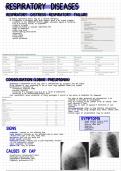
CONSOLIDATION (LOBAR PNELIMONIA)
-
pneumonia = inflammation of the lung that is characterised by exudation into the alveoli
-
X-ray changes of new shadowing in one or more lung segments (lobes) are present
-
pneumonia is classified as :
>
-
community acquired (CAP)
>
-
hospital acquired
>
-
occurring in a damaged lung (e
g as . . a result of aspiration)
>
-
occurring in an immunocompromised host
-
this classification allows prediction of likely pathogens assists in the choice of antibiotics for treatment
the signs of lobar pneumonia are characteristic are
-
referred to clinically as consolidation
-
may be a history of the sudden onset of malaise ,
Chest
pain dyspnoed's fever
,
-
there may be signs of cyanosis exhaustion in sick
patients
-
bronchopneumonia refers to lung infection characterised
by more patchy X-ray changes that often affect both
lower lobes
-
clinical
signs of consolidation may be absent
SYMPTOMS
-
cough (painful 3 dry at first)
-
fever 3 rigors (shivers)
-
pleuritic chest pain
dyspnoea
-
SIGNS tashycardia
-
-
confusion
-
expansion : reduced on the affected side
-
vocalfremitus : increased on the affected side (in other chest
disease this sign is of very little use ! )
-
percussion : dull ,
but not story dull
-
breath sounds : bronchial
-
additional sounds : medium late, or pan-inspiratory crackles
a the pneumonia resolves
-
vocal resonance : increased
-
pleural rub :
may be
present
CALISES OF CAP
-
streptococcus pneumoniae (730 %)
-
Chlamydia Pneumoniae (10 %)
-
Mycoplasma Pneumoniae (10 %)
Legionella Pneumoniae (S )
%
-
RESPIRATORY DISTRESS : RESPIRATORY FAILURE
-
a severe respiratory illness may be a medical emergency
-
it is important to recognise signs that suggest there is an urgent problem :
>
-
cyanosis or low peripheral arterial oxygen saturation (SpO2) on oximetry
,
>
-
use of accessory muscles of respiration
>
-
inability to speak
>
-
greatly increased or reduced respiratory rate
of exhaustion
>
-
signs
>
-
silent lung fields
>
-
Stridor Sairway obstruction)
> drowsiness
-
>
-
chest injury
>
-
tachycardia
>
-
pulsus paradoxus
CONSOLIDATION (LOBAR PNELIMONIA)
-
pneumonia = inflammation of the lung that is characterised by exudation into the alveoli
-
X-ray changes of new shadowing in one or more lung segments (lobes) are present
-
pneumonia is classified as :
>
-
community acquired (CAP)
>
-
hospital acquired
>
-
occurring in a damaged lung (e
g as . . a result of aspiration)
>
-
occurring in an immunocompromised host
-
this classification allows prediction of likely pathogens assists in the choice of antibiotics for treatment
the signs of lobar pneumonia are characteristic are
-
referred to clinically as consolidation
-
may be a history of the sudden onset of malaise ,
Chest
pain dyspnoed's fever
,
-
there may be signs of cyanosis exhaustion in sick
patients
-
bronchopneumonia refers to lung infection characterised
by more patchy X-ray changes that often affect both
lower lobes
-
clinical
signs of consolidation may be absent
SYMPTOMS
-
cough (painful 3 dry at first)
-
fever 3 rigors (shivers)
-
pleuritic chest pain
dyspnoea
-
SIGNS tashycardia
-
-
confusion
-
expansion : reduced on the affected side
-
vocalfremitus : increased on the affected side (in other chest
disease this sign is of very little use ! )
-
percussion : dull ,
but not story dull
-
breath sounds : bronchial
-
additional sounds : medium late, or pan-inspiratory crackles
a the pneumonia resolves
-
vocal resonance : increased
-
pleural rub :
may be
present
CALISES OF CAP
-
streptococcus pneumoniae (730 %)
-
Chlamydia Pneumoniae (10 %)
-
Mycoplasma Pneumoniae (10 %)
Legionella Pneumoniae (S )
%
-


