

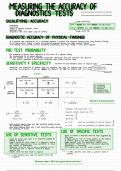
MEASLIRING THE ACCURACY OF
DIAGNOSTICS TESTS https://www.youtube.com/watch?v=U4_3fditnWg
https://www.youtube.com/watch?v=Z5TtopYX1Gc
QUALIFYING ACCURACY < high specificity
-
sensitivity SpPin >
-
Specific test , when Positive ,
rules In disease
-
specificity
SnNout- > Sensitive test when Negative rules Out disease
-
positive is negative predictor values , ,
-
likelihood ratios
-
diagnostic odds ratio (DOR) -
used for pooling
~
high sensitivity
DIAGNOSTIC ACCURACY OF PHYSICAL FINDINGS
-
if a physical sign characteristic of a suspected diagnosis is present that diagnosis becomes more likely /positive finding)
-
if the characteristic finding is absent the suspected diagnosis becomes less likely (negative finding)
-
some findings ,
when positive ,
increase probability significantly ,
but they change it little when negative
PRE-TEST PROBABILITY
-
the probability of disease before application of the results of a physical finding
-
the starting point for all clinical decisions
-
the best estimate of pre-test probability incorporates information from the Clinician's own
practice
> how
-
specific underlying diseases risks is exposures make disease movelless likely
,
SENSITIVITY B SPECIFICITY -
describes the discriminatory power of physical signs ,
screening
-
sensitivity = the proportion of patients with the diagnosis who have the physical sign ( + ve result) True positive rate
-
specificity: the proportion of patients without the diagnosis who lack the physical sign (-ve result) True negative rate
~
diagnostic
DISEASE
PRESENT ABSENT
I panti
TRUE POSITIVES FALSE POSITIVES
PRESENT
IPOSITIVE) A 49 B 79
Se Sensitivity
=
I Sp Specificity
:
p =
Prevalence
FALSE NEGATIVES TRYE LR :
Liklihood Ratio
ABSENT PV =
Predictive Value
↑ NEGATIVE) C 46
-
I so
I Sp =
BPD
I P =
A + B
A +
+ C+ B
[
Round to 2 decimal points
# patients with disease (n . ) =
A + S
A C
# without disease (nz) B+D
A + C A + C patients :
LR + =
LR - =
B
B
+ B B
D
+ B
sensitivity = E
=
Se/(1-Sp) =
(l-Se)/Sp specificity :
A
M3 =
A + B post-test probability of positive finding =
us
when present physical signs with high specificity greatly increase
finding
-
,
the probability of disease ny =
C + B post-test probability of negative
-
when absent physical signs
,
with a high sensitivity greatly decrease
the probability of disease
LISE OF SPECIFIC TESTS
USE OF SENSITIVE TESTS -
useful to confirm a diagnosis that has been suggested by
other data
-
should be chosen when there is an important penalty for -
a test is rarely positive in the absence
highly specific
missing a disease of gives a few false-positive results
disease ;
-
helpful during the early stages of a diagnostic workup ,
-
highly specific tests are particularly needed when
When several diagnoses are being considered to reduce , false-positive results can harm the patient physically ,
the number of possibilities emotionally or financially ,
-
diagnostic tests are used in these situations to rule -
most helpful when the test result is positive
out diseases with a negative result of a highly
sensitive test
1
:
-
helpful when the test result is negative a 100 % specific test that is positive rules in
disease
.
7 a 100 % sensitive test rules out disease if the test
is
negative
Minimum value = 95% for a good test to rule in/out
, TRADE-OFFS BETWEEN SENSITIVITY * SPECIFICITY
it is desirable to have a test that is both highly sensitive highly specific > often not possible
-
-
Whenever clinical data take on a range of values there is a trade-off between sensitivity 3 specificity for a given diagnostic
-
,
t est
in these situations the location of cutoff point the continuum between normal abnormal is arbitrary
a the paint on an
-
, , ,
decision
-
as a consequence ,
for any given test result expressed on a continuous scale , one characteristic , such as sensitivity ,
can be
increased only at the expense of the other (specificity/
https://www.youtube.com/watch?v=vtYDyGGeQyo
SIMPLIFYING DATA
ordinal scales =
example of simplification process (grade I- IV)
-
-
complex data are reduced to dichotomy /e g present/absent) . .
>
-
done when test results are used to help determine treatment decisions
>
-
therapeutic decisions are either/or decisions . either treatment is
g e .
begun or it is withheld
When
-
there are gradations of therapy according to the test result ,
the data are being treated in an ordinal fashion
THE ACCURACY OF A TEST RESULT
-
diagnosis is an imperfect process resulting ,
in a probability rather than a certainty of being right
the test is considered to be either positive /abnormal) or negative (normal) is the disease is either present/absent
-
-
4 possible types of test results 2 -
are correct/true 32 are wrong/false
> true
-
positive (A)
> true
negative (D)
-
=>falsepositiv ,
THE GOLD STANDARD CREFERENCE/CRITERION STANDARD
a test's accuracy is considered in relation to some
way of knowing whether the disease is truly present or not
-
-
sometimes the standard of accuracy is itself a relatively simple is inexpensive test
-
more often ,
one must turn to relatively elaborate , expensive or
risky tests to be certain whether the disease is present/absent
results of follow-up /for diseases that are not self-limited ordinarily become overt over several months even after
or
years a
-
test is donel can serve as a gold standard
-
immediately available gold standard too risky involved or expensive :
,
-
if follow-up is used the length of the follow-up period must be long enough
,
for the disease to declare itself ,
but not so
long that new cases can arise after the original testing
-
Clinicians patients prefer simpler tests to the rigorous gold standard at ,
least initially
-
simpler tests are used as proxies for more elaborate but more accurate/precise ways of
establishing the presence of disease ,
with the understanding that some risk of misslassification results
-
simpler tests are only useful when the risks of misclassification are known 3 are acceptably low
-
this requires a sound comparison of their
accuracy to an
appropriate standard
LACK OF INFORMATION ON NEGATIVE TESTS
-
the goal of all clinical studies aimed at describing the value of diagnostic tests should be to obtain data for all 4 squares
-
without all data ,
it is not possible to fully evaluate the accuracy of the test
-
physicians usually do not feel
justified in
proceeding with more exhaustive evaluation when preliminary diagnostic tests
are negative
-
as a result ,
data on the number of true false negatives generated by a test tend to be much less complete
LACK OF INFORMATION ON TEST RESULTS IN THE
NONDISEASED
-
some types of tests are commonly abnormal in people without disease or complaints
-
the test's performance can be grossly misleading when the test is applied to patients with the condition/complaint
LACK OF OBJECTIVE STANDARDS FOR DISEASE
-
for some conditions , there are simply no hard-and-fast criteria for diagnosis
eg angina
. .
pectoris
-
difficult to diagnose because of the lack of simple gold standard tests
-
circular reasoning can occur -
the validity of a laboratory test is established by comparing its results to a clinical diagnosis
based on a careful history of symptoms3 a physical examination
> once
-
established , the test is then used to validate the Clinical diagnosis gained from history physical examination
CONSEQUENCES OF IMPERFECT GOLD STANDARDS
-
it is sometimes not possible for physicians in practice to find information on how well the tests they use compare with a
thoroughly trustworthy standard
-
must choose as their standard of validity another test that admittedly is imperfect ,
but is considered the best available
-
if a new test is compared with an old /but imperfect) standard test the ,
new test may seem worse even though it is
actually better
-
a new test can perform no better than an established gold standard test .
3 It will seem inferior when it approximates the
truth more closely unless special strategies are used
DIAGNOSTICS TESTS https://www.youtube.com/watch?v=U4_3fditnWg
https://www.youtube.com/watch?v=Z5TtopYX1Gc
QUALIFYING ACCURACY < high specificity
-
sensitivity SpPin >
-
Specific test , when Positive ,
rules In disease
-
specificity
SnNout- > Sensitive test when Negative rules Out disease
-
positive is negative predictor values , ,
-
likelihood ratios
-
diagnostic odds ratio (DOR) -
used for pooling
~
high sensitivity
DIAGNOSTIC ACCURACY OF PHYSICAL FINDINGS
-
if a physical sign characteristic of a suspected diagnosis is present that diagnosis becomes more likely /positive finding)
-
if the characteristic finding is absent the suspected diagnosis becomes less likely (negative finding)
-
some findings ,
when positive ,
increase probability significantly ,
but they change it little when negative
PRE-TEST PROBABILITY
-
the probability of disease before application of the results of a physical finding
-
the starting point for all clinical decisions
-
the best estimate of pre-test probability incorporates information from the Clinician's own
practice
> how
-
specific underlying diseases risks is exposures make disease movelless likely
,
SENSITIVITY B SPECIFICITY -
describes the discriminatory power of physical signs ,
screening
-
sensitivity = the proportion of patients with the diagnosis who have the physical sign ( + ve result) True positive rate
-
specificity: the proportion of patients without the diagnosis who lack the physical sign (-ve result) True negative rate
~
diagnostic
DISEASE
PRESENT ABSENT
I panti
TRUE POSITIVES FALSE POSITIVES
PRESENT
IPOSITIVE) A 49 B 79
Se Sensitivity
=
I Sp Specificity
:
p =
Prevalence
FALSE NEGATIVES TRYE LR :
Liklihood Ratio
ABSENT PV =
Predictive Value
↑ NEGATIVE) C 46
-
I so
I Sp =
BPD
I P =
A + B
A +
+ C+ B
[
Round to 2 decimal points
# patients with disease (n . ) =
A + S
A C
# without disease (nz) B+D
A + C A + C patients :
LR + =
LR - =
B
B
+ B B
D
+ B
sensitivity = E
=
Se/(1-Sp) =
(l-Se)/Sp specificity :
A
M3 =
A + B post-test probability of positive finding =
us
when present physical signs with high specificity greatly increase
finding
-
,
the probability of disease ny =
C + B post-test probability of negative
-
when absent physical signs
,
with a high sensitivity greatly decrease
the probability of disease
LISE OF SPECIFIC TESTS
USE OF SENSITIVE TESTS -
useful to confirm a diagnosis that has been suggested by
other data
-
should be chosen when there is an important penalty for -
a test is rarely positive in the absence
highly specific
missing a disease of gives a few false-positive results
disease ;
-
helpful during the early stages of a diagnostic workup ,
-
highly specific tests are particularly needed when
When several diagnoses are being considered to reduce , false-positive results can harm the patient physically ,
the number of possibilities emotionally or financially ,
-
diagnostic tests are used in these situations to rule -
most helpful when the test result is positive
out diseases with a negative result of a highly
sensitive test
1
:
-
helpful when the test result is negative a 100 % specific test that is positive rules in
disease
.
7 a 100 % sensitive test rules out disease if the test
is
negative
Minimum value = 95% for a good test to rule in/out
, TRADE-OFFS BETWEEN SENSITIVITY * SPECIFICITY
it is desirable to have a test that is both highly sensitive highly specific > often not possible
-
-
Whenever clinical data take on a range of values there is a trade-off between sensitivity 3 specificity for a given diagnostic
-
,
t est
in these situations the location of cutoff point the continuum between normal abnormal is arbitrary
a the paint on an
-
, , ,
decision
-
as a consequence ,
for any given test result expressed on a continuous scale , one characteristic , such as sensitivity ,
can be
increased only at the expense of the other (specificity/
https://www.youtube.com/watch?v=vtYDyGGeQyo
SIMPLIFYING DATA
ordinal scales =
example of simplification process (grade I- IV)
-
-
complex data are reduced to dichotomy /e g present/absent) . .
>
-
done when test results are used to help determine treatment decisions
>
-
therapeutic decisions are either/or decisions . either treatment is
g e .
begun or it is withheld
When
-
there are gradations of therapy according to the test result ,
the data are being treated in an ordinal fashion
THE ACCURACY OF A TEST RESULT
-
diagnosis is an imperfect process resulting ,
in a probability rather than a certainty of being right
the test is considered to be either positive /abnormal) or negative (normal) is the disease is either present/absent
-
-
4 possible types of test results 2 -
are correct/true 32 are wrong/false
> true
-
positive (A)
> true
negative (D)
-
=>falsepositiv ,
THE GOLD STANDARD CREFERENCE/CRITERION STANDARD
a test's accuracy is considered in relation to some
way of knowing whether the disease is truly present or not
-
-
sometimes the standard of accuracy is itself a relatively simple is inexpensive test
-
more often ,
one must turn to relatively elaborate , expensive or
risky tests to be certain whether the disease is present/absent
results of follow-up /for diseases that are not self-limited ordinarily become overt over several months even after
or
years a
-
test is donel can serve as a gold standard
-
immediately available gold standard too risky involved or expensive :
,
-
if follow-up is used the length of the follow-up period must be long enough
,
for the disease to declare itself ,
but not so
long that new cases can arise after the original testing
-
Clinicians patients prefer simpler tests to the rigorous gold standard at ,
least initially
-
simpler tests are used as proxies for more elaborate but more accurate/precise ways of
establishing the presence of disease ,
with the understanding that some risk of misslassification results
-
simpler tests are only useful when the risks of misclassification are known 3 are acceptably low
-
this requires a sound comparison of their
accuracy to an
appropriate standard
LACK OF INFORMATION ON NEGATIVE TESTS
-
the goal of all clinical studies aimed at describing the value of diagnostic tests should be to obtain data for all 4 squares
-
without all data ,
it is not possible to fully evaluate the accuracy of the test
-
physicians usually do not feel
justified in
proceeding with more exhaustive evaluation when preliminary diagnostic tests
are negative
-
as a result ,
data on the number of true false negatives generated by a test tend to be much less complete
LACK OF INFORMATION ON TEST RESULTS IN THE
NONDISEASED
-
some types of tests are commonly abnormal in people without disease or complaints
-
the test's performance can be grossly misleading when the test is applied to patients with the condition/complaint
LACK OF OBJECTIVE STANDARDS FOR DISEASE
-
for some conditions , there are simply no hard-and-fast criteria for diagnosis
eg angina
. .
pectoris
-
difficult to diagnose because of the lack of simple gold standard tests
-
circular reasoning can occur -
the validity of a laboratory test is established by comparing its results to a clinical diagnosis
based on a careful history of symptoms3 a physical examination
> once
-
established , the test is then used to validate the Clinical diagnosis gained from history physical examination
CONSEQUENCES OF IMPERFECT GOLD STANDARDS
-
it is sometimes not possible for physicians in practice to find information on how well the tests they use compare with a
thoroughly trustworthy standard
-
must choose as their standard of validity another test that admittedly is imperfect ,
but is considered the best available
-
if a new test is compared with an old /but imperfect) standard test the ,
new test may seem worse even though it is
actually better
-
a new test can perform no better than an established gold standard test .
3 It will seem inferior when it approximates the
truth more closely unless special strategies are used


