

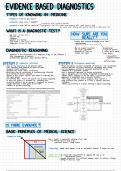
EVIDENCE BASED DIAGNOSTICS
TYPES OF KNOWING IN MEDICINE
-
diagnosis - how do you know ?
-
etiognosis - how does it happen ?
-
important when treating patients
prognosis result be ? GCS-good when dealing with head injuries only
- - what will the ~
prognostic tool :
not good when dealing with general patients
-
to determine LOC
WHAT IS A DIAGNOSTIC TEST ?
-
lab test >
-
blood tests HOW SURE ARE YOU
physical sign
REALLY ?
-
-
symptom
-
question on a history
-
risk Score >
-
SATS /South African Triage Score) ~ where does medical knowledge come from ?
algorithm >
group of tests >
epistemology
-
- -
the philosophical study of the nature, origin, and limits of human knowledge
L
-
not all studies represent ↓ experience
DIAGNOSTIC REASONING
C
the whole population -
types of patients
-
depends on how the -
where you're based
sample was taken
has biases
-
essential in the formulation of a diagnosis key to the effective i
safe management of patients
-
assumptions
-
predominant approach =
dual-process theory -
negative effects
can miss signs
SYSTEM1 CHEURISTIC , INTUITIVE) SYSTEM 2 (SYSTEMATIC ANALYTICAL ,
-
leans on the experience of the decision maker -
fewer boundaries greater availability of resources = less uncertainty
-
uses reasoning that depends on inductive logic -
decisions approach normative reasoning 3 rationality more closely
recognise overall patterns use the
Bayesian method to calculate probabilities of the
- =
-
decisions are made under uncertainty likelihood of a particular disease
-
physicians may be consciously or subconsciously influenced -
uses a systematic approach to remove uncertainty
by a variety of factors (biases) -
signs Symptoms are not readily recognized as belonging to a
system is fast frugal requires little effort frequently gets specific illness category or do not follow a particular script
-
, ,
the right answer -
approach is analytical slow i resource intensive
,
-
occasionally fails misses the patient who presents atypically .
-
More likely to get the correct
-
diagnosis than System 1
or when the pattern is mistaken for something else -
only processes one channel at a time i requires conscious
-
a passive reflexive set of systems
, triggered by context -
,
activation
in critical thinking logical reasoning
images emotions 3 older parts of the brain refined by training
-
,
-
capable of parallel processing
IS THERE EVIDENCE ?
BASIC PRINCIPLES OF MEDICAL SCIENCE
finding the truth
T
&
bias -
creates a systematic skewing of our view
.
e
g . Selection bias in drug trials
Bias biases
>
-
personal ; study biases
Confounding
confounding -
creates what appears to be an association however it skews our view
Randomis
rand om error -
by the measurement is slightly off due
chance to an
(measurement error) unpredictable factor
-
changes everytime to different degrees which can dilute a study's
ability to find the truth
,BAS >
-
a systematic error
-
measurement bias - when the method of measurement leads to systematically incorrect results
-
selection bias -> when comparisons are made between groups of patients that differ in ways other than the main factors under study
-
volunteer bias
-
loss to follow-up -> often in clinical studies where patients disappear /don't show up
-
information bias
-
confounding bias
-
effect modification CONTEXT INTENTION MATTERS !
TYPES OF BLAS ?
selection vs information bias
L
between & flaws in the data
-
systemic differences systemic errors due to
those taking part in a study' collection or measurement of outcome or
those who do not. . . or selection exposure data
process creates a
systemic error -
leads to misclassification of disease
making 2 groups of subjects
not comparable
Examples :
L /
volunteer bias ~ andom (non-differentiall systematic (differential)
-
-
healthy worker effect -
the chance/probability of misclassification -
misclassification varies between
-
detection (ascertainment bias) is the same for both
groups groups
-
loss to follow-up -
dilutes true effect by either -
creates a bias by misrepresenting
underestimating/overestimating true effect the true characteristics of one
group
.g
2 .
Glucometer .g
e .
height measurements
EXAMPLES :
-
recall bias
-
observer/interviewer bias (ECP ! )
-
biological variation
-
technical errors with instrument/techniques
COGNITIVE BLAS
-
greatest challenge the minimization of cognitive errors & specifically the biases failed heuristics that underlie them
=
-
systematic analysis ("flesh's blood" decision-making) occurs at the front line when resources are in short supply when time
- = ,
constraints apply & when shortcuts are being sought
-
we are less likely to fail patients diagnostically when we follow rational , normative models of decision making
-
medical decision makers educators have to do 3 things :
1 appreciate the full impact of diagnostic errors in medicine the contribution of sognitive errors in particular
2 refute the inevitability of cognitive diagnostic errors
3 dismiss the pessimism that surrounds approaches for lessening cognitive bias
-
unmasking cognitive errors in
of the diagnostic process then allows for the development of debiasing techniques
-
all [DRs respond) are evident in emergency
(cognitive dispositions to medicine described as a "natural laboratory of error"
-
CDRs can be overcome for a number of specific biases
-
a
cognitive debiasing technique using Cognitive forcing strategies is based on
metacognitive principles
-
much of clinical decision making is where the cognitive reality departs from the formalized ideal
,
TYPES OF KNOWING IN MEDICINE
-
diagnosis - how do you know ?
-
etiognosis - how does it happen ?
-
important when treating patients
prognosis result be ? GCS-good when dealing with head injuries only
- - what will the ~
prognostic tool :
not good when dealing with general patients
-
to determine LOC
WHAT IS A DIAGNOSTIC TEST ?
-
lab test >
-
blood tests HOW SURE ARE YOU
physical sign
REALLY ?
-
-
symptom
-
question on a history
-
risk Score >
-
SATS /South African Triage Score) ~ where does medical knowledge come from ?
algorithm >
group of tests >
epistemology
-
- -
the philosophical study of the nature, origin, and limits of human knowledge
L
-
not all studies represent ↓ experience
DIAGNOSTIC REASONING
C
the whole population -
types of patients
-
depends on how the -
where you're based
sample was taken
has biases
-
essential in the formulation of a diagnosis key to the effective i
safe management of patients
-
assumptions
-
predominant approach =
dual-process theory -
negative effects
can miss signs
SYSTEM1 CHEURISTIC , INTUITIVE) SYSTEM 2 (SYSTEMATIC ANALYTICAL ,
-
leans on the experience of the decision maker -
fewer boundaries greater availability of resources = less uncertainty
-
uses reasoning that depends on inductive logic -
decisions approach normative reasoning 3 rationality more closely
recognise overall patterns use the
Bayesian method to calculate probabilities of the
- =
-
decisions are made under uncertainty likelihood of a particular disease
-
physicians may be consciously or subconsciously influenced -
uses a systematic approach to remove uncertainty
by a variety of factors (biases) -
signs Symptoms are not readily recognized as belonging to a
system is fast frugal requires little effort frequently gets specific illness category or do not follow a particular script
-
, ,
the right answer -
approach is analytical slow i resource intensive
,
-
occasionally fails misses the patient who presents atypically .
-
More likely to get the correct
-
diagnosis than System 1
or when the pattern is mistaken for something else -
only processes one channel at a time i requires conscious
-
a passive reflexive set of systems
, triggered by context -
,
activation
in critical thinking logical reasoning
images emotions 3 older parts of the brain refined by training
-
,
-
capable of parallel processing
IS THERE EVIDENCE ?
BASIC PRINCIPLES OF MEDICAL SCIENCE
finding the truth
T
&
bias -
creates a systematic skewing of our view
.
e
g . Selection bias in drug trials
Bias biases
>
-
personal ; study biases
Confounding
confounding -
creates what appears to be an association however it skews our view
Randomis
rand om error -
by the measurement is slightly off due
chance to an
(measurement error) unpredictable factor
-
changes everytime to different degrees which can dilute a study's
ability to find the truth
,BAS >
-
a systematic error
-
measurement bias - when the method of measurement leads to systematically incorrect results
-
selection bias -> when comparisons are made between groups of patients that differ in ways other than the main factors under study
-
volunteer bias
-
loss to follow-up -> often in clinical studies where patients disappear /don't show up
-
information bias
-
confounding bias
-
effect modification CONTEXT INTENTION MATTERS !
TYPES OF BLAS ?
selection vs information bias
L
between & flaws in the data
-
systemic differences systemic errors due to
those taking part in a study' collection or measurement of outcome or
those who do not. . . or selection exposure data
process creates a
systemic error -
leads to misclassification of disease
making 2 groups of subjects
not comparable
Examples :
L /
volunteer bias ~ andom (non-differentiall systematic (differential)
-
-
healthy worker effect -
the chance/probability of misclassification -
misclassification varies between
-
detection (ascertainment bias) is the same for both
groups groups
-
loss to follow-up -
dilutes true effect by either -
creates a bias by misrepresenting
underestimating/overestimating true effect the true characteristics of one
group
.g
2 .
Glucometer .g
e .
height measurements
EXAMPLES :
-
recall bias
-
observer/interviewer bias (ECP ! )
-
biological variation
-
technical errors with instrument/techniques
COGNITIVE BLAS
-
greatest challenge the minimization of cognitive errors & specifically the biases failed heuristics that underlie them
=
-
systematic analysis ("flesh's blood" decision-making) occurs at the front line when resources are in short supply when time
- = ,
constraints apply & when shortcuts are being sought
-
we are less likely to fail patients diagnostically when we follow rational , normative models of decision making
-
medical decision makers educators have to do 3 things :
1 appreciate the full impact of diagnostic errors in medicine the contribution of sognitive errors in particular
2 refute the inevitability of cognitive diagnostic errors
3 dismiss the pessimism that surrounds approaches for lessening cognitive bias
-
unmasking cognitive errors in
of the diagnostic process then allows for the development of debiasing techniques
-
all [DRs respond) are evident in emergency
(cognitive dispositions to medicine described as a "natural laboratory of error"
-
CDRs can be overcome for a number of specific biases
-
a
cognitive debiasing technique using Cognitive forcing strategies is based on
metacognitive principles
-
much of clinical decision making is where the cognitive reality departs from the formalized ideal
,


