

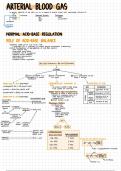
ARTERIAL BLOOD GAS
-
a specific collection of lab tests run on a sample of arterial blood ,
most importantly inclusive of :
>
-
PH
> PaOz -
acid-base Measured Directly Calculated
> Pa[Oz ·
BH ·
HCOz-
>
-
HCO3- ·
Pa[Oz ·
O2 saturation
·
Pa0z
ventilation
+ O2 saturation
=
oxygenation
NORMAL ACID-BASE REGULATION
ROLE OF ACID-BASE BALANCE
-
maintains Stable pH at 7 40
.
(7 . 35-7 .
45)
>
"physiologic pH" is necessary to prevent enzyme inactivation i denaturing
-
-
clinical consequences of dysregulation of acid-base balance :
vascular tone
>
poor
-
>
-
failure
myocardial pump
>
-
increased risk of arrhythmias
> skeletal
-
muscle weakness
>
-
electrolyte abnormalities
>
-
delirium/ Coma
>
-
impaired cellular respiration
Net Acid Production =
Net Acid Elimination
3 Stages
L V J
1 acid is produced as a acid is transported 3 acid is eliminated via the
consequence of normal via blood lungs 3 kidneys
metabolism
V
ELIMINATION
L
PROBLICTION OF ACID (physiologic) INTRAVASCULAR TRANSPORT OF OF ACID
Carbohydrates
·
,
fats >
-
CO2 (volatile acid) ACDto sudden a large swings site mechanism
prevent
in pH buffers
proteins (H2SO4 /non-volatile acid) , are necessary of [O2
lungs expiration
·
Buffers major characteristics : +
have 2
·
phospholipids <HsPOy (non-volatile acid)
I consist of either a weak acid (H proximal reabsorption of H 0
donor)is its conjugate base, or a M
excretion of H + as
PRODUCTION OF ACID (pathologis]
-
weak base (He acceptor) i its
d) ist al titratable acid
a ccumulated acids conjugate acid tubule/
uncontrolled 2 resist changes in PH
a cetoacetate collecting
diabetes , Y d UC t
excretion of NHyt
starvation & hydroxybutyrate Physiologic Buffers
-
extracellular :
hypotension >
impaired HCO3-1 CO2
·
hypoxia &
) delivery,
anaerobic
·
HPOx"2/HzPOp-
& , lactic acid albumin
metabolism
·
[8 7
7 -
intracellular :
poisoning ·
organic phosphates
~ inhibition of (e g . . 2 3
.
-
DPG .
ATP)
Oxidative ·
hemoglobin
phosphorylation
7
drugs/toxins PH ,
(e g asprin INH
. .
, ,
liver , impaired
* ZT · Cyanide disease lactate L
-
metformin) clearance
#HCO3] < PaCOz
glycollis acid
ethylene glycol ,
poisoning glyoxyllic acid COMPENSATION
oxallic acid body's mechanism
initial abnormality
of compensation
methanol formic asid
>
high HCOz- ↑ PaCOz
Henderson-Hasselbalch Equation
poisoning
low H[8zt ↓ Pa[Oz
PaCOz ↑ HCOz-
pH =
pka +
log[]
high
low PaCO2 ↓ H[Oz ~
pKa =
-log(equilibrium constant)
76 .
(pH pKa = +
log [CHCO3 ]
~
0 03
. xPaCOz
~
normal = 7 4
.
, LLINGS' ROLE IN ACID-BASE BALANCE
PERIPHERAL CENTRAL
conductinone ↓ arterial pH or
↑ Pa[Oz
↓ [Sf pH
a lveclus
1
V
L
mixed venous CO2 systemic arterial carotid
blood
& z
Y
body medullary
blood
pulmonary capillary chemoreceptors chemoreceptors
bed
&
medullary
respiratory center
~
↑ minute > ↓ PaCOz 34 ph
ventilation
KIDNEY'S ROLE IN ACID-BASE BALANCE
anP, glomerulus/ afferent arteriole
C
-
[
-
- efferent arteriole
aldosterone , tiph
Stimula
bytp. ~ to the ureters
↓ k+
pH3POTASSILIM BALANCE
K /H
+
EXCHANGE
+
-
in the presence of acid-base disturbances .
I can move across the cell membrane in exchange for K
" +
metabolis acidosis
with
-
most
pronounced
-
once intracellular It are buffered by organic phosphates /e g
. . ATP 2 3-DPG) intracellular proteins (e g
.
,
. .
hemoglobin)
result in apparent abnormalities of 1
+
balance that don't represent total K stores
+
-
can
accumulation of H
+
in extracellar space
ACIDEMIA H
+
V
k
+
inward movement of Ht
7 # cidemia Hyperkalemia
V
outward movement of K
+
-
for every 0 1 drop in .
pH ,
serum
V
# increases
S
intracellular buffering of H+ ~ 0 6
.
mEqIL (0 . 2- 1 7
.
mEqIL)
V
7
inward movement of H +
7
-
intracellular buffering of H +
#Ikalemia > Hypokalemia
=
net result :
hyperkalemia
-
a specific collection of lab tests run on a sample of arterial blood ,
most importantly inclusive of :
>
-
PH
> PaOz -
acid-base Measured Directly Calculated
> Pa[Oz ·
BH ·
HCOz-
>
-
HCO3- ·
Pa[Oz ·
O2 saturation
·
Pa0z
ventilation
+ O2 saturation
=
oxygenation
NORMAL ACID-BASE REGULATION
ROLE OF ACID-BASE BALANCE
-
maintains Stable pH at 7 40
.
(7 . 35-7 .
45)
>
"physiologic pH" is necessary to prevent enzyme inactivation i denaturing
-
-
clinical consequences of dysregulation of acid-base balance :
vascular tone
>
poor
-
>
-
failure
myocardial pump
>
-
increased risk of arrhythmias
> skeletal
-
muscle weakness
>
-
electrolyte abnormalities
>
-
delirium/ Coma
>
-
impaired cellular respiration
Net Acid Production =
Net Acid Elimination
3 Stages
L V J
1 acid is produced as a acid is transported 3 acid is eliminated via the
consequence of normal via blood lungs 3 kidneys
metabolism
V
ELIMINATION
L
PROBLICTION OF ACID (physiologic) INTRAVASCULAR TRANSPORT OF OF ACID
Carbohydrates
·
,
fats >
-
CO2 (volatile acid) ACDto sudden a large swings site mechanism
prevent
in pH buffers
proteins (H2SO4 /non-volatile acid) , are necessary of [O2
lungs expiration
·
Buffers major characteristics : +
have 2
·
phospholipids <HsPOy (non-volatile acid)
I consist of either a weak acid (H proximal reabsorption of H 0
donor)is its conjugate base, or a M
excretion of H + as
PRODUCTION OF ACID (pathologis]
-
weak base (He acceptor) i its
d) ist al titratable acid
a ccumulated acids conjugate acid tubule/
uncontrolled 2 resist changes in PH
a cetoacetate collecting
diabetes , Y d UC t
excretion of NHyt
starvation & hydroxybutyrate Physiologic Buffers
-
extracellular :
hypotension >
impaired HCO3-1 CO2
·
hypoxia &
) delivery,
anaerobic
·
HPOx"2/HzPOp-
& , lactic acid albumin
metabolism
·
[8 7
7 -
intracellular :
poisoning ·
organic phosphates
~ inhibition of (e g . . 2 3
.
-
DPG .
ATP)
Oxidative ·
hemoglobin
phosphorylation
7
drugs/toxins PH ,
(e g asprin INH
. .
, ,
liver , impaired
* ZT · Cyanide disease lactate L
-
metformin) clearance
#HCO3] < PaCOz
glycollis acid
ethylene glycol ,
poisoning glyoxyllic acid COMPENSATION
oxallic acid body's mechanism
initial abnormality
of compensation
methanol formic asid
>
high HCOz- ↑ PaCOz
Henderson-Hasselbalch Equation
poisoning
low H[8zt ↓ Pa[Oz
PaCOz ↑ HCOz-
pH =
pka +
log[]
high
low PaCO2 ↓ H[Oz ~
pKa =
-log(equilibrium constant)
76 .
(pH pKa = +
log [CHCO3 ]
~
0 03
. xPaCOz
~
normal = 7 4
.
, LLINGS' ROLE IN ACID-BASE BALANCE
PERIPHERAL CENTRAL
conductinone ↓ arterial pH or
↑ Pa[Oz
↓ [Sf pH
a lveclus
1
V
L
mixed venous CO2 systemic arterial carotid
blood
& z
Y
body medullary
blood
pulmonary capillary chemoreceptors chemoreceptors
bed
&
medullary
respiratory center
~
↑ minute > ↓ PaCOz 34 ph
ventilation
KIDNEY'S ROLE IN ACID-BASE BALANCE
anP, glomerulus/ afferent arteriole
C
-
[
-
- efferent arteriole
aldosterone , tiph
Stimula
bytp. ~ to the ureters
↓ k+
pH3POTASSILIM BALANCE
K /H
+
EXCHANGE
+
-
in the presence of acid-base disturbances .
I can move across the cell membrane in exchange for K
" +
metabolis acidosis
with
-
most
pronounced
-
once intracellular It are buffered by organic phosphates /e g
. . ATP 2 3-DPG) intracellular proteins (e g
.
,
. .
hemoglobin)
result in apparent abnormalities of 1
+
balance that don't represent total K stores
+
-
can
accumulation of H
+
in extracellar space
ACIDEMIA H
+
V
k
+
inward movement of Ht
7 # cidemia Hyperkalemia
V
outward movement of K
+
-
for every 0 1 drop in .
pH ,
serum
V
# increases
S
intracellular buffering of H+ ~ 0 6
.
mEqIL (0 . 2- 1 7
.
mEqIL)
V
7
inward movement of H +
7
-
intracellular buffering of H +
#Ikalemia > Hypokalemia
=
net result :
hyperkalemia


