

Chapter 6 - Nucleic Acids and Protein Synthesis
Biology AS
The structure of DNA and RNA
DNA (deoxyribonucleic acid) and RNA (ribonucleic acid) are macromolecules, and are
known and nucleic acids because they are originally found in the nucleus. The monomers
from which DNA and RNA molecules are made are nucleotides. DNA and RNA are
therefore polynucleotides.
Nucleotides
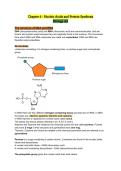
-molecules consisting of a nitrogen-containing base, a pentose sugar and a phosphate
group.
In DNA there are four different nitrogen-containing bases and also four in RNA. In DNA
the bases are; adenine, guanine, thymine and cytosine.
In RNA thymine is replaced by a similar base called uracil.
The bases are almost always referred to as: A,G,T,C and U.
Adenine and Guanine are related to the chemical purine and are called purines. Purines
only have 2 rings in their structure and pyrimidines have one ring.
Thymine, Cytosine and Uracil are related to the chemical pyrimidine and are referred to as
pyrimidines.
Pentose is a sugar containing 5 carbon atoms, 2 pentoses are found in the nucleic acids,
ribose and deoxyribose.
A nucleic acid with ribose = RNA (ribonucleic acid).
A nucleic acid containing deoxyribose = DNA (deoxyribonucleic acid).
The phosphate group gives the nucleic acids their acid nature.
, The structure of ATP
Adenosine triphosphate is not part of DNA or RNA, but it is also a nucleotide.
ATP contains adenine, ribose and phosphate.
Adenine + ribose = sugar-base called adenosine.
Adenosine is adenine with a sugar added to it.
Adenosine can then be combined with 1, 2 or 3 phosphate groups to turn it into AMP, ADP,
ATP (adenosine triphosphate).
Dinucleotides and polynucleotides
2 nucleotides can be joined together by a condensation reaction.
The molecule formed by joining 2 nucleotides is called a dinucleotide, the bond formed is
called a phosphodiester bond.
It uses the term -diester as the phosphate group involved now has 2 ester bonds, one of
each to the sugars it is connected to.
The sugars and phosphates are linked by the phosphodiester bonds to form a backbone
from which the bases stick out sideways at right angles to the backbone.
Biology AS
The structure of DNA and RNA
DNA (deoxyribonucleic acid) and RNA (ribonucleic acid) are macromolecules, and are
known and nucleic acids because they are originally found in the nucleus. The monomers
from which DNA and RNA molecules are made are nucleotides. DNA and RNA are
therefore polynucleotides.
Nucleotides
-molecules consisting of a nitrogen-containing base, a pentose sugar and a phosphate
group.
In DNA there are four different nitrogen-containing bases and also four in RNA. In DNA
the bases are; adenine, guanine, thymine and cytosine.
In RNA thymine is replaced by a similar base called uracil.
The bases are almost always referred to as: A,G,T,C and U.
Adenine and Guanine are related to the chemical purine and are called purines. Purines
only have 2 rings in their structure and pyrimidines have one ring.
Thymine, Cytosine and Uracil are related to the chemical pyrimidine and are referred to as
pyrimidines.
Pentose is a sugar containing 5 carbon atoms, 2 pentoses are found in the nucleic acids,
ribose and deoxyribose.
A nucleic acid with ribose = RNA (ribonucleic acid).
A nucleic acid containing deoxyribose = DNA (deoxyribonucleic acid).
The phosphate group gives the nucleic acids their acid nature.
, The structure of ATP
Adenosine triphosphate is not part of DNA or RNA, but it is also a nucleotide.
ATP contains adenine, ribose and phosphate.
Adenine + ribose = sugar-base called adenosine.
Adenosine is adenine with a sugar added to it.
Adenosine can then be combined with 1, 2 or 3 phosphate groups to turn it into AMP, ADP,
ATP (adenosine triphosphate).
Dinucleotides and polynucleotides
2 nucleotides can be joined together by a condensation reaction.
The molecule formed by joining 2 nucleotides is called a dinucleotide, the bond formed is
called a phosphodiester bond.
It uses the term -diester as the phosphate group involved now has 2 ester bonds, one of
each to the sugars it is connected to.
The sugars and phosphates are linked by the phosphodiester bonds to form a backbone
from which the bases stick out sideways at right angles to the backbone.


