DNA - THE CODE OF LIFE, AND RNA
DNA STRUCTURE AND CODING:
STRUCTURE:
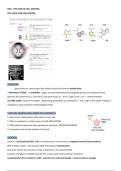
- giant molecule, consisting of two twisted strands to form the double helix.
> Monomers of DNA → nucleotides : Sugar molecule (deoxyribose), Phosphate group and nitrogenous base.
(adenine [A], thymine [T] 2, cytosine [C] and guanine [G] 3) - A+G= large Purine ; C+T = small Pyrimidine
The DNA ladder: Sides of the ladder = alternating deoxyribose and phosphate > The rungs of the ladder: linking of
nitrogenous bases joined by weak hydrogen bonds
FUNCTION: GENERATIONAL RUBIES SELL CONSTANTLY
1. DNA carries coded genetic information in each cell
2. DNA can replicate i.e. make a copy of itself: REPLICATION
3. DNA indirectly supervises the manufacture of protein: PROTEIN SYNTHESIS
4. It therefore controls the activities of the cell.
LOCATION:
nucleus = chromosomal DNA. [DNA in chromosomes in the nucleus, wrapped around histone proteins]
DNA outside nucleus = extranuclear DNA (chloroplast, mitochondria)
Structure: shorter and circular in shape compared to chromosomal DNA
Function: the genes of mtDNA code for the enzymes that control cellular respiration
Is passed down from mother to child - used to trace maternal lineage > rarely mutates / changes
, DNA REPLICATION - in interphase
- During cell division, cells need to make a complete copy of their genetic information.
- When DNA is replicated, the new DNA molecule is made up of one strand of the original DNA whereas the
other strand is made of freshly made DNA.
PROCESS:
- DNA helicase unwinds the double helix, breaking the hydrogen bonds between complementary base pairs to
separate the strands.
- One of the strands will act as a template for synthesis of the other strand. Complementary nucleotides will
attach to the template strand by hydrogen bonding.
- DNA polymerase catalyses the formation of phosphodiester bonds between nucleotides, forming a
complementary strand alongside the template parent strand.
- Two daughter DNA molecules are formed, each containing half of the original DNA molecule.
It is important that DNA polymerase accurately copies the template strand to avoid placing the wrong DNA
nucleotide in the incorrect position. To avoid this, DNA polymerase ‘proofreads’ the complementary strand as it
moves along the DNA.
DNA STRUCTURE AND CODING:
STRUCTURE:
- giant molecule, consisting of two twisted strands to form the double helix.
> Monomers of DNA → nucleotides : Sugar molecule (deoxyribose), Phosphate group and nitrogenous base.
(adenine [A], thymine [T] 2, cytosine [C] and guanine [G] 3) - A+G= large Purine ; C+T = small Pyrimidine
The DNA ladder: Sides of the ladder = alternating deoxyribose and phosphate > The rungs of the ladder: linking of
nitrogenous bases joined by weak hydrogen bonds
FUNCTION: GENERATIONAL RUBIES SELL CONSTANTLY
1. DNA carries coded genetic information in each cell
2. DNA can replicate i.e. make a copy of itself: REPLICATION
3. DNA indirectly supervises the manufacture of protein: PROTEIN SYNTHESIS
4. It therefore controls the activities of the cell.
LOCATION:
nucleus = chromosomal DNA. [DNA in chromosomes in the nucleus, wrapped around histone proteins]
DNA outside nucleus = extranuclear DNA (chloroplast, mitochondria)
Structure: shorter and circular in shape compared to chromosomal DNA
Function: the genes of mtDNA code for the enzymes that control cellular respiration
Is passed down from mother to child - used to trace maternal lineage > rarely mutates / changes
, DNA REPLICATION - in interphase
- During cell division, cells need to make a complete copy of their genetic information.
- When DNA is replicated, the new DNA molecule is made up of one strand of the original DNA whereas the
other strand is made of freshly made DNA.
PROCESS:
- DNA helicase unwinds the double helix, breaking the hydrogen bonds between complementary base pairs to
separate the strands.
- One of the strands will act as a template for synthesis of the other strand. Complementary nucleotides will
attach to the template strand by hydrogen bonding.
- DNA polymerase catalyses the formation of phosphodiester bonds between nucleotides, forming a
complementary strand alongside the template parent strand.
- Two daughter DNA molecules are formed, each containing half of the original DNA molecule.
It is important that DNA polymerase accurately copies the template strand to avoid placing the wrong DNA
nucleotide in the incorrect position. To avoid this, DNA polymerase ‘proofreads’ the complementary strand as it
moves along the DNA.