
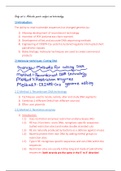
Study unit 6: Molecular genetic analysis and biotechnology
1) Introduction:
The ability to read nucleotide sequences has changed genetics by:
1) Allowing development of recombinant technology
2) Invention of PCR (polymerase chain reaction)
3) Development of fast and accurate DNA sequencing methods
4) Engineering of CRISPR-Cas system (clustered regularly interrupted short
palindromic repeats
5) Biotechnology: molecular techniques are used to create commercial
products
2) Molecular techniques: Cutting DNA
2.1) Method 1: Recombinant DNA technology
1) Techniques used to locate, isolate, alter and study DNA segments
2) Combines 2 different DNA (from different sources)
3) Often uses plasmids
2.2) Method 2: Restriction enzymes
1) Introduction:
1.1) Uses restriction enzymes/ restriction endonucleases (RE)
1.2) RE has 2 functions: scans DNA, recognizes specific sequences
(called restriction sites) and makes double stranded cuts
1.3) RE are naturally produced by bacteria as a defense against viruses
1.4) Bacteria protect their own DNA by adding methyl groups to
restriction sites
1.5) Type II RE: recognizes specific sequences and cuts DNA within the
sequences
1.6) Restriction sites are usually 4-8 bp long and made of palindromic
sequences (both strands are the same in the 5’ to 3’ direction)
,2) Restriction enzyme digestion:
2.1) Restriction enzymes are named after the bacteria they are isolated
from.
2.2) RE may cut DNA to produce sticky/cohesive end or blunt ends
2.3) Only sticky ends can be recombined with complementary DNA from
another organism
2.4) 5’ vs 3’ overhang: If the RE cuts closer to the 5’ end it produces a 5’
overhang, if the RE cuts closer to the 3’ end it produces a 3’ overhang
, 3)The probability to encounter a restriction site
3.1) Follows basic probability laws
1
3.2) You have a chance to get any specific nucleotide (A/T/C/G)
4
3.3) Probability depends only on the length of the recognition sequence
4) Restriction enzymes and recombinant DNA molecules:
4.1) Different DNA molecules from different organisms cut with the same RE
can be paired to create recombinant DNA molecules
1) Introduction:
The ability to read nucleotide sequences has changed genetics by:
1) Allowing development of recombinant technology
2) Invention of PCR (polymerase chain reaction)
3) Development of fast and accurate DNA sequencing methods
4) Engineering of CRISPR-Cas system (clustered regularly interrupted short
palindromic repeats
5) Biotechnology: molecular techniques are used to create commercial
products
2) Molecular techniques: Cutting DNA
2.1) Method 1: Recombinant DNA technology
1) Techniques used to locate, isolate, alter and study DNA segments
2) Combines 2 different DNA (from different sources)
3) Often uses plasmids
2.2) Method 2: Restriction enzymes
1) Introduction:
1.1) Uses restriction enzymes/ restriction endonucleases (RE)
1.2) RE has 2 functions: scans DNA, recognizes specific sequences
(called restriction sites) and makes double stranded cuts
1.3) RE are naturally produced by bacteria as a defense against viruses
1.4) Bacteria protect their own DNA by adding methyl groups to
restriction sites
1.5) Type II RE: recognizes specific sequences and cuts DNA within the
sequences
1.6) Restriction sites are usually 4-8 bp long and made of palindromic
sequences (both strands are the same in the 5’ to 3’ direction)
,2) Restriction enzyme digestion:
2.1) Restriction enzymes are named after the bacteria they are isolated
from.
2.2) RE may cut DNA to produce sticky/cohesive end or blunt ends
2.3) Only sticky ends can be recombined with complementary DNA from
another organism
2.4) 5’ vs 3’ overhang: If the RE cuts closer to the 5’ end it produces a 5’
overhang, if the RE cuts closer to the 3’ end it produces a 3’ overhang
, 3)The probability to encounter a restriction site
3.1) Follows basic probability laws
1
3.2) You have a chance to get any specific nucleotide (A/T/C/G)
4
3.3) Probability depends only on the length of the recognition sequence
4) Restriction enzymes and recombinant DNA molecules:
4.1) Different DNA molecules from different organisms cut with the same RE
can be paired to create recombinant DNA molecules


