

AQA • A Level Chemistry
Latest uploads for A Level Chemistry at AQA. Looking for A Level Chemistry notes at AQA? We have lots of notes, study guides and study notes available for A Level Chemistry at AQA.
-
1317
-
16
-
178
Courses A Level Chemistry at AQA
Notes available for the following courses of A Level Chemistry at AQA
-
3.1.9 - Rate equations (A-level only)
-
3.1.10 - Equilibrium constant K p for homogeneous systems (A-level only)
-
Unit 3.1.1 - Atomic structure
-
Unit 3.1.2 - Amount of substance
-
Unit 3.1.3 - Bonding
-
Unit 3.1.4 - Energetics
-
Unit 3.1.5 - Kinetics
-
Unit 3.1.6 - Chemical equilibria, Le Chatelier’s principle and Kc
-
Unit 3.1.7 - Oxidation, reduction and redox equations
-
Unit 3.1.8 - Thermodynamics (A-level only)
-
Unit 3.1.11 - Electrode potentials and electrochemical cells (A-level only)
-
Unit 3.1.12 - Acids and bases (A-level only)
-
Unit 3.2.1 - Periodicity
-
Unit 3.2.2 - Group 2, the alkaline earth metals
-
Unit 3.2.3 - Group 7(17), the halogens
-
Unit 3.2.4 - Properties of Period 3 elements and their oxides (A-level only)
-
Unit 3.2.5 - Transition metals (A-level only)
-
Unit 3.2.6 - Reactions of ions in aqueous solution (A-level only)
-
Unit 3.3.1 - Introduction to organic chemistry
-
Unit 3.3.2 - Alkanes
-
Unit 3.3.3 - Halogenoalkanes
-
Unit 3.3.4 - Alkenes
-
Unit 3.3.5 - Alcohols
-
Unit 3.3.6 - Organic analysis
-
Unit 3.3.7 - Optical isomerism (A-level only)
-
Unit 3.3.8 - Aldehydes and ketones (A-level only)
-
Unit 3.3.9 - Carboxylic acids and derivatives (A-level only)
-
Unit 3.3.10 - Aromatic chemistry (A-level only)
-
Unit 3.3.11 - Amines (A-level only)
-
Unit 3.3.12 - Polymers (A-level only)
-
Unit 3.3.13 - Amino acids, proteins and DNA (A-level only)
-
Unit 3.3.14 - Organic synthesis (A-level only)
-
Unit 3.3.15 - Nuclear magnetic resonance spectroscopy (A-level only)
-
Unit 3.3.16 - Chromatography (A-level only)
Latest content AQA • A Level Chemistry
This resource comprehensively covers all the essential information and topics outlined in the AQA specification, providing everything needed to effectively prepare and succeed in your studies.
- Summary
- • 22 pages's •
-
AQA•Unit 3.1.8 - Thermodynamics
Preview 3 out of 22 pages
Getting your document ready...
This resource comprehensively covers all the essential information and topics outlined in the AQA specification, providing everything needed to effectively prepare and succeed in your studies.

These notes cover the fundamental concepts of atomic structure, including Atomic Models, Electron Configuration, Periodic Trends and mass spectroscopy. These notes feature clear explanations and diagrams to aid understanding and retention
- Summary
- • 0 pages's •
-
AQA•Unit 3.1.1 - Atomic structure
Preview 0 out of 0 pages
Getting your document ready...
These notes cover the fundamental concepts of atomic structure, including Atomic Models, Electron Configuration, Periodic Trends and mass spectroscopy. These notes feature clear explanations and diagrams to aid understanding and retention

this is a document containing common questions that come up on each chemistry exam paper and has the definitions of every possible vocabulary you can be asked to define. also this helped me so much as i memorised the content on this document using a whiteboard and by that i had memorised most of them and there were some i hadn't known and on my actual exams i got asked a definition i had never known but due to this document i got the full 2 marks or else i had lost them
- Summary
- • 8 pages's •
-
AQA•common knowledge
Preview 1 out of 8 pages
Getting your document ready...
this is a document containing common questions that come up on each chemistry exam paper and has the definitions of every possible vocabulary you can be asked to define. also this helped me so much as i memorised the content on this document using a whiteboard and by that i had memorised most of them and there were some i hadn't known and on my actual exams i got asked a definition i had never known but due to this document i got the full 2 marks or else i had lost them

these are the notes you need t0 be able to kick start your journey from gcse to alevel chemistry it has all the basics and helps you ease down from feeling the difference between difficulty gap. it is very detailed and this knowledge is key to ace your whole alevel journey
- Package deal
- Class notes
- • 7 pages's •
-
AQA•bridging alevel chemistry
-
aqa alevel chemistry all of physical chemistry topics hnadwriiten notes detailed• Byaabubaker1312
Preview 1 out of 7 pages
Getting your document ready...
these are the notes you need t0 be able to kick start your journey from gcse to alevel chemistry it has all the basics and helps you ease down from feeling the difference between difficulty gap. it is very detailed and this knowledge is key to ace your whole alevel journey
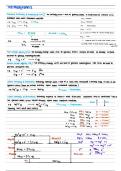
Thermodynamics in A-Level Chemistry involves the study of energy changes, particularly in chemical reactions. Here's a brief summary of the key concepts: 1. Enthalpy (H) Enthalpy Change (ΔH): The heat energy change measured under constant pressure. Exothermic Reactions: Release heat to the surroundings, ΔH is negative (e.g., combustion). Endothermic Reactions: Absorb heat from the surroundings, ΔH is positive (e.g., photosynthesis). 2. Standard Enthalpy Changes Standard Conditions: 2...
- Summary
- • 6 pages's •
-
AQA•Unit 3.1.8 - Thermodynamics
Preview 2 out of 6 pages
Getting your document ready...
Thermodynamics in A-Level Chemistry involves the study of energy changes, particularly in chemical reactions. Here's a brief summary of the key concepts: 1. Enthalpy (H) Enthalpy Change (ΔH): The heat energy change measured under constant pressure. Exothermic Reactions: Release heat to the surroundings, ΔH is negative (e.g., combustion). Endothermic Reactions: Absorb heat from the surroundings, ΔH is positive (e.g., photosynthesis). 2. Standard Enthalpy Changes Standard Conditions: 2...
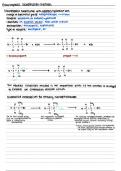
Summary - Organic pathway as (Chem)
- Summary
- • 12 pages's •
-
AQA•Organic pathway as
Preview 2 out of 12 pages
Getting your document ready...
Summary - Organic pathway as (Chem)
Organic analysis in A-Level Chemistry under the AQA specification involves the identification and characterization of organic compounds using a variety of techniques. Here’s a brief summary of the key aspects: 1. Functional Group Analysis Test for Alkenes: Bromine water test. Alkenes decolorize bromine water (from orange to colorless). Test for Alcohols: Primary and Secondary Alcohols: Oxidation with acidified potassium dichromate (orange to green). Tertiary Alcohols: No reaction with a...
- Summary
- • 2 pages's •
-
AQA•Unit 3.3.6 - Organic analysis
Preview 1 out of 2 pages
Getting your document ready...
Organic analysis in A-Level Chemistry under the AQA specification involves the identification and characterization of organic compounds using a variety of techniques. Here’s a brief summary of the key aspects: 1. Functional Group Analysis Test for Alkenes: Bromine water test. Alkenes decolorize bromine water (from orange to colorless). Test for Alcohols: Primary and Secondary Alcohols: Oxidation with acidified potassium dichromate (orange to green). Tertiary Alcohols: No reaction with a...
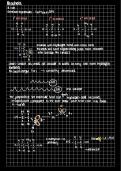
Alcohols are a class of organic compounds characterized by the presence of one or more hydroxyl (-OH) groups attached to a carbon atom. Here are the key points about alcohols relevant to A-level chemistry: Structure and Classification General Formula: The general formula for alcohols is C n H 2 n + 1 O H C n H 2n+1 OH. Functional Group: The defining feature of alcohols is the hydroxyl (-OH) group. Classification: Alcohols are classified based on the number of...
- Summary
- • 8 pages's •
-
AQA•Unit 3.3.5 - Alcohols
Preview 2 out of 8 pages
Getting your document ready...
Alcohols are a class of organic compounds characterized by the presence of one or more hydroxyl (-OH) groups attached to a carbon atom. Here are the key points about alcohols relevant to A-level chemistry: Structure and Classification General Formula: The general formula for alcohols is C n H 2 n + 1 O H C n H 2n+1 OH. Functional Group: The defining feature of alcohols is the hydroxyl (-OH) group. Classification: Alcohols are classified based on the number of...
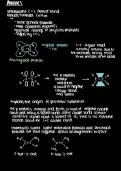
Alkenes are a class of hydrocarbons that contain at least one carbon-carbon double bond (C=C). Here are the key points about alkenes: Structure General Formula: The general formula for alkenes is C n H 2 n C n H 2n , where n n is the number of carbon atoms. Double Bond: The presence of a carbon-carbon double bond defines alkenes. This double bond consists of one sigma (σ) bond and one pi (π) bond. Nomenclature Naming: Alkenes are named by identifying the lo...
- Class notes
- • 8 pages's •
-
AQA•1.4 alkenes
Preview 2 out of 8 pages
Getting your document ready...
Alkenes are a class of hydrocarbons that contain at least one carbon-carbon double bond (C=C). Here are the key points about alkenes: Structure General Formula: The general formula for alkenes is C n H 2 n C n H 2n , where n n is the number of carbon atoms. Double Bond: The presence of a carbon-carbon double bond defines alkenes. This double bond consists of one sigma (σ) bond and one pi (π) bond. Nomenclature Naming: Alkenes are named by identifying the lo...

Oxidation, reduction, and redox equations are fundamental concepts in chemistry, particularly in the study of chemical reactions involving electron transfer. Oxidation Definition: Oxidation is the process where an atom, ion, or molecule loses one or more electrons. Oxidation State: The oxidation state (or oxidation number) of the species increases. Example: In the reaction Fe → Fe 2 + + 2 e − Fe→Fe 2+ +2e − , iron (Fe) is oxidized to iron(II) ion (Fe²⁺). Redu...
- Class notes
- • 5 pages's •
-
AQA•Unit 3.1.7 - Oxidation, reduction and redox equations
Preview 2 out of 5 pages
Getting your document ready...
Oxidation, reduction, and redox equations are fundamental concepts in chemistry, particularly in the study of chemical reactions involving electron transfer. Oxidation Definition: Oxidation is the process where an atom, ion, or molecule loses one or more electrons. Oxidation State: The oxidation state (or oxidation number) of the species increases. Example: In the reaction Fe → Fe 2 + + 2 e − Fe→Fe 2+ +2e − , iron (Fe) is oxidized to iron(II) ion (Fe²⁺). Redu...