BIOLOGY
YEAR 1
QUARTER 3
2019
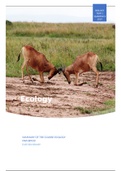
Ecology
SUMMARY OF THE COURSE ECOLOGY
NWI-BP030
ELISE REUVEKAMP
,Content
Lecture 1:................................................................................................................................................2
Lecture 2: Conditions and resources......................................................................................................3
Lecture 3: Populations............................................................................................................................5
Lecture 4: Communities..........................................................................................................................7
Lecture 5: Meta populations..................................................................................................................8
Lecture 6: Species richness on islands..................................................................................................10
Lecture 7: The ecology of predation and parasitism.............................................................................12
Lecture 8: The evolutions of predation and parasitism........................................................................13
Lecture 9: Mutualism............................................................................................................................15
Lecture 10: Community structure and food webs................................................................................16
Lecture 11: Energy fixation and Energy flows.......................................................................................17
Lecture 12: Flows of matter and biogeochemical cycles.......................................................................19
Lecture 13: conservation and restoration.............................................................................................21
, Ecology
Lecture 1:
What is ecology?
Ecology is the scientific study of:
- the distribution and abundance of organisms
- The interactions that determine that distribution
- The relationships between organisms and the transformation and flux of energy and matter
Hierarchical levels of biological organisation: biosphere, ecosystem, community, population,
organism, organs and tissues.
The diversity of ecological evidence is based on observations that include changes in abundance or
system functioning, experiments including lab and field and mathematical models that capture some
component of ecological interactions, function and structure.
Field experiments are carried out when a careful observation leads to a hypothesis that will be
tested. Testing the hypothesis usually involves a manipulative field experiment and a comparative
field of observation to see the difference.
Controlled experiments in the lab including green houses and common gardens are essential to
capture ecological processes. The controlled experiments reduce the complex situation in the field.
Mathematical models can be valuable for summarizing our current state of knowledge to the
essential factors, exploring what if scenarios and act as a benchmark in our search for understanding.
But you have to be careful, because any model is an approximation of the real world, conclusions and
predictions conditional of what is assumed and a model is more convincible once it has received
support of real data sets.
What is evolution?
Evolution is the change, over time, in the heritable characteristics of a population. Those best able to
survive (‘survival of the fittest’) risks and hazards of the environments; and those who were most
capable of successful reproduction. Fitness is the success of individuals in the process of natural
selection. Evolution is particularly rapid and intense when two species interact: coevolution.
Speciation, the formation of species is not related to natural selection unless it is coupled with
reproductive isolation of populations from each other. Bio species are organisms as being member of
a single species if they could at least potentially breed together in nature to produce fertile offspring.
The bio species are recognized when they have diverged enough to prevent them from forming
fertile hybrids.
Process of speciation:
1. Allopatric phase: subpopulations become geographically isolated and natural selection drives
genetic adaptation to their local environments
2. Reproductive isolates builds up between the two species
3. Sympatric phase: the two subpopulations remeet and natural selection will then favour any
feature in either subpopulation that reinforces reproductive isolation.
YEAR 1
QUARTER 3
2019
Ecology
SUMMARY OF THE COURSE ECOLOGY
NWI-BP030
ELISE REUVEKAMP
,Content
Lecture 1:................................................................................................................................................2
Lecture 2: Conditions and resources......................................................................................................3
Lecture 3: Populations............................................................................................................................5
Lecture 4: Communities..........................................................................................................................7
Lecture 5: Meta populations..................................................................................................................8
Lecture 6: Species richness on islands..................................................................................................10
Lecture 7: The ecology of predation and parasitism.............................................................................12
Lecture 8: The evolutions of predation and parasitism........................................................................13
Lecture 9: Mutualism............................................................................................................................15
Lecture 10: Community structure and food webs................................................................................16
Lecture 11: Energy fixation and Energy flows.......................................................................................17
Lecture 12: Flows of matter and biogeochemical cycles.......................................................................19
Lecture 13: conservation and restoration.............................................................................................21
, Ecology
Lecture 1:
What is ecology?
Ecology is the scientific study of:
- the distribution and abundance of organisms
- The interactions that determine that distribution
- The relationships between organisms and the transformation and flux of energy and matter
Hierarchical levels of biological organisation: biosphere, ecosystem, community, population,
organism, organs and tissues.
The diversity of ecological evidence is based on observations that include changes in abundance or
system functioning, experiments including lab and field and mathematical models that capture some
component of ecological interactions, function and structure.
Field experiments are carried out when a careful observation leads to a hypothesis that will be
tested. Testing the hypothesis usually involves a manipulative field experiment and a comparative
field of observation to see the difference.
Controlled experiments in the lab including green houses and common gardens are essential to
capture ecological processes. The controlled experiments reduce the complex situation in the field.
Mathematical models can be valuable for summarizing our current state of knowledge to the
essential factors, exploring what if scenarios and act as a benchmark in our search for understanding.
But you have to be careful, because any model is an approximation of the real world, conclusions and
predictions conditional of what is assumed and a model is more convincible once it has received
support of real data sets.
What is evolution?
Evolution is the change, over time, in the heritable characteristics of a population. Those best able to
survive (‘survival of the fittest’) risks and hazards of the environments; and those who were most
capable of successful reproduction. Fitness is the success of individuals in the process of natural
selection. Evolution is particularly rapid and intense when two species interact: coevolution.
Speciation, the formation of species is not related to natural selection unless it is coupled with
reproductive isolation of populations from each other. Bio species are organisms as being member of
a single species if they could at least potentially breed together in nature to produce fertile offspring.
The bio species are recognized when they have diverged enough to prevent them from forming
fertile hybrids.
Process of speciation:
1. Allopatric phase: subpopulations become geographically isolated and natural selection drives
genetic adaptation to their local environments
2. Reproductive isolates builds up between the two species
3. Sympatric phase: the two subpopulations remeet and natural selection will then favour any
feature in either subpopulation that reinforces reproductive isolation.