CLASS 1
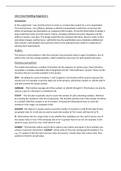
Law exists to regulate human lives.
‘To criminalise a certain kind of conduct is to declare that is a public wrong that
should not be done, to institute a threat of punishment… and to censure those who
nevertheless do it’.
- there is a literal sense to this definition.
- public wrong = harm principle.
- wrong is a subjective concept as is harm.
- is the harm principle definitive?
- Gardner: ‘potential risk of harm’.
- deterrence.
- private wrong?
- morality governs interaction between people. Objectivity in that most agree some things
are genuinely wrong.
- is morality dependent on context?
- Public wrong = PUBLIC INTEREST/THE COMMON GOOD (brings up problem of
disagreement).
- (in)direct harms.
- wrong acts as a constraint to the concept of harm. Harm Principle is more intelligible; it has
moral autonomy aspects to it. If I do not bother anyone, I am free to do whatever I wish.
- harm does not have to be morally wrong.
- THIS IS THE LEGAL MORALIST VIEW.
- the state defines public laws. What does this mean? That they quite literally define the
public law and essentially declares criminal behaviour.
- Principle of Legality: to ensure that people have access to the law and have a chance to
abide to the law and know of its existence to act accordingly.
- In criminal law, in the UK, the defendant/prosecutor have to make the best case if they
want to win… is truth necessarily leading to justice…? Evidence is more important.
- We are all fallible. We cannot be 100% sure, hence why evidence is more important in
court.
- It is unjust to take away human rights so we avoid wrongful convictions.
- THE BURDEN OF PROOF. The defendant has the right to remain silent. Proof beyond
reasonable doubts (what does this mean?)
- Balance of Probabilities.
- statutory exemptions diminish responsibility at times e.g. a defendant who is insane.
- Standard of Proof vs. Burden of Proof.
- justice is dependant on the court.
Woolmington v DPP [1935] *462 Woolmington Appellant; v The Director of Public
Prosecutions Respondent.
Law exists to regulate human lives.
‘To criminalise a certain kind of conduct is to declare that is a public wrong that
should not be done, to institute a threat of punishment… and to censure those who
nevertheless do it’.
- there is a literal sense to this definition.
- public wrong = harm principle.
- wrong is a subjective concept as is harm.
- is the harm principle definitive?
- Gardner: ‘potential risk of harm’.
- deterrence.
- private wrong?
- morality governs interaction between people. Objectivity in that most agree some things
are genuinely wrong.
- is morality dependent on context?
- Public wrong = PUBLIC INTEREST/THE COMMON GOOD (brings up problem of
disagreement).
- (in)direct harms.
- wrong acts as a constraint to the concept of harm. Harm Principle is more intelligible; it has
moral autonomy aspects to it. If I do not bother anyone, I am free to do whatever I wish.
- harm does not have to be morally wrong.
- THIS IS THE LEGAL MORALIST VIEW.
- the state defines public laws. What does this mean? That they quite literally define the
public law and essentially declares criminal behaviour.
- Principle of Legality: to ensure that people have access to the law and have a chance to
abide to the law and know of its existence to act accordingly.
- In criminal law, in the UK, the defendant/prosecutor have to make the best case if they
want to win… is truth necessarily leading to justice…? Evidence is more important.
- We are all fallible. We cannot be 100% sure, hence why evidence is more important in
court.
- It is unjust to take away human rights so we avoid wrongful convictions.
- THE BURDEN OF PROOF. The defendant has the right to remain silent. Proof beyond
reasonable doubts (what does this mean?)
- Balance of Probabilities.
- statutory exemptions diminish responsibility at times e.g. a defendant who is insane.
- Standard of Proof vs. Burden of Proof.
- justice is dependant on the court.
Woolmington v DPP [1935] *462 Woolmington Appellant; v The Director of Public
Prosecutions Respondent.