
Telescop
History of
dutch eyeglass maker
Telescopes es
-first recorded invention of telescope in 1608 by Hans Lippershey,
-Early 1600's refracting design consist of convex lense + concave
eye piece
-Lippershey’s design improved by Galileo
-1611, telescope with convex eyepiece + convex objective lens
described by Johannes Kepler
-1668, Isaac Newton invents first telescope with secondary mirror
-1733, Chester Moore Hall invents achromatic lens
-throughout 1800+ 1900's telescope designs are designed to
specific shapes + sizes for different purposes ex. Hooker telescope
-1931, Karl Guthe Janksy discovers radio waves in space which led
to invention of radio telescopes
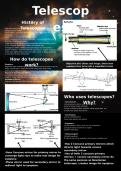
How do telescopes
Eyepiece:
work?
Magnifies light reflected by the large objective lens to size of eye so
Objective lens shows real image, which then
eyepiece then turns into a magnified virtual
better visualization. Produces virtual image from real image image for eye.
produced by objective lens.
Objective lens/Primary Mirror:
Converges light rays to focal point to show real image. Larger focal
length = large magnification = better visualization.
Secondary Mirror:
Redirects and focuses light towards the eyepiece.
Who uses telescopes?
Why?
• Astronomers
1.study planets, stars, suns, galaxies, ect.
2.see far away things on Earth
3.study to build rockets, shuttles, other telescopes, ect
4.make new space discoveries
.
• Astrologists
1.study constellations
2.see what planets are where
• Engineers
1.study planets, stars, suns, ect. for inventions
2.study existing inventions in space
3.better telescope
• Meteorologists
1.Predict weather
2.Look at storms for example, hurricanes, tornados, ect.
-Has 2 Concave primary mirrors which
directs light towards convex
secondary mirror
-Uses Concave mirror for primary mirror to
-Use of both 2 concave primary
converge light rays to make real image for
mirrors + convex secondary mirror do
eyepiece
the same purpose as Newtonian
-Plane mirror used for secondary mirror to
telescope, creates image for eyepiece
redirect light to eyepiece
History of
dutch eyeglass maker
Telescopes es
-first recorded invention of telescope in 1608 by Hans Lippershey,
-Early 1600's refracting design consist of convex lense + concave
eye piece
-Lippershey’s design improved by Galileo
-1611, telescope with convex eyepiece + convex objective lens
described by Johannes Kepler
-1668, Isaac Newton invents first telescope with secondary mirror
-1733, Chester Moore Hall invents achromatic lens
-throughout 1800+ 1900's telescope designs are designed to
specific shapes + sizes for different purposes ex. Hooker telescope
-1931, Karl Guthe Janksy discovers radio waves in space which led
to invention of radio telescopes
How do telescopes
Eyepiece:
work?
Magnifies light reflected by the large objective lens to size of eye so
Objective lens shows real image, which then
eyepiece then turns into a magnified virtual
better visualization. Produces virtual image from real image image for eye.
produced by objective lens.
Objective lens/Primary Mirror:
Converges light rays to focal point to show real image. Larger focal
length = large magnification = better visualization.
Secondary Mirror:
Redirects and focuses light towards the eyepiece.
Who uses telescopes?
Why?
• Astronomers
1.study planets, stars, suns, galaxies, ect.
2.see far away things on Earth
3.study to build rockets, shuttles, other telescopes, ect
4.make new space discoveries
.
• Astrologists
1.study constellations
2.see what planets are where
• Engineers
1.study planets, stars, suns, ect. for inventions
2.study existing inventions in space
3.better telescope
• Meteorologists
1.Predict weather
2.Look at storms for example, hurricanes, tornados, ect.
-Has 2 Concave primary mirrors which
directs light towards convex
secondary mirror
-Uses Concave mirror for primary mirror to
-Use of both 2 concave primary
converge light rays to make real image for
mirrors + convex secondary mirror do
eyepiece
the same purpose as Newtonian
-Plane mirror used for secondary mirror to
telescope, creates image for eyepiece
redirect light to eyepiece


