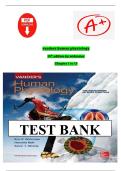
vanders human physiology
15th edition by widmaier
Chapter 1 to 19
TEST BANK
, TABLE OF CONTENT
1 Homeostasis: A Framework for Human Physiology
2 Chemical Composition of the Body
3 Cellular Structure, Proteins, and Metabolism
4 Movement of Molecules Across Cell Membranes
5 Control of Cells by Chemical Messengers
6 Neuronal Signaling and the Structure of the Nervous System
7 Sensory Physiology
8 Consciousness, the Brain, and Behavior
9 Muscle
10 Control of Body Movement
11 The Endocrine System
12 Cardiovascular Physiology
13 Respiratory Physiology
14 The Kidneys and Regulation of Water and Inorganic Ions
15 The Digestion and Absorption of Food
16 Regulation of Organic Metabolism and Energy Balance
17 Reproduction
18 The Immune System
19 Medical Physiology: Integration Using Clinical Cases
, Chapter
01 Homeostasis: A Framework for Human
Physiology
Multiple Choice Questions
1. Which of these is NOT one of the four general categories of cells that make up
the human body?
A. epithelial cells
B. collagen cells
C. connective tissue cell
D. neuron
E. muscle cell
Bloom's: Level: 1. Remember
HAPS Objective: A06.01 Describe, in order from simplest to most complex, the major levels of organization in the human
organism. HAPS Topic: Module A06 Levels of organization.
Learning Outcome: 01.02
Section: 01.02
Topic: Levels of organization
2. Physiology is the study of
A. How two organisms interact
B. How organisms function
C. The spread of diseases
D. The structure of the body
Bloom's: Level: 1. Remember
HAPS Objective: A05.01 Define the terms anatomy and
physiology. HAPS Topic: Module B01 Definition.
Learning Outcome: 01.01
Section: 01.01
Topic: Scope of anatomy and physiology
, 3. The study of disease states in the body is called
A. Pathophysiology
B. Anatomy
C. Homeostasis
D. Biology
E. Histology
Bloom's: Level: 1. Remember
HAPS Objective: A05.01 Define the terms anatomy and
physiology. HAPS Topic: Module B01 Definition.
Learning Outcome: 01.01
Section: 01.01
Topic: Scope of anatomy and physiology
4. Which is NOT a connective tissue cell?
A. bone cells
B. skeletal muscle cells
C. blood cells
D. fat cells
E. cartilage cells
Bloom's: Level: 1. Remember
HAPS Objective: A06.02 Give an example of each level of
organization. HAPS Topic: Module A06 Levels of organization.
Learning Outcome: 01.02
Section: 01.02
Topic: Levels of organization
5. What is the principal function performed by epithelial cells?
A. fat storage
B. anchoring body structures
C. forming boundaries between body compartments
D. generating movement
E. transmitting electrical signals
Bloom's: Level: 1. Remember
HAPS Objective: A06.02 Give an example of each level of
organization. HAPS Topic: Module A06 Levels of organization.
Learning Outcome: 01.02
Section: 01.02
Topic: Levels of organization
15th edition by widmaier
Chapter 1 to 19
TEST BANK
, TABLE OF CONTENT
1 Homeostasis: A Framework for Human Physiology
2 Chemical Composition of the Body
3 Cellular Structure, Proteins, and Metabolism
4 Movement of Molecules Across Cell Membranes
5 Control of Cells by Chemical Messengers
6 Neuronal Signaling and the Structure of the Nervous System
7 Sensory Physiology
8 Consciousness, the Brain, and Behavior
9 Muscle
10 Control of Body Movement
11 The Endocrine System
12 Cardiovascular Physiology
13 Respiratory Physiology
14 The Kidneys and Regulation of Water and Inorganic Ions
15 The Digestion and Absorption of Food
16 Regulation of Organic Metabolism and Energy Balance
17 Reproduction
18 The Immune System
19 Medical Physiology: Integration Using Clinical Cases
, Chapter
01 Homeostasis: A Framework for Human
Physiology
Multiple Choice Questions
1. Which of these is NOT one of the four general categories of cells that make up
the human body?
A. epithelial cells
B. collagen cells
C. connective tissue cell
D. neuron
E. muscle cell
Bloom's: Level: 1. Remember
HAPS Objective: A06.01 Describe, in order from simplest to most complex, the major levels of organization in the human
organism. HAPS Topic: Module A06 Levels of organization.
Learning Outcome: 01.02
Section: 01.02
Topic: Levels of organization
2. Physiology is the study of
A. How two organisms interact
B. How organisms function
C. The spread of diseases
D. The structure of the body
Bloom's: Level: 1. Remember
HAPS Objective: A05.01 Define the terms anatomy and
physiology. HAPS Topic: Module B01 Definition.
Learning Outcome: 01.01
Section: 01.01
Topic: Scope of anatomy and physiology
, 3. The study of disease states in the body is called
A. Pathophysiology
B. Anatomy
C. Homeostasis
D. Biology
E. Histology
Bloom's: Level: 1. Remember
HAPS Objective: A05.01 Define the terms anatomy and
physiology. HAPS Topic: Module B01 Definition.
Learning Outcome: 01.01
Section: 01.01
Topic: Scope of anatomy and physiology
4. Which is NOT a connective tissue cell?
A. bone cells
B. skeletal muscle cells
C. blood cells
D. fat cells
E. cartilage cells
Bloom's: Level: 1. Remember
HAPS Objective: A06.02 Give an example of each level of
organization. HAPS Topic: Module A06 Levels of organization.
Learning Outcome: 01.02
Section: 01.02
Topic: Levels of organization
5. What is the principal function performed by epithelial cells?
A. fat storage
B. anchoring body structures
C. forming boundaries between body compartments
D. generating movement
E. transmitting electrical signals
Bloom's: Level: 1. Remember
HAPS Objective: A06.02 Give an example of each level of
organization. HAPS Topic: Module A06 Levels of organization.
Learning Outcome: 01.02
Section: 01.02
Topic: Levels of organization