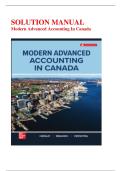
SOLUTION MANUAL
Modern Advanced Accounting In Canada
,
, Chapter 1
Conceptual & Case Analysis
Frameworks For Financial Reporting
A Brief Description Of The Major Points Covered In Each Case And
Problem.Cases
Case 1-1
In This Case, Students Are Introduced To The Difference In Accounting For R&D Costs
Between Ifrs And Aspe And Asked To Provide Arguments To Support The Different
Standards.
Case 1-2 (Adapted From A Case Prepared By Peter Secord, Saint Mary’s University)
In This Real Life Case, Students Are Asked To Discuss The Merits Of Historical Costs Vs.
Replacement Costs. Actual Note Disclosure From A Company’s Financial Statements Is
Provided As Background Material.
Case 1-3 (Adapted From A Case Prepared By Peter Secord, Saint Mary’s University)
,A Canadian Company Has Just Acquired A Non-Controlling Interest In A U.S. Public
Company. It Must Decide Whether To Use Ifrs Or U.S. Gaap For The U.S. Subsidiary.
Financial Statement Information Is Provided Under Ifrs And U.S. Gaap. The Reasons For
Some Of The Differences In Numbers Must Be Explained And An Opinion Provided As To
Which Method Best Reflects Economic Reality.
Case 1-4
This Case Is Adapted From A Cpa Canada Case. A Private Company Is Planning To Go
Public. Analysis And Recommendations Are Required For Accounting Issues Related To
Purchase And Installation Of New Information System, Revenue Recognition, Convertible
Debentures And Doubtfulaccounts Receivable.
Case 1-5
This Case Is Adapted From A Cpa Canada Case. A Private Company Is Planning To
Transition From Aspe To Ifrs. Analysis And Recommendations Are Required For
Accounting Issues Related To Convertible Debentures, Unusual Item, Revenue Recognition,
Contingency And Impairment.
,Problems
Problem 1-1 (40 Min.)
A Single Asset Is Acquired. Students Are Asked To Prepare And Compare Financial
Statement Numbers During The Life Of The Asset Using Both A Historical Cost And
A Current Value Model.
Problem 1-2 (40 Min.)
Details Of A European Company That Reports Using Ifrs Are Given Along With Specific
Details Relating To Certain Account Balances. Students Are Asked To Show How
These Balances Should Be Reported Under 1) Aspe And 2) Ifrs Using The Facts
Provided. Students Are Also Asked To Reconcile Net Income And Shareholders` Equity
From Ifrs To Aspe.
Problem 1-3 (50 Min.)
A Private Company Plans To Convert To Ifrs Go Public Within 5 Years.
It Wants To Know The Impact On Net Income And Shareholders’ Equity If It
Converts From Aspe To Ifrs For Impaired Loans, Interest Costs, Actuarial Gains, Compound
Financial Instrument And Income Taxes.
Problem 1-4 (50 Min.)
While Taking The Role Of A Financial Analyst, The Student Uses Vertical And
Horizontal Analysis And Ratios To Analyse And Interpret The Profitability, Solvency And
Liquidity Of A Private Company.
Problem 1-5 (25 Min.)
A Private Company Plans To Convert To Ifrs. It Wants To Know The Impact On Three Key
Ratios If It Converts From Aspe To Ifrs For Impaired Loans, Capitalization Of Interest And
Actuarial Gains/Losses.
,Problem 1-6 (50 Min.)
A Private Company Plans To Convert From Aspe To Ifrs And Wants To Know The
Impact On Three Key Ratios If It Converts From Aspe To Ifrs For Impairment Losses,
Convertible Bonds And Income Taxes.
Solutions To Review Questions
1. There Are Times When External Users May Want Financial Reports That Do Not
Follow Gaap. For Example, Users May Need Financial Statements Using Non-Gaap
Accounting Policies Required For Legislative Or Regulatory Purposes, Or For Contract
Compliance. A Prospective Lender May Want To Receive A Balance Sheet With Assets
Reported At Fair Value Rather Than Historical Cost. Accountants Have The Skills And
Abilities To Provide Financial Information In A Variety Of Formats Or Using A Variety Of
Accounting Policies. When The Financial Statements Use Non-Gaap Accounting
Policies, The Accounting Policies Must Be Disclosed In The Notes To The Financial
Statements. The Accountant’s Report Would Make Reference To These Accounting
Policies.
2. The Three Main Areas Where Judgment Needs To Be Applied Are As Follows:
- Choosing Accounting Policies That Are Appropriate For The Company’s Situation
- Making Estimates To Accurately Reflect The Company’s Financial Position
And Results Ofoperations
- Deciding What To Disclose And How To Disclose It In The Notes To The Financial Statements.
3. The Gaap-Based Financial Statements Are Prepared Primarily For The Benefit Of
External Users. The Financial Statements Provide A Summary Of The Financial Position
And Results Of Operations For The Company. Management Has Access To The Detailed
Information Available Within The Company. Therefore, The Formal Financial Statements
Should Give Priority To The Needs Of The External Users.
4. The Main Reason The Accounting Standards Board Decided To Create A Separate
Section Of The Cpa Canada Handbook For Private Enterprises Was To Address The
Cost/Benefit Discrepancy With Respect To Smaller Private Companies’ Ability To Comply
With Gaap. Gaap Has Become Increasingly Complex And For Smaller Private
, Enterprises This Often Means That The Cost Of Complying With Such Requirements
Outweighs The Benefit Received From Compliance. In 2002, The Acsb Adopted
Differential Reporting, Which Allowed Private Enterprises Choices With The Respect To
Certain Complex Accounting Standards (E.G. The Option To Use The Cost Method
For
Investments That Would Otherwise Require The Equity Method). In 2009, The Acsb
Decided To Create A Self-Contained Set Of Standards For Private Enterprises. These
Standards Were Effective For Fiscal Periods Beginning On Or After January 1, 2011.
5. There Are A Few Reasons Why A Private Company Would Want To Comp
With Ifrs Even
Though It Is Not Required To Do So. It May Have Plans To Become Publicly Listed At
Some Point
In The Future And Will Then Be Required To Comply With Ifrs. In This Case It
Would Make Sense To Prepare Ifrs Compliant Statements In Anticipation Of The Public
Transaction Since The Company Would Have To Provide Multiple Years Of Comparative
Financial Statements That Comply With Ifrs. A Private Company May Have Users
Of Their Financial Statements That Find Ifrs Statements More Useful For Their
Purposes (E.G. Creditors, Customers, Partners, And Other Stakeholders That May Receive
The Company’s Financial Statements). Given The Global Economy And The Increased
Number Of Countries That Have Converted To Ifrs, This Is More Likely Than It Once
Might Have Been.
6. The Following Financial Statement Items Could Have Different Account Balances Under
Aspe As Compared To Ifrs: Impaired Loans, Property, Plant, & Equipment,
Development Costs, Post-Employment Benefits, Income Taxes, Compound Financial
Instruments, Preferred Shares And Convertible Bonds
7. For The Item Listed In Exhibit 1.1, All Items Except For Disclosure Would Likely Change
When A Company Switched From Aspe To Ifrs.
8. The Return On Assets Or Return On Equity Is Typically Used To Assess Profitability. The
Current Ratio Is Typically Used To Assess Liquidity. The Debt-To-Equity Ratio Is
Typically Used To Assess Solvency.
9. If Xzy Co. Had Capitalized Rather Than Expenses The Development Costs In Year
1, The Company’s Key Ratios Would Change As Follows:
, - The Current Ratio Would Increase If The Development Costs Were Classified As A
Current Asset Because Current Assets Would Increase And Current Liabilities Would
Remain The Same; The Current Ratio Would Not Change If The Development Costs
Were Classified As A Non-Current Asset Because Both Current Assets And Current
Liabilities Would Remain The Same;
- The Debt-To-Equity Ratio Would Decrease Because Debt Would Remain The
Same And Equity Would Increase
- The Return On Equity Change Would Increase Because Net Income And Equity
Would Increase By The Same Dollar Amount But Net Income Would Be A Higher
Percentage Of Equity After The Change
10. The Six Steps Of The Case Framework Are As Follows:
- Determine Your Role And Requirements
- Identify Users & Their Needs
- Identify & Rank Issues
- Identify Viable Alternatives For Each Major Issue
- Analyze Alternatives Using Criteria For Resolving
- Communicate Practical Recommendations/Conclusions
11. The Report Recipient Is The Direct Recipient Of Your Report Or Memo E.G. The
Partner Who Asked You To Prepare The Memo. The Primary Users Are The Users
Who Will Be Affected By The Actions Taken As A Result Of Your Recommendations
E.G. Bankers And Shareholders Who Will Receive The Financial Statements. The
Primary Users Should Be Given Priority In Financial Reporting Because They Are Primary
Recipients Of The Financial Statements; They Are Directly Affected By The Financial
Statements. If They Did Not Want To Receive The Financial Statements, We Would Not
Be Preparing Them And Would Not Have To Write A Memo To The Partner With
Respect To The Financial Statements.
12. The Biggest Factor To Be Used When Ranking The Importance Of Issues To Be
Resolved Is The Materiality Of The Item. If One Problem Involves A $10,000 Item And
Another Problem Involves A $10 Million Item, Then The $10 Million Item Likely Is The
Most Important Item. After That, Issues Are Typically Ranked In The Following
Order Of Priority:
Modern Advanced Accounting In Canada
,
, Chapter 1
Conceptual & Case Analysis
Frameworks For Financial Reporting
A Brief Description Of The Major Points Covered In Each Case And
Problem.Cases
Case 1-1
In This Case, Students Are Introduced To The Difference In Accounting For R&D Costs
Between Ifrs And Aspe And Asked To Provide Arguments To Support The Different
Standards.
Case 1-2 (Adapted From A Case Prepared By Peter Secord, Saint Mary’s University)
In This Real Life Case, Students Are Asked To Discuss The Merits Of Historical Costs Vs.
Replacement Costs. Actual Note Disclosure From A Company’s Financial Statements Is
Provided As Background Material.
Case 1-3 (Adapted From A Case Prepared By Peter Secord, Saint Mary’s University)
,A Canadian Company Has Just Acquired A Non-Controlling Interest In A U.S. Public
Company. It Must Decide Whether To Use Ifrs Or U.S. Gaap For The U.S. Subsidiary.
Financial Statement Information Is Provided Under Ifrs And U.S. Gaap. The Reasons For
Some Of The Differences In Numbers Must Be Explained And An Opinion Provided As To
Which Method Best Reflects Economic Reality.
Case 1-4
This Case Is Adapted From A Cpa Canada Case. A Private Company Is Planning To Go
Public. Analysis And Recommendations Are Required For Accounting Issues Related To
Purchase And Installation Of New Information System, Revenue Recognition, Convertible
Debentures And Doubtfulaccounts Receivable.
Case 1-5
This Case Is Adapted From A Cpa Canada Case. A Private Company Is Planning To
Transition From Aspe To Ifrs. Analysis And Recommendations Are Required For
Accounting Issues Related To Convertible Debentures, Unusual Item, Revenue Recognition,
Contingency And Impairment.
,Problems
Problem 1-1 (40 Min.)
A Single Asset Is Acquired. Students Are Asked To Prepare And Compare Financial
Statement Numbers During The Life Of The Asset Using Both A Historical Cost And
A Current Value Model.
Problem 1-2 (40 Min.)
Details Of A European Company That Reports Using Ifrs Are Given Along With Specific
Details Relating To Certain Account Balances. Students Are Asked To Show How
These Balances Should Be Reported Under 1) Aspe And 2) Ifrs Using The Facts
Provided. Students Are Also Asked To Reconcile Net Income And Shareholders` Equity
From Ifrs To Aspe.
Problem 1-3 (50 Min.)
A Private Company Plans To Convert To Ifrs Go Public Within 5 Years.
It Wants To Know The Impact On Net Income And Shareholders’ Equity If It
Converts From Aspe To Ifrs For Impaired Loans, Interest Costs, Actuarial Gains, Compound
Financial Instrument And Income Taxes.
Problem 1-4 (50 Min.)
While Taking The Role Of A Financial Analyst, The Student Uses Vertical And
Horizontal Analysis And Ratios To Analyse And Interpret The Profitability, Solvency And
Liquidity Of A Private Company.
Problem 1-5 (25 Min.)
A Private Company Plans To Convert To Ifrs. It Wants To Know The Impact On Three Key
Ratios If It Converts From Aspe To Ifrs For Impaired Loans, Capitalization Of Interest And
Actuarial Gains/Losses.
,Problem 1-6 (50 Min.)
A Private Company Plans To Convert From Aspe To Ifrs And Wants To Know The
Impact On Three Key Ratios If It Converts From Aspe To Ifrs For Impairment Losses,
Convertible Bonds And Income Taxes.
Solutions To Review Questions
1. There Are Times When External Users May Want Financial Reports That Do Not
Follow Gaap. For Example, Users May Need Financial Statements Using Non-Gaap
Accounting Policies Required For Legislative Or Regulatory Purposes, Or For Contract
Compliance. A Prospective Lender May Want To Receive A Balance Sheet With Assets
Reported At Fair Value Rather Than Historical Cost. Accountants Have The Skills And
Abilities To Provide Financial Information In A Variety Of Formats Or Using A Variety Of
Accounting Policies. When The Financial Statements Use Non-Gaap Accounting
Policies, The Accounting Policies Must Be Disclosed In The Notes To The Financial
Statements. The Accountant’s Report Would Make Reference To These Accounting
Policies.
2. The Three Main Areas Where Judgment Needs To Be Applied Are As Follows:
- Choosing Accounting Policies That Are Appropriate For The Company’s Situation
- Making Estimates To Accurately Reflect The Company’s Financial Position
And Results Ofoperations
- Deciding What To Disclose And How To Disclose It In The Notes To The Financial Statements.
3. The Gaap-Based Financial Statements Are Prepared Primarily For The Benefit Of
External Users. The Financial Statements Provide A Summary Of The Financial Position
And Results Of Operations For The Company. Management Has Access To The Detailed
Information Available Within The Company. Therefore, The Formal Financial Statements
Should Give Priority To The Needs Of The External Users.
4. The Main Reason The Accounting Standards Board Decided To Create A Separate
Section Of The Cpa Canada Handbook For Private Enterprises Was To Address The
Cost/Benefit Discrepancy With Respect To Smaller Private Companies’ Ability To Comply
With Gaap. Gaap Has Become Increasingly Complex And For Smaller Private
, Enterprises This Often Means That The Cost Of Complying With Such Requirements
Outweighs The Benefit Received From Compliance. In 2002, The Acsb Adopted
Differential Reporting, Which Allowed Private Enterprises Choices With The Respect To
Certain Complex Accounting Standards (E.G. The Option To Use The Cost Method
For
Investments That Would Otherwise Require The Equity Method). In 2009, The Acsb
Decided To Create A Self-Contained Set Of Standards For Private Enterprises. These
Standards Were Effective For Fiscal Periods Beginning On Or After January 1, 2011.
5. There Are A Few Reasons Why A Private Company Would Want To Comp
With Ifrs Even
Though It Is Not Required To Do So. It May Have Plans To Become Publicly Listed At
Some Point
In The Future And Will Then Be Required To Comply With Ifrs. In This Case It
Would Make Sense To Prepare Ifrs Compliant Statements In Anticipation Of The Public
Transaction Since The Company Would Have To Provide Multiple Years Of Comparative
Financial Statements That Comply With Ifrs. A Private Company May Have Users
Of Their Financial Statements That Find Ifrs Statements More Useful For Their
Purposes (E.G. Creditors, Customers, Partners, And Other Stakeholders That May Receive
The Company’s Financial Statements). Given The Global Economy And The Increased
Number Of Countries That Have Converted To Ifrs, This Is More Likely Than It Once
Might Have Been.
6. The Following Financial Statement Items Could Have Different Account Balances Under
Aspe As Compared To Ifrs: Impaired Loans, Property, Plant, & Equipment,
Development Costs, Post-Employment Benefits, Income Taxes, Compound Financial
Instruments, Preferred Shares And Convertible Bonds
7. For The Item Listed In Exhibit 1.1, All Items Except For Disclosure Would Likely Change
When A Company Switched From Aspe To Ifrs.
8. The Return On Assets Or Return On Equity Is Typically Used To Assess Profitability. The
Current Ratio Is Typically Used To Assess Liquidity. The Debt-To-Equity Ratio Is
Typically Used To Assess Solvency.
9. If Xzy Co. Had Capitalized Rather Than Expenses The Development Costs In Year
1, The Company’s Key Ratios Would Change As Follows:
, - The Current Ratio Would Increase If The Development Costs Were Classified As A
Current Asset Because Current Assets Would Increase And Current Liabilities Would
Remain The Same; The Current Ratio Would Not Change If The Development Costs
Were Classified As A Non-Current Asset Because Both Current Assets And Current
Liabilities Would Remain The Same;
- The Debt-To-Equity Ratio Would Decrease Because Debt Would Remain The
Same And Equity Would Increase
- The Return On Equity Change Would Increase Because Net Income And Equity
Would Increase By The Same Dollar Amount But Net Income Would Be A Higher
Percentage Of Equity After The Change
10. The Six Steps Of The Case Framework Are As Follows:
- Determine Your Role And Requirements
- Identify Users & Their Needs
- Identify & Rank Issues
- Identify Viable Alternatives For Each Major Issue
- Analyze Alternatives Using Criteria For Resolving
- Communicate Practical Recommendations/Conclusions
11. The Report Recipient Is The Direct Recipient Of Your Report Or Memo E.G. The
Partner Who Asked You To Prepare The Memo. The Primary Users Are The Users
Who Will Be Affected By The Actions Taken As A Result Of Your Recommendations
E.G. Bankers And Shareholders Who Will Receive The Financial Statements. The
Primary Users Should Be Given Priority In Financial Reporting Because They Are Primary
Recipients Of The Financial Statements; They Are Directly Affected By The Financial
Statements. If They Did Not Want To Receive The Financial Statements, We Would Not
Be Preparing Them And Would Not Have To Write A Memo To The Partner With
Respect To The Financial Statements.
12. The Biggest Factor To Be Used When Ranking The Importance Of Issues To Be
Resolved Is The Materiality Of The Item. If One Problem Involves A $10,000 Item And
Another Problem Involves A $10 Million Item, Then The $10 Million Item Likely Is The
Most Important Item. After That, Issues Are Typically Ranked In The Following
Order Of Priority: