UROGENITAL SYSTEM
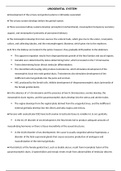
● Development of the urinary and genital systems is intimately associated.
● The urinary system develops before the genital system.
● Three successive kidney systems develop: pronephroi (nonfunctional), mesonephroi (temporary excretory
organs), and metanephroi (primordia of permanent kidneys).
● The metanephroi develop from two sources: the ureteric buds, which give rise to the ureter, renal pelvis,
calices, and collecting tubules, and the metanephrogenic blastema, which gives rise to the nephrons.
● At first, the kidneys are located in the pelvis; however, they gradually shift position to the abdomen.
This apparent migration results from disproportionate growth of the fetal lumbar and sacral regions.
Gonadal sex is determined by testes-determining factor, which is located on the Y chromosome.
Testes determining factor directs testicular differentiation.
The interstitial cells (Leydig cells) produce testosterone, which stimulates development of the
mesonephric ducts into male genital ducts. Testosterone also stimulates development of the
indifferent external genitalia into the penis and scrotum.
MIS, produced by the Sertoli cells, inhibits development of theparamesonephric ducts (primordia of
the female genital ducts).
● In the absence of a Y chromosome and the presence of two X chromosomes, ovaries develop, the
mesonephric ducts regress, and the paramesonephric ducts develop into the uterus and uterine tubes.
The vagina develops from the vaginal plate derived from the urogenital sinus, and the indifferent
external genitalia develop into the clitoris and labia majora and minora.
● Persons with ovotesticular DSD have both ovarian & testicular tissue & variable int. & ext. genitalia.
In the 46, XY disorder of sex development, the fetal testes fail to produce adequate amounts of
masculinizing hormones or there is tissue insensitivity of the sexual structures.
In the 46,XX disorder of sex development, the cause is usually congenital adrenal hyperplasia, a
disorder of the fetal suprarenal glands that causes excessive production of androgens and
masculinization of the external genitalia.
● Most defects of the female genital tract, such as double uterus, result from incomplete fusion of the
paramesonephric ducts. Cryptorchidism and ectopic testes result from abnormalities of testicular descent.
● Development of the urinary and genital systems is intimately associated.
● The urinary system develops before the genital system.
● Three successive kidney systems develop: pronephroi (nonfunctional), mesonephroi (temporary excretory
organs), and metanephroi (primordia of permanent kidneys).
● The metanephroi develop from two sources: the ureteric buds, which give rise to the ureter, renal pelvis,
calices, and collecting tubules, and the metanephrogenic blastema, which gives rise to the nephrons.
● At first, the kidneys are located in the pelvis; however, they gradually shift position to the abdomen.
This apparent migration results from disproportionate growth of the fetal lumbar and sacral regions.
Gonadal sex is determined by testes-determining factor, which is located on the Y chromosome.
Testes determining factor directs testicular differentiation.
The interstitial cells (Leydig cells) produce testosterone, which stimulates development of the
mesonephric ducts into male genital ducts. Testosterone also stimulates development of the
indifferent external genitalia into the penis and scrotum.
MIS, produced by the Sertoli cells, inhibits development of theparamesonephric ducts (primordia of
the female genital ducts).
● In the absence of a Y chromosome and the presence of two X chromosomes, ovaries develop, the
mesonephric ducts regress, and the paramesonephric ducts develop into the uterus and uterine tubes.
The vagina develops from the vaginal plate derived from the urogenital sinus, and the indifferent
external genitalia develop into the clitoris and labia majora and minora.
● Persons with ovotesticular DSD have both ovarian & testicular tissue & variable int. & ext. genitalia.
In the 46, XY disorder of sex development, the fetal testes fail to produce adequate amounts of
masculinizing hormones or there is tissue insensitivity of the sexual structures.
In the 46,XX disorder of sex development, the cause is usually congenital adrenal hyperplasia, a
disorder of the fetal suprarenal glands that causes excessive production of androgens and
masculinization of the external genitalia.
● Most defects of the female genital tract, such as double uterus, result from incomplete fusion of the
paramesonephric ducts. Cryptorchidism and ectopic testes result from abnormalities of testicular descent.