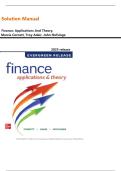
Solution Manual
Finance: Applications And Theory,
Marcia Cornett, Troy Adair, John Nofsinge
2025 release
© McGraw Hill LLC. All rights reserved. No reproduction or distribution without the prior written consent of McGraw Hill LLC.
,Table of contents
Part one: introduction
1 introduction to financial management
Part two: financial statements
2 reviewing financial statements
appendix 2a: various formats for financial statements (available in connect)
3 analyzing financial statements
Part three: valuing of future cash flows 118
4 time value of money 1: analyzing single cash flows
5 time value of money 2: analyzing annuity cash flows
Part four: valuing of bonds and stocks 188
6 understanding financial markets and institutions
appendix 6a: the financial crisis: the failure of financial institution specialness (available in connect)
7 valuing bonds
8 valuing stocks
Part five: risk and return
9 characterizing risk and return
10 estimating risk and return
Part six: capital budgeting
11 calculating the cost of capital
12 estimating cash flows on capital budgeting projects
appendix 12a: macrs depreciation tables
13 weighing net present value and other capital budgeting criteria
Part seven: working capital management and financial planning
14 working capital management and policies
appendix 14a: the cash budget
15 financial planning and forecasting
Part eight: capital structure issues
16 assessing long-term debt, equity, and capital structure
17 sharing firm wealth: dividends, share repurchases, and other payouts
18 issuing capital and the investment banking process
Part nine: other topics in finance
19 international corporate finance
20 mergers and acquisitions and financial distress
© McGraw Hill LLC. All rights reserved. No reproduction or distribution without the prior written consent of McGraw Hill LLC.
, Solution manual for
finance applications and theory 6e cornett
Chapter 2-20
Chapter 2 – reviewing financial statements
Questions
Lg2-1 1. List and describe the four major financial statements.
The four basic financial statements are:
1. The balance sheet reports a firm’s assets, liabilities, and equity at a particular point in time.
2. The income statement shows the total revenues that a firm earns and the total expenses the
firm incurs to generate those revenues over a specific period of time—generally one year.
3. The statement of cash flows shows the firm’s cash flows over a given period of time. This
statement reports the amounts of cash the firm generated and distributed during a particular
time period. The bottom line on the statement of cash flows―the difference between cash
sources and uses―equals the change in cash and marketable securities on the firm’s balance
sheet from the previous year’s balance.
4. The statement of retained earnings provides additional details about changes in retained
earnings during a reporting period. This financial statement reconciles net income earned
during a given period minus any cash dividends paid within that period to the change in
retained earnings between the beginning and ending of the period.
Lg2-1 2. On which of the four major financial statements (balance sheet, income statement, statement of
cash flows, or statement of retained earnings) would you find the following items?
a. Earnings before taxes - income statement
b. Net plant and equipment - balance sheet
c. Increase in fixed assets - statement of cash flows
d. Gross profits - income statement
e. Balance of retained earnings, december 31, 20xx - statement of retained earnings and balance
sheet
f. Common stock and paid-in surplus - balance sheet
g. Net cash flow from investing activities - statement of cash flows
h. Accrued wages and taxes – balance sheet
i. Increase in inventory - statement of cash flows
Lg2-1 3. What is the difference between current liabilities and long-term debt?
© McGraw Hill LLC. All rights reserved. No reproduction or distribution without the prior written consent of McGraw Hill LLC.
, Current liabilities constitute the firm’s obligations due within one year, including accrued wages and
taxes, accounts payable, and notes payable. Long-term debt includes long-term loans and bonds with
maturities of more than one year.
Lg2-1 4. How does the choice of accounting method used to record fixed asset depreciation affect
management of the balance sheet?
Firm managers can choose the accounting method they use to record depreciation against their
fixed assets. Two choices include the straight-line method and the modified accelerated cost
recovery system (macrs). Companies often calculate depreciation using macrs when they figure
the firm’s taxes and the straight-line method when reporting income to the firm’s stockholders.
The macrs method accelerates deprecation, which results in higher depreciation expenses, lower
taxable income, and lower taxes in the early years of a project’s life. The straight-line method
results in lower depreciation expenses, but also results in higher taxes in the early years of a
project’s life. Firms seeking to lower their cash outflows from tax payments will favor the macrs
depreciation method.
Lg2-1 5. What is bonus depreciation? How did the tax cuts and jobs act of 2017 temporarily extend
and modify bonus depreciation?
Since 2001, businesses have had the ability to immediately deduct a percentage of the acquisition
cost of qualifying assets as "bonus depreciation." this additional depreciation deduction was
allowed to encourage business investment. However, bonus depreciation was a temporary
provision; the rate would have been 50 percent in 2017, 40 percent in 2018, and 30 percent in
2019, before phasing out in 2020. The tax cuts and jobs act of 2017 extended and modified bonus
depreciation, allowing businesses to immediately deduct 100 percent of the cost of eligible
property in the year it is placed in service, through 2022. The amount of allowable bonus
depreciation will then be phased down over four years: 80 percent will be allowed for property
placed in service in 2023, 60 percent in 2024, 40 percent in 2025, and 20 percent in 2026.
Macrs or straight-line depreciation is applied to any costs that do not qualify for bonus depreciation.
Lg2-1 6. What are the costs and benefits of holding liquid securities on a firm’s balance sheet?
The more liquid assets a firm holds, the less likely the firm will be to experience financial
distress. However, liquid assets generate little or no profits for a firm. For example, cash is the
most liquid of all assets, but it earns little, if any, return for the firm. In contrast, fixed assets are
illiquid, but provide the means to generate revenue. Thus, managers must consider the trade-off
between the advantages of liquidity on the balance sheet and the disadvantages of having money
sit idle rather than generating profits.
Lg2-2 7. Why can the book value and market value of a firm differ?
© McGraw Hill LLC. All rights reserved. No reproduction or distribution without the prior written consent of McGraw Hill LLC.
Finance: Applications And Theory,
Marcia Cornett, Troy Adair, John Nofsinge
2025 release
© McGraw Hill LLC. All rights reserved. No reproduction or distribution without the prior written consent of McGraw Hill LLC.
,Table of contents
Part one: introduction
1 introduction to financial management
Part two: financial statements
2 reviewing financial statements
appendix 2a: various formats for financial statements (available in connect)
3 analyzing financial statements
Part three: valuing of future cash flows 118
4 time value of money 1: analyzing single cash flows
5 time value of money 2: analyzing annuity cash flows
Part four: valuing of bonds and stocks 188
6 understanding financial markets and institutions
appendix 6a: the financial crisis: the failure of financial institution specialness (available in connect)
7 valuing bonds
8 valuing stocks
Part five: risk and return
9 characterizing risk and return
10 estimating risk and return
Part six: capital budgeting
11 calculating the cost of capital
12 estimating cash flows on capital budgeting projects
appendix 12a: macrs depreciation tables
13 weighing net present value and other capital budgeting criteria
Part seven: working capital management and financial planning
14 working capital management and policies
appendix 14a: the cash budget
15 financial planning and forecasting
Part eight: capital structure issues
16 assessing long-term debt, equity, and capital structure
17 sharing firm wealth: dividends, share repurchases, and other payouts
18 issuing capital and the investment banking process
Part nine: other topics in finance
19 international corporate finance
20 mergers and acquisitions and financial distress
© McGraw Hill LLC. All rights reserved. No reproduction or distribution without the prior written consent of McGraw Hill LLC.
, Solution manual for
finance applications and theory 6e cornett
Chapter 2-20
Chapter 2 – reviewing financial statements
Questions
Lg2-1 1. List and describe the four major financial statements.
The four basic financial statements are:
1. The balance sheet reports a firm’s assets, liabilities, and equity at a particular point in time.
2. The income statement shows the total revenues that a firm earns and the total expenses the
firm incurs to generate those revenues over a specific period of time—generally one year.
3. The statement of cash flows shows the firm’s cash flows over a given period of time. This
statement reports the amounts of cash the firm generated and distributed during a particular
time period. The bottom line on the statement of cash flows―the difference between cash
sources and uses―equals the change in cash and marketable securities on the firm’s balance
sheet from the previous year’s balance.
4. The statement of retained earnings provides additional details about changes in retained
earnings during a reporting period. This financial statement reconciles net income earned
during a given period minus any cash dividends paid within that period to the change in
retained earnings between the beginning and ending of the period.
Lg2-1 2. On which of the four major financial statements (balance sheet, income statement, statement of
cash flows, or statement of retained earnings) would you find the following items?
a. Earnings before taxes - income statement
b. Net plant and equipment - balance sheet
c. Increase in fixed assets - statement of cash flows
d. Gross profits - income statement
e. Balance of retained earnings, december 31, 20xx - statement of retained earnings and balance
sheet
f. Common stock and paid-in surplus - balance sheet
g. Net cash flow from investing activities - statement of cash flows
h. Accrued wages and taxes – balance sheet
i. Increase in inventory - statement of cash flows
Lg2-1 3. What is the difference between current liabilities and long-term debt?
© McGraw Hill LLC. All rights reserved. No reproduction or distribution without the prior written consent of McGraw Hill LLC.
, Current liabilities constitute the firm’s obligations due within one year, including accrued wages and
taxes, accounts payable, and notes payable. Long-term debt includes long-term loans and bonds with
maturities of more than one year.
Lg2-1 4. How does the choice of accounting method used to record fixed asset depreciation affect
management of the balance sheet?
Firm managers can choose the accounting method they use to record depreciation against their
fixed assets. Two choices include the straight-line method and the modified accelerated cost
recovery system (macrs). Companies often calculate depreciation using macrs when they figure
the firm’s taxes and the straight-line method when reporting income to the firm’s stockholders.
The macrs method accelerates deprecation, which results in higher depreciation expenses, lower
taxable income, and lower taxes in the early years of a project’s life. The straight-line method
results in lower depreciation expenses, but also results in higher taxes in the early years of a
project’s life. Firms seeking to lower their cash outflows from tax payments will favor the macrs
depreciation method.
Lg2-1 5. What is bonus depreciation? How did the tax cuts and jobs act of 2017 temporarily extend
and modify bonus depreciation?
Since 2001, businesses have had the ability to immediately deduct a percentage of the acquisition
cost of qualifying assets as "bonus depreciation." this additional depreciation deduction was
allowed to encourage business investment. However, bonus depreciation was a temporary
provision; the rate would have been 50 percent in 2017, 40 percent in 2018, and 30 percent in
2019, before phasing out in 2020. The tax cuts and jobs act of 2017 extended and modified bonus
depreciation, allowing businesses to immediately deduct 100 percent of the cost of eligible
property in the year it is placed in service, through 2022. The amount of allowable bonus
depreciation will then be phased down over four years: 80 percent will be allowed for property
placed in service in 2023, 60 percent in 2024, 40 percent in 2025, and 20 percent in 2026.
Macrs or straight-line depreciation is applied to any costs that do not qualify for bonus depreciation.
Lg2-1 6. What are the costs and benefits of holding liquid securities on a firm’s balance sheet?
The more liquid assets a firm holds, the less likely the firm will be to experience financial
distress. However, liquid assets generate little or no profits for a firm. For example, cash is the
most liquid of all assets, but it earns little, if any, return for the firm. In contrast, fixed assets are
illiquid, but provide the means to generate revenue. Thus, managers must consider the trade-off
between the advantages of liquidity on the balance sheet and the disadvantages of having money
sit idle rather than generating profits.
Lg2-2 7. Why can the book value and market value of a firm differ?
© McGraw Hill LLC. All rights reserved. No reproduction or distribution without the prior written consent of McGraw Hill LLC.