ENERGY
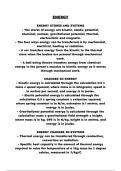
ENERGY STORES AND SYSTEMS
- The stores of energy are kinetic, elastic potential,
chemical, nuclear, gravitational potential, thermal,
electrostatic and magnetic.
- The four ways energy can be transferred is by mechanical,
electrical, heating or radiation.
- A car transfers energy from the kinetic to the thermal
store when the brakes are pressed through mechanical
work.
- A ball being thrown transfers energy from chemical
energy in the person's muscles to kinetic energy as it moves
through mechanical work.
CHANGES IN ENERGY
- Kinetic energy is calculated through the calculation 0.5 x
mass x speed squared, where mass is in kilograms, speed is
in metres per second, and energy is in joules.
- Elastic potential energy is calculated through the
calculation 0.5 x spring constant x extension squared,
where spring constant is in N/m, extension is i metres, and
energy is in joules.
- Gravitational potential energy is calculated through the
calculation mass x gravitational field strength x height,
where mass is in kg, GFS is in N/kg, height is in metres, and
energy is in joules.
ENERGY CHANGES IN SYSTEMS
- Thermal energy can be transferred through conduction,
convection or radiation.
- Specific heat capacity is the amount of thermal energy
required to raise the temperature of a 1kg mass by 1 degree
celsius, measured in J/kg/C.
, - Change in thermal energy = mass (kg) x specific heat
capacity x change in temperature.
POWER
- Power is the rate at which energy is transferred, or the
rate at which work is done, and its units are watts.
- Power = energy transferred or work done divided by time,
where time is in seconds and energy/work is in joules.
- If one motor can do the same work faster than another,
that motor is more powerful.
ENERGY TRANSFERS IN A SYSTEM
- Energy can be transferred, stored or dissipated, but
cannot be created or destroyed.
- When energy is described in less useful ways, it is
described as waste energy.
- The rate of cooling of a building can be reduced by
increasing the thickness and reducing thermal conductivity
of the walls. For example, cavity walls with an air space
between them, draught excluders which prevent warm air
escaping, double glazing, boiler jackets and loft insulation.
EFFICIENCY
- A system is efficient if most of the energy transferred is
useful.
- Efficiency is calculated by dividing the useful power or
energy output by the total power or energy input.
- The efficiency of an energy transfer can be increased by
lubricating parts which reduces friction and loss of thermal
energy, streamlining moving objects which reduces air
resistance and also reduces friction, or by recycling waste
energy into useful stores.
NATIONAL AND GLOBAL ENERGY RESOURCES
, - The main energy resources on Earth include
non-renewables such as coal, oil, gas and nuclear, and
renewables such as wind, tidal, solar, water waves,
geothermal, hydroelectric and biofuels.
- Energy resources are used for transport via mostly fossil
fuels, heating via mostly fossil fuels, solar power and
geothermal power, and electricity generation via mostly
fossil fuels, nuclear power, as well as wind and hydroelectric
power.
- Burning fossil fuels can damage the environment via
global warming, where solar radiation gets trapped in the
atmosphere by greenhouse gases, increasing temperature.
This has led to climate change, rising sea levels, extinction
and migration of species and spread of disease.
TRENDS IN ENERGY USAGE
- Fossil fuels account for the majority of energy usage in
the UK. However, this is decreasing due to negative impacts
on the environment, and more renewable resources are
being used.
- Renewable energy, however, may not be as reliable, such
as wind and solar energy if we do not get the right weather.
- Non renewable energy is projected to run out in the very
near future, so is not as easy to extract as it was during the
Industrial Period.
- Science cannot always deal with these environmental
issues from using energy resources due to economic factors,
political factors and social factors.
ELECTRICITY
STANDARD CIRCUIT DIAGRAM SYMBOLS
- Examples of symbols include that of an open switch,
closed switch, cell, battery, diode, resistor, variable resistor
ENERGY STORES AND SYSTEMS
- The stores of energy are kinetic, elastic potential,
chemical, nuclear, gravitational potential, thermal,
electrostatic and magnetic.
- The four ways energy can be transferred is by mechanical,
electrical, heating or radiation.
- A car transfers energy from the kinetic to the thermal
store when the brakes are pressed through mechanical
work.
- A ball being thrown transfers energy from chemical
energy in the person's muscles to kinetic energy as it moves
through mechanical work.
CHANGES IN ENERGY
- Kinetic energy is calculated through the calculation 0.5 x
mass x speed squared, where mass is in kilograms, speed is
in metres per second, and energy is in joules.
- Elastic potential energy is calculated through the
calculation 0.5 x spring constant x extension squared,
where spring constant is in N/m, extension is i metres, and
energy is in joules.
- Gravitational potential energy is calculated through the
calculation mass x gravitational field strength x height,
where mass is in kg, GFS is in N/kg, height is in metres, and
energy is in joules.
ENERGY CHANGES IN SYSTEMS
- Thermal energy can be transferred through conduction,
convection or radiation.
- Specific heat capacity is the amount of thermal energy
required to raise the temperature of a 1kg mass by 1 degree
celsius, measured in J/kg/C.
, - Change in thermal energy = mass (kg) x specific heat
capacity x change in temperature.
POWER
- Power is the rate at which energy is transferred, or the
rate at which work is done, and its units are watts.
- Power = energy transferred or work done divided by time,
where time is in seconds and energy/work is in joules.
- If one motor can do the same work faster than another,
that motor is more powerful.
ENERGY TRANSFERS IN A SYSTEM
- Energy can be transferred, stored or dissipated, but
cannot be created or destroyed.
- When energy is described in less useful ways, it is
described as waste energy.
- The rate of cooling of a building can be reduced by
increasing the thickness and reducing thermal conductivity
of the walls. For example, cavity walls with an air space
between them, draught excluders which prevent warm air
escaping, double glazing, boiler jackets and loft insulation.
EFFICIENCY
- A system is efficient if most of the energy transferred is
useful.
- Efficiency is calculated by dividing the useful power or
energy output by the total power or energy input.
- The efficiency of an energy transfer can be increased by
lubricating parts which reduces friction and loss of thermal
energy, streamlining moving objects which reduces air
resistance and also reduces friction, or by recycling waste
energy into useful stores.
NATIONAL AND GLOBAL ENERGY RESOURCES
, - The main energy resources on Earth include
non-renewables such as coal, oil, gas and nuclear, and
renewables such as wind, tidal, solar, water waves,
geothermal, hydroelectric and biofuels.
- Energy resources are used for transport via mostly fossil
fuels, heating via mostly fossil fuels, solar power and
geothermal power, and electricity generation via mostly
fossil fuels, nuclear power, as well as wind and hydroelectric
power.
- Burning fossil fuels can damage the environment via
global warming, where solar radiation gets trapped in the
atmosphere by greenhouse gases, increasing temperature.
This has led to climate change, rising sea levels, extinction
and migration of species and spread of disease.
TRENDS IN ENERGY USAGE
- Fossil fuels account for the majority of energy usage in
the UK. However, this is decreasing due to negative impacts
on the environment, and more renewable resources are
being used.
- Renewable energy, however, may not be as reliable, such
as wind and solar energy if we do not get the right weather.
- Non renewable energy is projected to run out in the very
near future, so is not as easy to extract as it was during the
Industrial Period.
- Science cannot always deal with these environmental
issues from using energy resources due to economic factors,
political factors and social factors.
ELECTRICITY
STANDARD CIRCUIT DIAGRAM SYMBOLS
- Examples of symbols include that of an open switch,
closed switch, cell, battery, diode, resistor, variable resistor