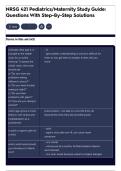
NRSG 421 Pediatrics/Maternity Study Guide:
Questions With Step-By-Step Solutions
Save
Terms in this set (43)
a female child, age 6, is -D
brought to the health - get a better understanding is school is difficult for
clinic for a routine them or not, get them to explain further, tell you
checkup. To assess the more
child's vision, the nurse
should ask:
a) "Do you have any
problems seeing
different colours?"
b) "Do you have trouble
seeing at night?"
c) "Do you have
problems with glare?"
d) "How are you doing in
school?"
which age-group is most preschoolers = not able to concrete think yet
likely to view illness and beyond this, think they did something bad
hospitalization as a
punishment
- advil
is advil or aspirin safer for
- aspirin only safe over 18, can cause reyes
a child
syndrome
- rice cereal
which solid foods should
- introduced at 6 months, fortified (added vitamins
you introduce to infants
and minerals)
first?
- rice over wheat because wheat is a higher allergen
, - cow's milk = until 1 year
which foods should be - eggs = 9-12 months
avoided for longer in - high allergy foods = 9 months = nuts, eggs, wheat,
infants? cow's milk, shellfish, soy
- honey = 2 years
why do children have a children have a harder time communicating their
higher chance on pain, harder to assess pain, appendix gets bigger
rupturing their appendix? and ruptures
when should an infant be - 6 months
able to sit up
unsupported?
- d5NS
- go to isotonic solution in peds, little bit of
what is the most common
dextrose
IV fluid ordered for a
- sick kids have increased metabolism - uses sugar
child with appendicitis?
up faster
- don't eat or drink as much
· Sitting upright
· Increased respiratory rate
· Irritability
early signs of respiratory
· Increased heart rate
distress
· Retractions
· Use of accessory muscles
· Auscultation - decreased air entry, wheezes
· Change in blood pressure
· RR & HR way higher
late signs of respiratory
· Diaphoretic
distress
· Colour is changing, cyanosis
· Drooling - epiglottitis
Questions With Step-By-Step Solutions
Save
Terms in this set (43)
a female child, age 6, is -D
brought to the health - get a better understanding is school is difficult for
clinic for a routine them or not, get them to explain further, tell you
checkup. To assess the more
child's vision, the nurse
should ask:
a) "Do you have any
problems seeing
different colours?"
b) "Do you have trouble
seeing at night?"
c) "Do you have
problems with glare?"
d) "How are you doing in
school?"
which age-group is most preschoolers = not able to concrete think yet
likely to view illness and beyond this, think they did something bad
hospitalization as a
punishment
- advil
is advil or aspirin safer for
- aspirin only safe over 18, can cause reyes
a child
syndrome
- rice cereal
which solid foods should
- introduced at 6 months, fortified (added vitamins
you introduce to infants
and minerals)
first?
- rice over wheat because wheat is a higher allergen
, - cow's milk = until 1 year
which foods should be - eggs = 9-12 months
avoided for longer in - high allergy foods = 9 months = nuts, eggs, wheat,
infants? cow's milk, shellfish, soy
- honey = 2 years
why do children have a children have a harder time communicating their
higher chance on pain, harder to assess pain, appendix gets bigger
rupturing their appendix? and ruptures
when should an infant be - 6 months
able to sit up
unsupported?
- d5NS
- go to isotonic solution in peds, little bit of
what is the most common
dextrose
IV fluid ordered for a
- sick kids have increased metabolism - uses sugar
child with appendicitis?
up faster
- don't eat or drink as much
· Sitting upright
· Increased respiratory rate
· Irritability
early signs of respiratory
· Increased heart rate
distress
· Retractions
· Use of accessory muscles
· Auscultation - decreased air entry, wheezes
· Change in blood pressure
· RR & HR way higher
late signs of respiratory
· Diaphoretic
distress
· Colour is changing, cyanosis
· Drooling - epiglottitis