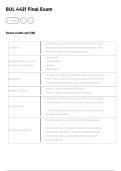
BUL 4421 Final Exam
Save
Terms in this set (118)
a promise or set of promises for the breach of which
Contract the law gives a remedy or the performance of which
the law in some way recognizes a duty.
Agreement
a legally binding contract consideration
requires four elements: capacity
legal object
consists of an offer by one party, called the offeror, to
agreement enter into a contract and an acceptance of the terms
of the offer by the other party, called the offeree.
offeror - party who makes the offer
offeror vs. offeree
offeree - party to whom the offer is made
the bargained-for exchange or what each party gets
in exchange for his or her promise under the contract.
consideration
- what a legal entity receives in return for performing
a contract obligation
the legal ability to enter into a binding agreement
Most adults over the age of majority have capacity;
contractual capacity
those under the age of majority, people suffering
from mental illness, and sufficiently intoxicated
persons do not
, we base the existence of a contract on the parties'
outward manifestations of intent and we base its
interpretation on how a reasonable person would
objective theory of interpret it
contracts
The subjective intent of parties is not usually relevant;
what matters is how they represented their intent
through their actions and words
a promise in exchange for a promise. As soon as the
bilateral contract promises exchanged, a contract is formed and the
parties' legal obligations arise
requires performance in order to form a contract (1.e.
a promise + a requested action). The offeror wants the
offeree to do something, not promise to do
unilateral contract something.
- only performance by the offeree constitutes a valid
acceptance
the terms of the contract are all clearly set forth in
Express Contract
either written or spoken words
arise not from words but from the conduct of the
implied contract
parties
also called "implied-in-law contracts, but they are not
actually contracts. Courts impose contractual
quasi contract obligations on one of the parties as If a contract
existed to prevent one party from being unjustly
enriched at the expense of te other party.
not a contract at all. Either its object is illegal or it has
void contract
some defect so serious it is not a contract.
one or both of the parties has the ability to either
voidable contract
withdraw from the contract or enforce it.
, 1. offer must be communicated to offeree
2.offeror must manifest serious intent to be bound by
elements of a valid offer
the acceptance
3. offer must contain reasonable definite terms
the offeree gives the offeror consideration in
exchange for holding the offer open for a specified
option contract
period of time. The offer is irrevocable for that period
of time.
1. Offer must be communicated to offeree
2. Offeror must manifest the intent to be bound by the
elements of a valid offer:
acceptance
3. Offer must include all material terms
the offeror can revoke the offer at any time unless the
offeree entered into an option contract with the
revocation
offeror. Revocation is effective when the offeree
receives it.
another way to terminate the offer, effectuated by the
offeree.
rejection
Regardless of how long the offer was stated to be
open, once the offeree rejects it, it is terminated.
an offer made by an offeree to his offeror relating to
the same matter as the original and proposing a
counteroffer
substituted bargain differing from that proposed in
the original offer
The terms of the acceptance must mirror the terms of
the offer exactly for common law contracts. If not, no
mirror image rule
contract is formed and the purported acceptance is
treated as a counteroffer.
destruction or subsequent If the subject matter of the offer is destroyed or
illegality of the subject becomes illegal, the offer immediately terminates.
matter
Save
Terms in this set (118)
a promise or set of promises for the breach of which
Contract the law gives a remedy or the performance of which
the law in some way recognizes a duty.
Agreement
a legally binding contract consideration
requires four elements: capacity
legal object
consists of an offer by one party, called the offeror, to
agreement enter into a contract and an acceptance of the terms
of the offer by the other party, called the offeree.
offeror - party who makes the offer
offeror vs. offeree
offeree - party to whom the offer is made
the bargained-for exchange or what each party gets
in exchange for his or her promise under the contract.
consideration
- what a legal entity receives in return for performing
a contract obligation
the legal ability to enter into a binding agreement
Most adults over the age of majority have capacity;
contractual capacity
those under the age of majority, people suffering
from mental illness, and sufficiently intoxicated
persons do not
, we base the existence of a contract on the parties'
outward manifestations of intent and we base its
interpretation on how a reasonable person would
objective theory of interpret it
contracts
The subjective intent of parties is not usually relevant;
what matters is how they represented their intent
through their actions and words
a promise in exchange for a promise. As soon as the
bilateral contract promises exchanged, a contract is formed and the
parties' legal obligations arise
requires performance in order to form a contract (1.e.
a promise + a requested action). The offeror wants the
offeree to do something, not promise to do
unilateral contract something.
- only performance by the offeree constitutes a valid
acceptance
the terms of the contract are all clearly set forth in
Express Contract
either written or spoken words
arise not from words but from the conduct of the
implied contract
parties
also called "implied-in-law contracts, but they are not
actually contracts. Courts impose contractual
quasi contract obligations on one of the parties as If a contract
existed to prevent one party from being unjustly
enriched at the expense of te other party.
not a contract at all. Either its object is illegal or it has
void contract
some defect so serious it is not a contract.
one or both of the parties has the ability to either
voidable contract
withdraw from the contract or enforce it.
, 1. offer must be communicated to offeree
2.offeror must manifest serious intent to be bound by
elements of a valid offer
the acceptance
3. offer must contain reasonable definite terms
the offeree gives the offeror consideration in
exchange for holding the offer open for a specified
option contract
period of time. The offer is irrevocable for that period
of time.
1. Offer must be communicated to offeree
2. Offeror must manifest the intent to be bound by the
elements of a valid offer:
acceptance
3. Offer must include all material terms
the offeror can revoke the offer at any time unless the
offeree entered into an option contract with the
revocation
offeror. Revocation is effective when the offeree
receives it.
another way to terminate the offer, effectuated by the
offeree.
rejection
Regardless of how long the offer was stated to be
open, once the offeree rejects it, it is terminated.
an offer made by an offeree to his offeror relating to
the same matter as the original and proposing a
counteroffer
substituted bargain differing from that proposed in
the original offer
The terms of the acceptance must mirror the terms of
the offer exactly for common law contracts. If not, no
mirror image rule
contract is formed and the purported acceptance is
treated as a counteroffer.
destruction or subsequent If the subject matter of the offer is destroyed or
illegality of the subject becomes illegal, the offer immediately terminates.
matter