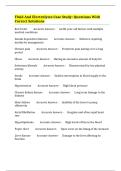
Fluid And Electrolyte Case Studies – Questions With
Fully Explained Solutions
A 67 y.o. man was admitted to your unit with a BP of 100/60, P =112, R=32,
poor skin turgor, and dry mucous membranes.
Serum Na = 150, glucose = 126,
BUN = 30 (↑) and H/H are elevated.
He tells you he hasn't been feeling well for the past few days and he's been
taking furosemide three times a day instead of once per day (as prescribed)
for three days.
1) This patient is experiencing what kind of fluid imbalance?
2) List symptoms and lab findings that support the identification of
hypovolemia. Accurate Answer:- 1) Hypovolemia
2)Serum Na = 150, glucose = 126,
BUN = 30 (↑) and H/H are elevated.
BP low normal, tachycardic, tachypneic, poor skin turgor, dry mucous
membranes
J.B. a 30 y.o. female with a history of renal failure is admitted to your unit for
hypotension after dialysis. Her current BP is 70/20 and the MD wants to order
IV fluid.
1) What kind of IVF would you recommend?
2) What is important to consider in your continued monitoring of this patient?
Accurate Answer:- 1) Albumin or normal saline
What is important to consider in your continued monitoring of this patient?
2)These patients are normally hypervolemic so monitoring their response to
the fluid is essential (we could overload them - usually ok because they are on
dialysis, but we'd still monitor them for volume overload)
Potassium Case Study #1: A 77-year-old female was admitted after 3 days of
nausea and vomiting. In the past three days, she had consumed scant amounts
of water and ginger ale.
Fully Explained Solutions
A 67 y.o. man was admitted to your unit with a BP of 100/60, P =112, R=32,
poor skin turgor, and dry mucous membranes.
Serum Na = 150, glucose = 126,
BUN = 30 (↑) and H/H are elevated.
He tells you he hasn't been feeling well for the past few days and he's been
taking furosemide three times a day instead of once per day (as prescribed)
for three days.
1) This patient is experiencing what kind of fluid imbalance?
2) List symptoms and lab findings that support the identification of
hypovolemia. Accurate Answer:- 1) Hypovolemia
2)Serum Na = 150, glucose = 126,
BUN = 30 (↑) and H/H are elevated.
BP low normal, tachycardic, tachypneic, poor skin turgor, dry mucous
membranes
J.B. a 30 y.o. female with a history of renal failure is admitted to your unit for
hypotension after dialysis. Her current BP is 70/20 and the MD wants to order
IV fluid.
1) What kind of IVF would you recommend?
2) What is important to consider in your continued monitoring of this patient?
Accurate Answer:- 1) Albumin or normal saline
What is important to consider in your continued monitoring of this patient?
2)These patients are normally hypervolemic so monitoring their response to
the fluid is essential (we could overload them - usually ok because they are on
dialysis, but we'd still monitor them for volume overload)
Potassium Case Study #1: A 77-year-old female was admitted after 3 days of
nausea and vomiting. In the past three days, she had consumed scant amounts
of water and ginger ale.