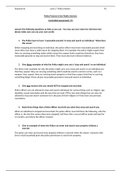
Shannon W Unit 17: Police Powers P3
Police Powers in the Public Services
Controlled assessment- P3
Answer the following questions as fully as you can. You may use your notes for reference but
please make sure you use your own words.
1. The Police have to have ‘reasonable grounds’ to stop and search an individual. What does
this mean?
Before stopping and searching an individual, the police officer must have reasonable grounds which
mean they must have a valid reason for stopping them. For example; the police might suspect that
they are carrying something stolen which means the suspect looks suspicious therefore; they have
reasonable grounds to stop and search them. They must also have relevant evidence.
2. Give three examples of why the Police might carry out a ‘stop and search’ on an individual.
The three main examples for why the police might carry out a stop and search on an individual are;
that they suspect they are carrying something which could be used to commit a crime, such as a
weapon, they suspect they are carrying stolen property or that they suspect that they’re carrying
something illegal. These all give reasonable grounds to stop and search an individual.
3. Give two reasons why you should NOT be stopped and searched
Police officers are not allowed to stop and search individuals for various things such as religion, age,
disability, sexual orientation and the way that you look. P3The two main things they are also not
allowed to stop and search someone for is because of their religion or if they have any previous
convictions.
4. State three things that a Police Officer must tell you when they stop and search you.
When an individual is stopped and searched, the police officer must tell them the following; who the
officer is, the law (the reason they were stopped), tell them that a record will be made and kept for
12 months, and where the officer is based.
5. Give an example of when the Police can enter and search your property without a
warrant.
The police can enter and search your property without a warrant when the owner/ someone who
lives in that household gives the police permission to search the property.
Police Powers in the Public Services
Controlled assessment- P3
Answer the following questions as fully as you can. You may use your notes for reference but
please make sure you use your own words.
1. The Police have to have ‘reasonable grounds’ to stop and search an individual. What does
this mean?
Before stopping and searching an individual, the police officer must have reasonable grounds which
mean they must have a valid reason for stopping them. For example; the police might suspect that
they are carrying something stolen which means the suspect looks suspicious therefore; they have
reasonable grounds to stop and search them. They must also have relevant evidence.
2. Give three examples of why the Police might carry out a ‘stop and search’ on an individual.
The three main examples for why the police might carry out a stop and search on an individual are;
that they suspect they are carrying something which could be used to commit a crime, such as a
weapon, they suspect they are carrying stolen property or that they suspect that they’re carrying
something illegal. These all give reasonable grounds to stop and search an individual.
3. Give two reasons why you should NOT be stopped and searched
Police officers are not allowed to stop and search individuals for various things such as religion, age,
disability, sexual orientation and the way that you look. P3The two main things they are also not
allowed to stop and search someone for is because of their religion or if they have any previous
convictions.
4. State three things that a Police Officer must tell you when they stop and search you.
When an individual is stopped and searched, the police officer must tell them the following; who the
officer is, the law (the reason they were stopped), tell them that a record will be made and kept for
12 months, and where the officer is based.
5. Give an example of when the Police can enter and search your property without a
warrant.
The police can enter and search your property without a warrant when the owner/ someone who
lives in that household gives the police permission to search the property.