

ACT and RFT
April 22, 2022 23:20
Acceptance & Commitment Therapy ACT The Principle of Destructive Normalcy
1950’s - Behaviour therapy
In this context, “good health” is defined as the absence of distressing private content
1970’s - Cognitive therapy (CBT) This incorrectly suggests that when you have distressing private content, it’s a sign you are not “healthy”
and are in fact – abnormal
1980’s to present - 3rd wave behavioural therapies- ACT has been called one of the “third wave” behavioural therapies The goal therefore is to eliminate (hide, get rid of, take a pill for) the distressing content in the service of
being normal (the culture of “feel goodism”)
In the event that distressing content cannot be readily controlled or eliminated, the person (maybe YOU)
is required to come up with a justification for why that is so (reasons)
For example: “Oh, I am just having a difficult day, I must be tired, but I will be better tomorrow”
ACT places importance on changing the way The goal therefore is to eliminate and/or control the distressing content in the service of achieving health
individuals relate to their experience as opposed to
changing the content of their experience Generativity
ACT:
accepting the pain that inevitably goes with it RFT is a psychological theory of human language and
Is built on empirically based principles Human pain (physical and psychological) is ever-present, normal and self-restorative
Unwillingness to have pain leads to reliance on avoidance and control-based strategies
cognition, developed and tested largely through the
efforts of Steven C. Hayes
Aims to increase psychological flexibility Excessive use of control and avoidance leads to a loss of contact with committed actions
and vital purposeful living
It is not physical/mental pain per se that is the “enemy” but our attempts to avoid or Based on the philosophical roots of functional
Uses a mindfulness-based approach control it which lead to disordered behaviour and suffering
contextualism (FC), it focuses on how humans learn
language through interactions with the environment
Is best used in conjunction with behaviour-change strategies Humans have the ability to derive relationships that
are not explicitly taught
Symbolism
This means that our knowledge can increase in more
than one way whenever we learn a single new piece
In CBT, clients are encouraged to challenge distressing thoughts by of information
looking for evidence and coming up with more rational responses;
In ACT, the thought is accepted as - “a thought”, e.g., “I’m having the
thought (just words) that I am going to mess up at this party”, the
“thought” is then defused using a variety of techniques, which may
include mindfulness, metaphors and language
Human language is a highly complex system of symbols that
Research and empirical support suggest that ACT includes words, images, sounds, facial expressions, and physical
gestures
works in a number of areas, such as: Humans use language in two domains:
1) public and 2) private
PTSD, trauma, anxiety disorders, substance abuse,
eating disorders, depression, sexual abuse ACT starts with the assumption that the NORMAL psychological processes of a human
mind readily become destructive and create psychological suffering for all of us
survivors, at risk youth, mood disorders, etc. ACT speculates that the ROOT of this suffering is human language itself
RFT is a very difficult concept for most people and could use an entire course of its own to be
explained thoroughly (if you are interested, you can do the free RFT tutorial on foxylearning.com) Your Mind is Not Your Friend – or Your Enemy
It can be argued that you can be an effective ACT therapist without knowing everything there is to
know about RFT, which is good news On the bright side, language helps us: Make maps and models of the world, predict and plan for the future, share
However, knowing the underpinnings of RFT will make you an even more effective ACT therapist
If ACT is like driving your car, RFT is like knowing how the engine works: you can be an excellent knowledge, learn from the past, imagine things that have never existed and go on to create them, develop rules
driver while knowing very little about the mechanics that guide our behaviour effectively, communicate effectively, develop relationships and friendships
On the dark side, language is what we use to: Lie, to manipulate and deceive; to dwell on and “relive” painful
events from he past; to scare ourselves by imagining unpleasant futures, to compare, judge, criticize and
condemn both ourselves and others and to create rules for ourselves that can often be life constricting or
destructive
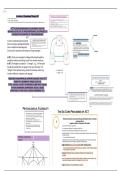
Psychological Flexibility
The general goal of ACT is to increase psychological flexibility –
The Six Core Processes of ACT
“the ability to contact the present moment more fully as a
conscious human being, and to change OR persist in behaviour
when doing so serves valued ends”
Psychological Flexibility is the ultimate goal of ACT
Contacting the present moment means being psychologically present; consciously
Psychological flexibility is established through the six core
processes of ACT
1 connecting with and
engaging in whatever is happening in this moment
Each of these areas are conceptualized as a positive
psychological skill, not merely a method of avoiding • Humans find it VERY hard to stay present
psychopathology • It is so easy to get caught up in our thoughts and lose touch
• We spend a lot of time absorbed in thoughts about the past or the future
• Instead of being FULLY conscious of our experience we may operate on automatic pilot, merely “going
through the motions”
• Can you recall doing this recently?
• Contacting the present moment means consciously paying attention to our here-and-now experience
instead of drifting off into our thoughts or operating on “automatic pilot”
• First, mindfulness is an awareness process, NOT a thinking process
• It involves bringing awareness or paying attention to your experience in this moment as opposed to
being “caught up” in your thoughts
• Second, mindfulness involves a particular attitude: One of openness and
curiosity.
• Even if your experience in this moment is difficult, painful, or unpleasant, you can be open to it and
curious about it instead of running from it or fighting with it (great concept)
• Third, mindfulness involves flexibility of attention
April 22, 2022 23:20
Acceptance & Commitment Therapy ACT The Principle of Destructive Normalcy
1950’s - Behaviour therapy
In this context, “good health” is defined as the absence of distressing private content
1970’s - Cognitive therapy (CBT) This incorrectly suggests that when you have distressing private content, it’s a sign you are not “healthy”
and are in fact – abnormal
1980’s to present - 3rd wave behavioural therapies- ACT has been called one of the “third wave” behavioural therapies The goal therefore is to eliminate (hide, get rid of, take a pill for) the distressing content in the service of
being normal (the culture of “feel goodism”)
In the event that distressing content cannot be readily controlled or eliminated, the person (maybe YOU)
is required to come up with a justification for why that is so (reasons)
For example: “Oh, I am just having a difficult day, I must be tired, but I will be better tomorrow”
ACT places importance on changing the way The goal therefore is to eliminate and/or control the distressing content in the service of achieving health
individuals relate to their experience as opposed to
changing the content of their experience Generativity
ACT:
accepting the pain that inevitably goes with it RFT is a psychological theory of human language and
Is built on empirically based principles Human pain (physical and psychological) is ever-present, normal and self-restorative
Unwillingness to have pain leads to reliance on avoidance and control-based strategies
cognition, developed and tested largely through the
efforts of Steven C. Hayes
Aims to increase psychological flexibility Excessive use of control and avoidance leads to a loss of contact with committed actions
and vital purposeful living
It is not physical/mental pain per se that is the “enemy” but our attempts to avoid or Based on the philosophical roots of functional
Uses a mindfulness-based approach control it which lead to disordered behaviour and suffering
contextualism (FC), it focuses on how humans learn
language through interactions with the environment
Is best used in conjunction with behaviour-change strategies Humans have the ability to derive relationships that
are not explicitly taught
Symbolism
This means that our knowledge can increase in more
than one way whenever we learn a single new piece
In CBT, clients are encouraged to challenge distressing thoughts by of information
looking for evidence and coming up with more rational responses;
In ACT, the thought is accepted as - “a thought”, e.g., “I’m having the
thought (just words) that I am going to mess up at this party”, the
“thought” is then defused using a variety of techniques, which may
include mindfulness, metaphors and language
Human language is a highly complex system of symbols that
Research and empirical support suggest that ACT includes words, images, sounds, facial expressions, and physical
gestures
works in a number of areas, such as: Humans use language in two domains:
1) public and 2) private
PTSD, trauma, anxiety disorders, substance abuse,
eating disorders, depression, sexual abuse ACT starts with the assumption that the NORMAL psychological processes of a human
mind readily become destructive and create psychological suffering for all of us
survivors, at risk youth, mood disorders, etc. ACT speculates that the ROOT of this suffering is human language itself
RFT is a very difficult concept for most people and could use an entire course of its own to be
explained thoroughly (if you are interested, you can do the free RFT tutorial on foxylearning.com) Your Mind is Not Your Friend – or Your Enemy
It can be argued that you can be an effective ACT therapist without knowing everything there is to
know about RFT, which is good news On the bright side, language helps us: Make maps and models of the world, predict and plan for the future, share
However, knowing the underpinnings of RFT will make you an even more effective ACT therapist
If ACT is like driving your car, RFT is like knowing how the engine works: you can be an excellent knowledge, learn from the past, imagine things that have never existed and go on to create them, develop rules
driver while knowing very little about the mechanics that guide our behaviour effectively, communicate effectively, develop relationships and friendships
On the dark side, language is what we use to: Lie, to manipulate and deceive; to dwell on and “relive” painful
events from he past; to scare ourselves by imagining unpleasant futures, to compare, judge, criticize and
condemn both ourselves and others and to create rules for ourselves that can often be life constricting or
destructive
Psychological Flexibility
The general goal of ACT is to increase psychological flexibility –
The Six Core Processes of ACT
“the ability to contact the present moment more fully as a
conscious human being, and to change OR persist in behaviour
when doing so serves valued ends”
Psychological Flexibility is the ultimate goal of ACT
Contacting the present moment means being psychologically present; consciously
Psychological flexibility is established through the six core
processes of ACT
1 connecting with and
engaging in whatever is happening in this moment
Each of these areas are conceptualized as a positive
psychological skill, not merely a method of avoiding • Humans find it VERY hard to stay present
psychopathology • It is so easy to get caught up in our thoughts and lose touch
• We spend a lot of time absorbed in thoughts about the past or the future
• Instead of being FULLY conscious of our experience we may operate on automatic pilot, merely “going
through the motions”
• Can you recall doing this recently?
• Contacting the present moment means consciously paying attention to our here-and-now experience
instead of drifting off into our thoughts or operating on “automatic pilot”
• First, mindfulness is an awareness process, NOT a thinking process
• It involves bringing awareness or paying attention to your experience in this moment as opposed to
being “caught up” in your thoughts
• Second, mindfulness involves a particular attitude: One of openness and
curiosity.
• Even if your experience in this moment is difficult, painful, or unpleasant, you can be open to it and
curious about it instead of running from it or fighting with it (great concept)
• Third, mindfulness involves flexibility of attention


