

Bias & Ethics - Grade 11 Psychology Notes
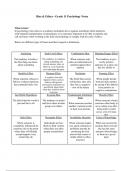
What is bias?
In psychology, bias refers to a tendency/inclination for or against something which interferes
with impartial interpretation of information. It is extremely important to be able to identify and
call out biases when working in the field of psychology to comply with the code of ethics.
Below are different types of biases and their respective definitions.
Anchoring Sunk Cost Fallacy Confirmation Bias Dunning-Kruger Effect
The tendency to believe The tendency to continue When someone only The tendency to give
the first thing one hears doing something one seeks out information to overly positive
about something invests money, time, or confirm/support their opinions on a topic one
effort in, even when the opinion has low ability in
cost outweighs the pros
Backfire Effect Barnum Effect Declinism Framing Effect
A cognitive bias that
When someone refuses to happens when a person The belief that society When people decide
believe evidence/opinions believes that generic will decline, thus why between their options
that contradict their own personality statements are they have a negative by seeing if the options
specifically about them view of the future have positive or
when they could be about negative connotations
everyone
Just World Hypothesis In-group Bias Fundamental Attribution Placebo Effect
Error
The belief that the world is The tendency to prefer When someone’s brain
just and fair to all and favor those in their When someone ascribes convinces their body to
group over others another’s actions/words act a certain way after
to their own persona being told it would
occur, even if it may
not.
Halo Effect Bystander Effect Availability Heuristic Curse of Knowledge
When someone is Individuals are less When someone makes When one incorrectly
completely influenced by likely to help victims very quick solutions to assumes that everyone
someone else to the point when there are other problems (mostly by else has the same
where they will blindly people around them producing the first amount of knowledge
accept/support every answer that comes to as them on a given
action they do mind) which is often topic
incorrect
What is bias?
In psychology, bias refers to a tendency/inclination for or against something which interferes
with impartial interpretation of information. It is extremely important to be able to identify and
call out biases when working in the field of psychology to comply with the code of ethics.
Below are different types of biases and their respective definitions.
Anchoring Sunk Cost Fallacy Confirmation Bias Dunning-Kruger Effect
The tendency to believe The tendency to continue When someone only The tendency to give
the first thing one hears doing something one seeks out information to overly positive
about something invests money, time, or confirm/support their opinions on a topic one
effort in, even when the opinion has low ability in
cost outweighs the pros
Backfire Effect Barnum Effect Declinism Framing Effect
A cognitive bias that
When someone refuses to happens when a person The belief that society When people decide
believe evidence/opinions believes that generic will decline, thus why between their options
that contradict their own personality statements are they have a negative by seeing if the options
specifically about them view of the future have positive or
when they could be about negative connotations
everyone
Just World Hypothesis In-group Bias Fundamental Attribution Placebo Effect
Error
The belief that the world is The tendency to prefer When someone’s brain
just and fair to all and favor those in their When someone ascribes convinces their body to
group over others another’s actions/words act a certain way after
to their own persona being told it would
occur, even if it may
not.
Halo Effect Bystander Effect Availability Heuristic Curse of Knowledge
When someone is Individuals are less When someone makes When one incorrectly
completely influenced by likely to help victims very quick solutions to assumes that everyone
someone else to the point when there are other problems (mostly by else has the same
where they will blindly people around them producing the first amount of knowledge
accept/support every answer that comes to as them on a given
action they do mind) which is often topic
incorrect


