21/10/24
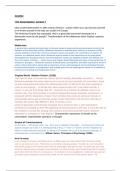
‘The Great Gatsby’: Lecture 7
Idea of self-tranformation in 19th century America - a place where you can become yourself
or re-invent yourself in the way you couldn’t in Europe.
The American Empire has expanded. Was it a genocidal movement westward or a
democratic move by the people? Transformation of the wilderness which Gatsby’s parents
experience.
Modernism
‘A general term applied retrospectively to the wide range of experimental and avant-garde trends in the
literature of the early 20th century. Modernist literature is characterised chiefly by a rejection of 19th-
century traditions and of their consensus between author and reader: the conventions of realism, for
instance, or traditional poetic metre. Modernist writers tended to see themselves as an avant-garde
disengaged from bourgeois values, and disturbed their readers by adopting complex and difficult new
forms and styles. In fiction, ... James Joyce and Virginia Woolf attempted new ways of tracing the flow of
characters' thoughts.... Modernist writing is predominantly cosmopolitan, and often expresses a sense of
urban cultural dislocation, along with an awareness of new anthropological and psychological theories.
Its favoured techniques of juxtaposition and multiple point of view challenge the reader to re-establish a
coherence of meaning from fragmentary forms.’
Virginia Woolf, ‘Modern Fiction’. (1925)
‘Our quarrel, then, is not with the classics [but the leading Edwardian novelists.] ... Arnold
Bennett is perhaps the worst culprit as he is by far the best workman. He can make a book
so well constructed and sold in its craftsmanship that it is difficult for the most exacting of
critics to see through.... Is life like this: Must novels be like this? Look within and life. it
seems. is very far from being "like this". Examine for a moment an ordinary mind on an
ordinarv dav. The mind receives a myriad of impressions-trivial. Fantastic, evanescent. or
engraved with the sharpness of steel. From all sides they come an incessant shower of
innumerable atoms and as they fall. as they shane themselves into the lite of Mondav or
Tuesdav the accent falls different v from of old life is not a
series of gig lamps symmetricallv arranged; but a luminous halo, a semi-transparent
envelope surrounding us from the beginning of consciousness to the end. Is it not the task of
the novelist to convey this varying, this unknown and uncircumscribed spirit, whatever
aberration or complexity it may display?’ Characteristic expression of wonder at the
unknowable, unpredictable operation of thought.
Stream of Consciousness
‘In this room, -- this lecture room, say - there are a multitude of thoughts.... Consciousness does not
appear chopped up in bits. It is nothing jointed; it flows. A "river" or "stream" are the metaphors by
which it is most naturally described. In talking of it hereafter, let us call it the stream of thought, of
consciousness, or perceptive life.’ William James, ‘Principles of Psychology’ (1890)
Nick Carraway
In my younger and more vulnerable years my father gave me some advice that I've been turning
over in my mind ever since. "Whenever you feel like criticising anyone," he told me, "just remember
that all the people in this world haven't had the advantages that you've had.” He didn't say any more,
but we've always been unusually communicative in a reserved way, and I understood that he meant a
great deal more than that. In consequence, I'm inclined to reserve judgment, a habit that has opened
up many curious natures to me and also made me the victim of not a few veteran bores. The
‘The Great Gatsby’: Lecture 7
Idea of self-tranformation in 19th century America - a place where you can become yourself
or re-invent yourself in the way you couldn’t in Europe.
The American Empire has expanded. Was it a genocidal movement westward or a
democratic move by the people? Transformation of the wilderness which Gatsby’s parents
experience.
Modernism
‘A general term applied retrospectively to the wide range of experimental and avant-garde trends in the
literature of the early 20th century. Modernist literature is characterised chiefly by a rejection of 19th-
century traditions and of their consensus between author and reader: the conventions of realism, for
instance, or traditional poetic metre. Modernist writers tended to see themselves as an avant-garde
disengaged from bourgeois values, and disturbed their readers by adopting complex and difficult new
forms and styles. In fiction, ... James Joyce and Virginia Woolf attempted new ways of tracing the flow of
characters' thoughts.... Modernist writing is predominantly cosmopolitan, and often expresses a sense of
urban cultural dislocation, along with an awareness of new anthropological and psychological theories.
Its favoured techniques of juxtaposition and multiple point of view challenge the reader to re-establish a
coherence of meaning from fragmentary forms.’
Virginia Woolf, ‘Modern Fiction’. (1925)
‘Our quarrel, then, is not with the classics [but the leading Edwardian novelists.] ... Arnold
Bennett is perhaps the worst culprit as he is by far the best workman. He can make a book
so well constructed and sold in its craftsmanship that it is difficult for the most exacting of
critics to see through.... Is life like this: Must novels be like this? Look within and life. it
seems. is very far from being "like this". Examine for a moment an ordinary mind on an
ordinarv dav. The mind receives a myriad of impressions-trivial. Fantastic, evanescent. or
engraved with the sharpness of steel. From all sides they come an incessant shower of
innumerable atoms and as they fall. as they shane themselves into the lite of Mondav or
Tuesdav the accent falls different v from of old life is not a
series of gig lamps symmetricallv arranged; but a luminous halo, a semi-transparent
envelope surrounding us from the beginning of consciousness to the end. Is it not the task of
the novelist to convey this varying, this unknown and uncircumscribed spirit, whatever
aberration or complexity it may display?’ Characteristic expression of wonder at the
unknowable, unpredictable operation of thought.
Stream of Consciousness
‘In this room, -- this lecture room, say - there are a multitude of thoughts.... Consciousness does not
appear chopped up in bits. It is nothing jointed; it flows. A "river" or "stream" are the metaphors by
which it is most naturally described. In talking of it hereafter, let us call it the stream of thought, of
consciousness, or perceptive life.’ William James, ‘Principles of Psychology’ (1890)
Nick Carraway
In my younger and more vulnerable years my father gave me some advice that I've been turning
over in my mind ever since. "Whenever you feel like criticising anyone," he told me, "just remember
that all the people in this world haven't had the advantages that you've had.” He didn't say any more,
but we've always been unusually communicative in a reserved way, and I understood that he meant a
great deal more than that. In consequence, I'm inclined to reserve judgment, a habit that has opened
up many curious natures to me and also made me the victim of not a few veteran bores. The