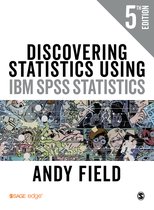
Discovering Statistics Using IBM SPSS Statistics
● Author: Andy Field
● Latest Edition: 6th Edition (2024)
● Publisher: SAGE Publications
● ISBN: 9781529630008
Summary:
Andy Field's book offers a humorous and accessible approach to learning statistics, making
complex concepts understandable. It provides step-by-step guidance on using IBM SPSS for
statistical analysis, covering topics from basic descriptive statistics to advanced inferential
techniques. The 6th edition includes updates to align with the latest SPSS software,
expanded discussions on the general linear model, and more diverse examples to enhance
inclusivity.
📘 Chapter 1: Why Is My Evil Lecturer Forcing Me to
Learn Statistics?
🔹 Overview
This introductory chapter addresses a common concern among students: Why study
statistics? Andy Field approaches this question with humor, empathy, and clarity. He explains
that statistics isn't just about numbers — it's a powerful tool for understanding the world,
making decisions, and evaluating evidence.
🔹 Key Objectives of the Chapter
● To debunk myths and fears about statistics.
● To explain why statistics is essential in psychology, social sciences, and
research in general.
● To introduce basic philosophical foundations of scientific inquiry and statistical
thinking.
● To encourage students to adopt a critical, thoughtful mindset.
🔹 Why Learn Statistics?
Field argues that learning statistics helps you:
, 1. Make better decisions using data.
2. Critically evaluate claims in research, media, and policy.
3. Design sound experiments and studies.
4. Avoid being misled by flawed reasoning or data manipulation.
He emphasizes that even non-statisticians benefit from understanding how evidence is
gathered, analyzed, and interpreted.
🔹 Common Fears and Misconceptions
Field lists several common student misconceptions:
● “I’m bad at math.”
● “Statistics is boring.”
● “I’ll never use this.”
He reassures readers that statistics is more about logic and understanding patterns
than doing complex arithmetic, and that modern tools like SPSS do much of the heavy lifting.
🔹 The Scientific Method and the Role of Statistics
Statistics is introduced as the language of science — essential for:
● Testing hypotheses
● Determining the strength of evidence
● Making inferences from data
Field touches upon:
● Falsifiability (Popper)
● Hypothesis testing
● The importance of replication
These principles form the foundation of how researchers evaluate and contribute knowledge.
🔹 Variables and Measurement
Field introduces basic terminology that will recur throughout the book:
● Variables: Characteristics that can take on different values.
● Independent variable (IV): What the researcher manipulates.
● Dependent variable (DV): What is measured.
● Levels of measurement:
○ Nominal (categories)
, ○ Ordinal (rankings)
○ Interval (equal intervals, no true zero)
○ Ratio (equal intervals + true zero)
🔹 Garbage In, Garbage Out
A humorous but important point: poorly collected data yields misleading conclusions.
Field stresses the importance of good research design, accurate data collection, and
honest reporting.
🔹 A Brief Word on SPSS
Although the book focuses on SPSS for data analysis, this chapter explains that SPSS is
only a tool. What matters most is understanding what you're doing and why. SPSS will
be introduced in a step-by-step, beginner-friendly manner.
🧾 Key Terms Explained
Term Definition
Statistics A set of tools for analyzing and interpreting
data.
Scientific Method A process for forming hypotheses,
collecting data, and testing ideas.
Hypothesis A testable prediction about relationships
between variables.
Variable Any attribute or factor that can vary or be
measured.
Independent Variable The variable manipulated to observe its
effect on the dependent variable.
Dependent Variable The outcome variable that is measured in a
study.
Levels of Measurement Classification of variables based on the
nature of the data (nominal, etc.).
SPSS IBM’s software for statistical analysis.
, 📘 Chapter 2: Everything You Ever Wanted to Know
About Statistics (Well, Sort Of)
🔹 Overview
This chapter builds the foundation for understanding the logic behind statistical analysis.
It introduces core statistical concepts such as types of statistics, distributions,
measurement error, effect size, significance, and the basic structure of inferential
testing.
Field’s aim is to get readers to think about why we use statistics and how statistical analysis
helps us interpret reality in an uncertain world.
🔹 Descriptive vs. Inferential Statistics
● Descriptive statistics summarize data (e.g., mean, median, standard deviation).
● Inferential statistics use sample data to make generalizations about a population.
Inferential statistics involve estimation and hypothesis testing — both are subject to
uncertainty, and statistics help us quantify that uncertainty.
🔹 Populations and Samples
● A population is the full group you’re interested in.
● A sample is the smaller group you collect data from.
Field stresses that random sampling improves the accuracy and generalizability of
statistical inference.
🔹 Measurement Error and Sampling Error
● Measurement error arises from imperfections in tools, human error, or external
factors.
● Sampling error is the natural variation from sample to sample.
Statistics help us estimate how much error might be present in our results.
● Author: Andy Field
● Latest Edition: 6th Edition (2024)
● Publisher: SAGE Publications
● ISBN: 9781529630008
Summary:
Andy Field's book offers a humorous and accessible approach to learning statistics, making
complex concepts understandable. It provides step-by-step guidance on using IBM SPSS for
statistical analysis, covering topics from basic descriptive statistics to advanced inferential
techniques. The 6th edition includes updates to align with the latest SPSS software,
expanded discussions on the general linear model, and more diverse examples to enhance
inclusivity.
📘 Chapter 1: Why Is My Evil Lecturer Forcing Me to
Learn Statistics?
🔹 Overview
This introductory chapter addresses a common concern among students: Why study
statistics? Andy Field approaches this question with humor, empathy, and clarity. He explains
that statistics isn't just about numbers — it's a powerful tool for understanding the world,
making decisions, and evaluating evidence.
🔹 Key Objectives of the Chapter
● To debunk myths and fears about statistics.
● To explain why statistics is essential in psychology, social sciences, and
research in general.
● To introduce basic philosophical foundations of scientific inquiry and statistical
thinking.
● To encourage students to adopt a critical, thoughtful mindset.
🔹 Why Learn Statistics?
Field argues that learning statistics helps you:
, 1. Make better decisions using data.
2. Critically evaluate claims in research, media, and policy.
3. Design sound experiments and studies.
4. Avoid being misled by flawed reasoning or data manipulation.
He emphasizes that even non-statisticians benefit from understanding how evidence is
gathered, analyzed, and interpreted.
🔹 Common Fears and Misconceptions
Field lists several common student misconceptions:
● “I’m bad at math.”
● “Statistics is boring.”
● “I’ll never use this.”
He reassures readers that statistics is more about logic and understanding patterns
than doing complex arithmetic, and that modern tools like SPSS do much of the heavy lifting.
🔹 The Scientific Method and the Role of Statistics
Statistics is introduced as the language of science — essential for:
● Testing hypotheses
● Determining the strength of evidence
● Making inferences from data
Field touches upon:
● Falsifiability (Popper)
● Hypothesis testing
● The importance of replication
These principles form the foundation of how researchers evaluate and contribute knowledge.
🔹 Variables and Measurement
Field introduces basic terminology that will recur throughout the book:
● Variables: Characteristics that can take on different values.
● Independent variable (IV): What the researcher manipulates.
● Dependent variable (DV): What is measured.
● Levels of measurement:
○ Nominal (categories)
, ○ Ordinal (rankings)
○ Interval (equal intervals, no true zero)
○ Ratio (equal intervals + true zero)
🔹 Garbage In, Garbage Out
A humorous but important point: poorly collected data yields misleading conclusions.
Field stresses the importance of good research design, accurate data collection, and
honest reporting.
🔹 A Brief Word on SPSS
Although the book focuses on SPSS for data analysis, this chapter explains that SPSS is
only a tool. What matters most is understanding what you're doing and why. SPSS will
be introduced in a step-by-step, beginner-friendly manner.
🧾 Key Terms Explained
Term Definition
Statistics A set of tools for analyzing and interpreting
data.
Scientific Method A process for forming hypotheses,
collecting data, and testing ideas.
Hypothesis A testable prediction about relationships
between variables.
Variable Any attribute or factor that can vary or be
measured.
Independent Variable The variable manipulated to observe its
effect on the dependent variable.
Dependent Variable The outcome variable that is measured in a
study.
Levels of Measurement Classification of variables based on the
nature of the data (nominal, etc.).
SPSS IBM’s software for statistical analysis.
, 📘 Chapter 2: Everything You Ever Wanted to Know
About Statistics (Well, Sort Of)
🔹 Overview
This chapter builds the foundation for understanding the logic behind statistical analysis.
It introduces core statistical concepts such as types of statistics, distributions,
measurement error, effect size, significance, and the basic structure of inferential
testing.
Field’s aim is to get readers to think about why we use statistics and how statistical analysis
helps us interpret reality in an uncertain world.
🔹 Descriptive vs. Inferential Statistics
● Descriptive statistics summarize data (e.g., mean, median, standard deviation).
● Inferential statistics use sample data to make generalizations about a population.
Inferential statistics involve estimation and hypothesis testing — both are subject to
uncertainty, and statistics help us quantify that uncertainty.
🔹 Populations and Samples
● A population is the full group you’re interested in.
● A sample is the smaller group you collect data from.
Field stresses that random sampling improves the accuracy and generalizability of
statistical inference.
🔹 Measurement Error and Sampling Error
● Measurement error arises from imperfections in tools, human error, or external
factors.
● Sampling error is the natural variation from sample to sample.
Statistics help us estimate how much error might be present in our results.