
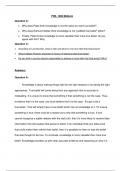
PHIL 1000 Midterm
Question A:
• Why does Plato think knowledge is not the same as mere true belief?
• Why does Edmund Gettier think knowledge is not “justified true belief” either?
• Finally, Plato thinks knowledge is more valuable than mere true belief, do you
agree with him? Why
Question C:
• According to Lara Buchak, what is faith and what is it to have faith that God exists?
• What is Blaise Pascal’s argument in favour of believing that God exists?
• Do you think it can be rational (reasonable) to believe or have faith that God exists? Why?
Answers:
Question A:
Knowledge is about making things right for the right reasons or by taking the right
approaches. True belief will come along from any approach that is accurate or
misleading. It is unsure to know that something if that something is not the case. Thus,
to believe that it is the case, one must believe that it is the case. It's got to be a
true belief. One will simply have a true belief which has no knowledge to it. To ensure
something is true, there must be a reason as to why that something is true. If one
cannot recognize a stable relation with the real truth, then it’s more likely to receive false
information that will weaken that person’s belief. If an individual finds any false proof
that could make them rethink their belief, then it is possible for them to lose the belief
that was thought to be true. To conclude, knowledge is more valuable than mere true
belief. Knowledge provides us with clear accurate evidence and reasoning on why it is
, true. If people have a strong connection with the real truth, then it’s less likely to be at
risk of weakening their belief.
Gettier does not believe in the knowledge analysis of Justified-True-Belief
because JTB is not enough, but it may be necessary. One may feel like having a
Justified-True-Belief to gain knowledge, but his argument proves that there’s no
knowledge contained in JTB. Gettier illustrates this by his counter-example approach
known as the Gettier case. According to the standard analysis, JTB suggests that these
scenarios, which are defined in Gettier cases, imply that these scenarios are plausible,
and thus JTB must be incorrect. For instance, in one of his examples, it appears that
Smith believes that the one who receives the work will have an amount of 10 coins in
his pocket. He’s rational in believing due to a valid source that has assured him that
Jones is going to receive it, and Jones has 10 coins. However, then the belief actually
appears to be true. Thus, according to JTB concept, Smith recognized that the man who
was accepted for the job must have 10 coins in his pocket. Although, Gettier and
several others claimed that this does not seem rational, because this was supposed to
be the case of knowledge when basing it on JBT theory. Smith appears to have been
right not due to his understanding where he obtained misleading knowledge but it was
rather a coincidence where he just got lucky.
Yes, I agree with Plato who thinks that knowledge is more valuable than just true
belief. It’s stated that knowledge is more important than simply true belief when it’s
deeply embedded or reasoned. An individual with knowledge has the potential to argue
for the reason behind the truth, while a person with a clear true belief understands the
Question A:
• Why does Plato think knowledge is not the same as mere true belief?
• Why does Edmund Gettier think knowledge is not “justified true belief” either?
• Finally, Plato thinks knowledge is more valuable than mere true belief, do you
agree with him? Why
Question C:
• According to Lara Buchak, what is faith and what is it to have faith that God exists?
• What is Blaise Pascal’s argument in favour of believing that God exists?
• Do you think it can be rational (reasonable) to believe or have faith that God exists? Why?
Answers:
Question A:
Knowledge is about making things right for the right reasons or by taking the right
approaches. True belief will come along from any approach that is accurate or
misleading. It is unsure to know that something if that something is not the case. Thus,
to believe that it is the case, one must believe that it is the case. It's got to be a
true belief. One will simply have a true belief which has no knowledge to it. To ensure
something is true, there must be a reason as to why that something is true. If one
cannot recognize a stable relation with the real truth, then it’s more likely to receive false
information that will weaken that person’s belief. If an individual finds any false proof
that could make them rethink their belief, then it is possible for them to lose the belief
that was thought to be true. To conclude, knowledge is more valuable than mere true
belief. Knowledge provides us with clear accurate evidence and reasoning on why it is
, true. If people have a strong connection with the real truth, then it’s less likely to be at
risk of weakening their belief.
Gettier does not believe in the knowledge analysis of Justified-True-Belief
because JTB is not enough, but it may be necessary. One may feel like having a
Justified-True-Belief to gain knowledge, but his argument proves that there’s no
knowledge contained in JTB. Gettier illustrates this by his counter-example approach
known as the Gettier case. According to the standard analysis, JTB suggests that these
scenarios, which are defined in Gettier cases, imply that these scenarios are plausible,
and thus JTB must be incorrect. For instance, in one of his examples, it appears that
Smith believes that the one who receives the work will have an amount of 10 coins in
his pocket. He’s rational in believing due to a valid source that has assured him that
Jones is going to receive it, and Jones has 10 coins. However, then the belief actually
appears to be true. Thus, according to JTB concept, Smith recognized that the man who
was accepted for the job must have 10 coins in his pocket. Although, Gettier and
several others claimed that this does not seem rational, because this was supposed to
be the case of knowledge when basing it on JBT theory. Smith appears to have been
right not due to his understanding where he obtained misleading knowledge but it was
rather a coincidence where he just got lucky.
Yes, I agree with Plato who thinks that knowledge is more valuable than just true
belief. It’s stated that knowledge is more important than simply true belief when it’s
deeply embedded or reasoned. An individual with knowledge has the potential to argue
for the reason behind the truth, while a person with a clear true belief understands the


