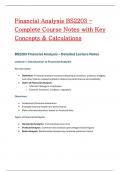
Financial Analysis BS2203 –
Complete Course Notes with Key
Concepts & Calculations
BS2203 Financial Analysis – Detailed Lecture Notes
Lecture 1: Introduction to Financial Analysis
Key Concepts:
• Definition: Financial analysis involves evaluating businesses, projects, budgets,
and other finance-related entities to determine performance and suitability.
• Users of Financial Analysis:
o Internal: Managers, employees
o External: Investors, creditors, regulators
Objectives:
• Understand financial statements
• Evaluate financial health and performance
• Make informed decisions based on financial data
Types of Financial Analysis:
• Horizontal Analysis: Trend analysis over time
• Vertical Analysis: Common-size analysis (percentage of base figure)
• Ratio Analysis: Relationship between key financial statement items
, Lecture 2: Financial Statements Overview
1. Income Statement:
• Measures performance over a period
• Key elements: Revenue, COGS, Gross Profit, Operating Expenses, Net Income
2. Balance Sheet:
• Snapshot at a point in time
• Key elements: Assets = Liabilities + Equity
3. Cash Flow Statement:
• Categories: Operating, Investing, Financing
• Reconciles net income to changes in cash
4. Statement of Changes in Equity:
• Shows changes in owners’ equity accounts
GAAP vs IFRS Differences (Key Focus Areas):
• Treatment of development costs
• Revaluation of assets
• Revenue recognition timing
Lecture 3: Ratio Analysis – Profitability
Key Ratios:
1. Gross Profit Margin = Gross Profit / Revenue
2. Operating Margin = Operating Income / Revenue
3. Net Profit Margin = Net Income / Revenue
4. Return on Assets (ROA) = Net Income / Total Assets
5. Return on Equity (ROE) = Net Income / Shareholder’s Equity
Complete Course Notes with Key
Concepts & Calculations
BS2203 Financial Analysis – Detailed Lecture Notes
Lecture 1: Introduction to Financial Analysis
Key Concepts:
• Definition: Financial analysis involves evaluating businesses, projects, budgets,
and other finance-related entities to determine performance and suitability.
• Users of Financial Analysis:
o Internal: Managers, employees
o External: Investors, creditors, regulators
Objectives:
• Understand financial statements
• Evaluate financial health and performance
• Make informed decisions based on financial data
Types of Financial Analysis:
• Horizontal Analysis: Trend analysis over time
• Vertical Analysis: Common-size analysis (percentage of base figure)
• Ratio Analysis: Relationship between key financial statement items
, Lecture 2: Financial Statements Overview
1. Income Statement:
• Measures performance over a period
• Key elements: Revenue, COGS, Gross Profit, Operating Expenses, Net Income
2. Balance Sheet:
• Snapshot at a point in time
• Key elements: Assets = Liabilities + Equity
3. Cash Flow Statement:
• Categories: Operating, Investing, Financing
• Reconciles net income to changes in cash
4. Statement of Changes in Equity:
• Shows changes in owners’ equity accounts
GAAP vs IFRS Differences (Key Focus Areas):
• Treatment of development costs
• Revaluation of assets
• Revenue recognition timing
Lecture 3: Ratio Analysis – Profitability
Key Ratios:
1. Gross Profit Margin = Gross Profit / Revenue
2. Operating Margin = Operating Income / Revenue
3. Net Profit Margin = Net Income / Revenue
4. Return on Assets (ROA) = Net Income / Total Assets
5. Return on Equity (ROE) = Net Income / Shareholder’s Equity