
Electricity - May 13, 2025
What?: Electricity is a form of energy that is formed by the interaction of charged particles
(electrons (-), protons (+)) *only electrons can move
Electric charges:
1. Static charge: A buildup of an unequal number of protons and electrons on the
surface of a material. *not moving
The larger the difference between #pt and #e, the bigger the charge. Ex. 12pt, 6e would
leave us with a positive charge of 6.
How to charge an object:
● Objects are charged by transferring electrons
● To become negatively charged -> add electrons
● To become positively charged -> remove electrons
Charging by friction: Friction is created when two materials
are rubbed together.
- When friction is created between two different
materials, electrons can transfer from one to the other
- One material will lose electrons becoming
positive
- One material will gain electrons will become
negative
*no new charges are created, just moved
around
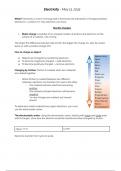
To determine which material loses/gains electrons, you must
use the electrostatic series.
The electrostatic series: Using the electrostatic series, starting with nylon and lucite each
with 8 charges, show how the electron would be transferred when charged by friction.
Nylon: ⊕⊕⊕⊕ Lucite:
Electrons transfer from nylon to lucite
What?: Electricity is a form of energy that is formed by the interaction of charged particles
(electrons (-), protons (+)) *only electrons can move
Electric charges:
1. Static charge: A buildup of an unequal number of protons and electrons on the
surface of a material. *not moving
The larger the difference between #pt and #e, the bigger the charge. Ex. 12pt, 6e would
leave us with a positive charge of 6.
How to charge an object:
● Objects are charged by transferring electrons
● To become negatively charged -> add electrons
● To become positively charged -> remove electrons
Charging by friction: Friction is created when two materials
are rubbed together.
- When friction is created between two different
materials, electrons can transfer from one to the other
- One material will lose electrons becoming
positive
- One material will gain electrons will become
negative
*no new charges are created, just moved
around
To determine which material loses/gains electrons, you must
use the electrostatic series.
The electrostatic series: Using the electrostatic series, starting with nylon and lucite each
with 8 charges, show how the electron would be transferred when charged by friction.
Nylon: ⊕⊕⊕⊕ Lucite:
Electrons transfer from nylon to lucite


