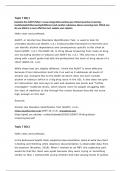
Topic 7 DQ 1
Examine the AUDIT (https://www.integration.samhsa.gov/clinical-practice/screening-
tools#sample%20screening%20forms) and another substance abuse screening tool. Which one
do you think is a more effective tool, explain your opinion.
Hello class and professor,
AUDIT, or Alcohol Use Disorders Identification Test, is used to look for
unhealthy alcohol use (AUDIT, n.d.). It also provides framework to intervene and
can identify alcohol dependence and consequences specific to the client at
hand (AUDIT, n.d.). The DAST-10, or Drug Abuse Screening Tool, looks at drug
use excluding alcohol or tobacco use (DAST-10, n.d.). This test has a chart
along with a point guide that tells the professional the level of drug abuse of a
client (DAST-10, n.d.).
While these test are slightly different, I think the AUDIT is more effective
because it has intervention built into it as well as it addresses all levels of
alcohol use. Compare this to the DAST-10 which does not even include
alcohol or tobacco (which is a big drug issue in the US), it also does not give
an intervention tips and says to wait and reassess low levels and "further
investigate" moderate levels, which leaves room for people struggling with
the start of addiction to slip through the cracks because they did not score
high enough on this test.
Sources:
Alcohol Use Disorders Identification Test (AUDIT). (n.d.).
https://auditscreen.org/ DAST-10. (n.d). drugabuse.gov
https://gwe[.usc.edu/wp- content/uploads/2019/11/DAST-10-drug-abuse-
screening-test.pdf
Topic 7 DQ 2
Hello class and professor,
In the behavioral health field, subjective documentation looks at what the client
is feeling and thinking while objective documentation is observable data from
the sessions (Knowles, 2019). When I worked as an RBT, the subjective part
would be that the client was upset because they were crying or something
similar to that. I worked with young children that had varying levels of autism,
Examine the AUDIT (https://www.integration.samhsa.gov/clinical-practice/screening-
tools#sample%20screening%20forms) and another substance abuse screening tool. Which one
do you think is a more effective tool, explain your opinion.
Hello class and professor,
AUDIT, or Alcohol Use Disorders Identification Test, is used to look for
unhealthy alcohol use (AUDIT, n.d.). It also provides framework to intervene and
can identify alcohol dependence and consequences specific to the client at
hand (AUDIT, n.d.). The DAST-10, or Drug Abuse Screening Tool, looks at drug
use excluding alcohol or tobacco use (DAST-10, n.d.). This test has a chart
along with a point guide that tells the professional the level of drug abuse of a
client (DAST-10, n.d.).
While these test are slightly different, I think the AUDIT is more effective
because it has intervention built into it as well as it addresses all levels of
alcohol use. Compare this to the DAST-10 which does not even include
alcohol or tobacco (which is a big drug issue in the US), it also does not give
an intervention tips and says to wait and reassess low levels and "further
investigate" moderate levels, which leaves room for people struggling with
the start of addiction to slip through the cracks because they did not score
high enough on this test.
Sources:
Alcohol Use Disorders Identification Test (AUDIT). (n.d.).
https://auditscreen.org/ DAST-10. (n.d). drugabuse.gov
https://gwe[.usc.edu/wp- content/uploads/2019/11/DAST-10-drug-abuse-
screening-test.pdf
Topic 7 DQ 2
Hello class and professor,
In the behavioral health field, subjective documentation looks at what the client
is feeling and thinking while objective documentation is observable data from
the sessions (Knowles, 2019). When I worked as an RBT, the subjective part
would be that the client was upset because they were crying or something
similar to that. I worked with young children that had varying levels of autism,