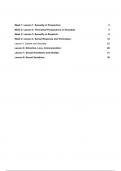
Week 1: Lesson 1: Sexuality in Perspective: 2
Week 2: Lesson 2: Theoretical Perspectives on Sexuality: 5
Week 3: Lesson 3: Sexuality in Research: 8
Week 4: Lesson 4: Sexual Response and Techniques: 12
Lesson 5: Gender and Sexuality: 21
Lesson 6: Attraction, Love, Communication: 26
Lesson 7: Sexual Orientation and Identity: 31
Lesson 8: Sexual Variations: 36
,Week 1: Lesson 1: Sexuality in Perspective:
Chapter 1:
➔ Religion is a source of values/ethics regarding sexuality, and is a powerful influence on
the sexual attitudes/behavior of many indivuals.
➔ Moral code for each religion is unique, each religion has different views on what is
right/wrong in regards to sexuality.
➔ Ethnocentrism: the tendency to regard our own ethnic group/culture as superior to
others’ and to believe that its customs/way of life are the standards by which other
cultures should be judged.
◆ Tends to influence peoples understanding of human sexual behaviour
◆ Canadians tend to have more permissive attitudes towards sexuality than
Americans do.
, ◆ All societies regulate sexual behavior in some way, though the exact regulations
vary greatly from one culture to the next.
➔ Incest Taboos: regulations prohibiting seual interaction between close blood relatives,
such as brother and sister or father and daughter.
➔ Racial Microaggression: Subtle insults directed at people of color and often done
unconsciously.
➔ Kissing is one of the first partnered sexual activities we engage in and one of the most
frequent after.
➔ Kissing is not found in all societies
➔ Very few societies encourage people to engage in sexual intercourse
➔ Most groups have restrictions that forbid intercourse at certain times/situations.
➔ Masturbation: self-stiulation of the genitals to prouce sexual arousal.
◆ Not all societies have positive attitudes about masturbation
➔ Societies differ considerably in their rules regarding premarital sex.
➔ In all human societies, physical characteristics are important in determining whom one
chooses a sex partner.
➔ Sexual health: a state of physical, emotional, mental and social well-being related to
sexuality.
➔ Sexual rights: basic, inalienable rights regarding sexuality, both positive/negative, such
as rights to reproductive, self-determination and sexual self-expression, and freedom
from sexual abuse and violence.
➔ Sexual activity: activity that produces arousal or is intended to produce arousal.
➔ Sex (sexual beahvior and anatomy) is distinct from gender (being female or male).
➔ Historically , religion was the main source of information concerning sexuality.
Lecture: Sex and Evolution: Supernormal Stimuli:
➔ What we prefer is the result of how human brains have been hardwired by nature.
➔ Sexual Selection:
◆ Intrasexual Selection
● Competition, usually among males
○ Best males win access to females
◆ Intersexual selection
● Choice, usually by females
○ Best females get first choice
Sexuality in Perspective:
➔ Sexual Terminology:
◆ Sex: biology, sexual anatomy
◆ Gender: ones (personal, social, legal) status as male or female
◆ Sexual Behavior: behavior that produces arousal and increases the chance of
orgasm
◆ Human sexuality: the ways in which we experience and express ourselves as
sexual beings
, ➔ Biopsychosocial Approach:
◆ Psychological:
● Emotions
● Learning
● Beliefs
● Stress management
◆ Social
● Family
● Peer relationships
● Culture
● Socioeconomics
◆ Biological
● Physiological
● Medications
● Neurochemistry
● Genetics
➔ Religion:
◆ Until 19th century, dominant source of information about sexuality
● Worship of deities
● Moral codes
➔ Science:
◆ Began in the 19th century
◆ Victorian era
● Very conservative english values
◆ Importnant sex researchers:
● Sigmund Freud
● Alfred Kinsey
● Masters and Johnson
➔ The Media:
◆ Primetime TV: average of 10 instances of sexual behavior per hour
● What do these instances look like?
● What is and isn’t typically portrayed?
● Are there “good examples” out there?
◆ The internet:
● There’s porn everywhere
○ “Fake news” sex education?
● Sexual predators
○ 20% of teens solicited online
● Sexual education
○ www.sexandu.ca
◆ Media have 3 types of influence
● Cultivation: what you see represents reality
● Agenda setting: what is important; what to think about
● Social learning: what to do; how to do it
Week 2: Lesson 2: Theoretical Perspectives on Sexuality: 5
Week 3: Lesson 3: Sexuality in Research: 8
Week 4: Lesson 4: Sexual Response and Techniques: 12
Lesson 5: Gender and Sexuality: 21
Lesson 6: Attraction, Love, Communication: 26
Lesson 7: Sexual Orientation and Identity: 31
Lesson 8: Sexual Variations: 36
,Week 1: Lesson 1: Sexuality in Perspective:
Chapter 1:
➔ Religion is a source of values/ethics regarding sexuality, and is a powerful influence on
the sexual attitudes/behavior of many indivuals.
➔ Moral code for each religion is unique, each religion has different views on what is
right/wrong in regards to sexuality.
➔ Ethnocentrism: the tendency to regard our own ethnic group/culture as superior to
others’ and to believe that its customs/way of life are the standards by which other
cultures should be judged.
◆ Tends to influence peoples understanding of human sexual behaviour
◆ Canadians tend to have more permissive attitudes towards sexuality than
Americans do.
, ◆ All societies regulate sexual behavior in some way, though the exact regulations
vary greatly from one culture to the next.
➔ Incest Taboos: regulations prohibiting seual interaction between close blood relatives,
such as brother and sister or father and daughter.
➔ Racial Microaggression: Subtle insults directed at people of color and often done
unconsciously.
➔ Kissing is one of the first partnered sexual activities we engage in and one of the most
frequent after.
➔ Kissing is not found in all societies
➔ Very few societies encourage people to engage in sexual intercourse
➔ Most groups have restrictions that forbid intercourse at certain times/situations.
➔ Masturbation: self-stiulation of the genitals to prouce sexual arousal.
◆ Not all societies have positive attitudes about masturbation
➔ Societies differ considerably in their rules regarding premarital sex.
➔ In all human societies, physical characteristics are important in determining whom one
chooses a sex partner.
➔ Sexual health: a state of physical, emotional, mental and social well-being related to
sexuality.
➔ Sexual rights: basic, inalienable rights regarding sexuality, both positive/negative, such
as rights to reproductive, self-determination and sexual self-expression, and freedom
from sexual abuse and violence.
➔ Sexual activity: activity that produces arousal or is intended to produce arousal.
➔ Sex (sexual beahvior and anatomy) is distinct from gender (being female or male).
➔ Historically , religion was the main source of information concerning sexuality.
Lecture: Sex and Evolution: Supernormal Stimuli:
➔ What we prefer is the result of how human brains have been hardwired by nature.
➔ Sexual Selection:
◆ Intrasexual Selection
● Competition, usually among males
○ Best males win access to females
◆ Intersexual selection
● Choice, usually by females
○ Best females get first choice
Sexuality in Perspective:
➔ Sexual Terminology:
◆ Sex: biology, sexual anatomy
◆ Gender: ones (personal, social, legal) status as male or female
◆ Sexual Behavior: behavior that produces arousal and increases the chance of
orgasm
◆ Human sexuality: the ways in which we experience and express ourselves as
sexual beings
, ➔ Biopsychosocial Approach:
◆ Psychological:
● Emotions
● Learning
● Beliefs
● Stress management
◆ Social
● Family
● Peer relationships
● Culture
● Socioeconomics
◆ Biological
● Physiological
● Medications
● Neurochemistry
● Genetics
➔ Religion:
◆ Until 19th century, dominant source of information about sexuality
● Worship of deities
● Moral codes
➔ Science:
◆ Began in the 19th century
◆ Victorian era
● Very conservative english values
◆ Importnant sex researchers:
● Sigmund Freud
● Alfred Kinsey
● Masters and Johnson
➔ The Media:
◆ Primetime TV: average of 10 instances of sexual behavior per hour
● What do these instances look like?
● What is and isn’t typically portrayed?
● Are there “good examples” out there?
◆ The internet:
● There’s porn everywhere
○ “Fake news” sex education?
● Sexual predators
○ 20% of teens solicited online
● Sexual education
○ www.sexandu.ca
◆ Media have 3 types of influence
● Cultivation: what you see represents reality
● Agenda setting: what is important; what to think about
● Social learning: what to do; how to do it