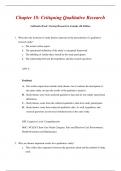
Chapter 18: Critiquing Qualitative Research
LoBiondo-Wood: Nursing Research in Canada, 4th Edition
1. What does the inclusion of study themes represent in the presentation of a qualitative
research study?
a. The actual written report
b. The operational definition of the study’s conceptual framework
c. The labelling of similar ideas shared by the study participants
d. The relationship between the hypotheses and the research questions
ANS: C
Feedback
A. The written report does include study themes, but it contains the description of
the entire study, not just the results of the qualitative analysis.
B. Study themes arise from analyzed qualitative data and are not simply operational
definitions.
C. Study themes come from the collected qualitative data from study participants.
D. Study themes come from analyzed qualitative data. As well, hypotheses and
research questions are not used simultaneously in the same study.
DIF: Cognitive Level: Comprehension
MSC: NCLEX Client Care Needs Category: Safe and Effective Care Environment;
Health Promotion and Maintenance
2. Why are themes important results for a qualitative study?
a. They reflect the congruence between the questions asked and the method of study
used.
, b. They allow description of a large quantity of data in a condensed format.
c. They demonstrate both emic and etic views of a topic.
d. They explain the nature of the differences reported by participants experiencing a
similar phenomenon.
ANS: B
Feedback
A. Themes come from data collected from the responses of study participants.
B. Themes provide a structure to discuss the verbose qualitative data provided by the
study participants.
C. Themes reveal the emic view of study participants’ responses to the researcher’s
questions.
D. Themes generally reveal the similarities of ideas expressed by study participants.
DIF: Cognitive Level: Analysis
MSC: NCLEX Client Care Needs Category: Safe and Effective Care Environment;
Health Promotion and Maintenance
3. Which of the following titles is appropriate for a qualitative study?
a. Exploring the Relationship Between Age of Teen and Degree of Maternal
Bonding
b. Evaluating Decision-Making Coaching Intervention in Cancer Treatment
c. Using Virtual Reality as a Distraction Method During Chemotherapy
d. Understanding Tradition of Fetal Genital Mutilation
ANS: D
Feedback
, A. “Exploring the Relationship Between Age of Teen and Degree of Maternal
Bonding” reflects a correlational quantitative design.
B. “Evaluating Decision-Making Coaching Intervention in Cancer Treatment” is not
reflective of a qualitative design; nor does it suggest a clear quantitative design,
since it uses evaluation research language.
C. The phrase “using virtual reality” in this title suggests the application of a
“treatment” by the researcher, which would suit a quantitative design.
D. Qualitative research involves exploration of concepts, phenomena, and cultures,
which is reflected by the phrase “understanding tradition.”
DIF: Cognitive Level: Analysis
MSC: NCLEX Client Care Needs Category: Safe and Effective Care Environment;
Health Promotion and Maintenance
4. Which of the following processes should you avoid when evaluating qualitative research?
a. Reading the research report to identify participants’ emic views and ideas
b. Performing a power analysis to determine the adequacy of sample size
c. Determining whether the author’s conclusions reflect the study findings
d. Identifying the purpose of the research
ANS: B
Feedback
A. Qualitative research should be read with the intent of understanding the
experiences and ideas expressed by study participants.
B. Power analysis would be performed for quantitative studies, not for qualitative
studies.
C. Research evaluation should include determining if the author’s conclusions
reflect the study findings.
D. Research evaluation should include identifying the purpose of the research study.
LoBiondo-Wood: Nursing Research in Canada, 4th Edition
1. What does the inclusion of study themes represent in the presentation of a qualitative
research study?
a. The actual written report
b. The operational definition of the study’s conceptual framework
c. The labelling of similar ideas shared by the study participants
d. The relationship between the hypotheses and the research questions
ANS: C
Feedback
A. The written report does include study themes, but it contains the description of
the entire study, not just the results of the qualitative analysis.
B. Study themes arise from analyzed qualitative data and are not simply operational
definitions.
C. Study themes come from the collected qualitative data from study participants.
D. Study themes come from analyzed qualitative data. As well, hypotheses and
research questions are not used simultaneously in the same study.
DIF: Cognitive Level: Comprehension
MSC: NCLEX Client Care Needs Category: Safe and Effective Care Environment;
Health Promotion and Maintenance
2. Why are themes important results for a qualitative study?
a. They reflect the congruence between the questions asked and the method of study
used.
, b. They allow description of a large quantity of data in a condensed format.
c. They demonstrate both emic and etic views of a topic.
d. They explain the nature of the differences reported by participants experiencing a
similar phenomenon.
ANS: B
Feedback
A. Themes come from data collected from the responses of study participants.
B. Themes provide a structure to discuss the verbose qualitative data provided by the
study participants.
C. Themes reveal the emic view of study participants’ responses to the researcher’s
questions.
D. Themes generally reveal the similarities of ideas expressed by study participants.
DIF: Cognitive Level: Analysis
MSC: NCLEX Client Care Needs Category: Safe and Effective Care Environment;
Health Promotion and Maintenance
3. Which of the following titles is appropriate for a qualitative study?
a. Exploring the Relationship Between Age of Teen and Degree of Maternal
Bonding
b. Evaluating Decision-Making Coaching Intervention in Cancer Treatment
c. Using Virtual Reality as a Distraction Method During Chemotherapy
d. Understanding Tradition of Fetal Genital Mutilation
ANS: D
Feedback
, A. “Exploring the Relationship Between Age of Teen and Degree of Maternal
Bonding” reflects a correlational quantitative design.
B. “Evaluating Decision-Making Coaching Intervention in Cancer Treatment” is not
reflective of a qualitative design; nor does it suggest a clear quantitative design,
since it uses evaluation research language.
C. The phrase “using virtual reality” in this title suggests the application of a
“treatment” by the researcher, which would suit a quantitative design.
D. Qualitative research involves exploration of concepts, phenomena, and cultures,
which is reflected by the phrase “understanding tradition.”
DIF: Cognitive Level: Analysis
MSC: NCLEX Client Care Needs Category: Safe and Effective Care Environment;
Health Promotion and Maintenance
4. Which of the following processes should you avoid when evaluating qualitative research?
a. Reading the research report to identify participants’ emic views and ideas
b. Performing a power analysis to determine the adequacy of sample size
c. Determining whether the author’s conclusions reflect the study findings
d. Identifying the purpose of the research
ANS: B
Feedback
A. Qualitative research should be read with the intent of understanding the
experiences and ideas expressed by study participants.
B. Power analysis would be performed for quantitative studies, not for qualitative
studies.
C. Research evaluation should include determining if the author’s conclusions
reflect the study findings.
D. Research evaluation should include identifying the purpose of the research study.