

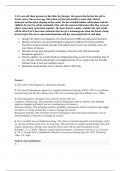
A 67-year-old client presents to the clinic for therapy. He reports that he lost his wife to
breast cancer three years ago. Since then, he has been unable to enter their shared
bedroom and has been sleeping on the couch. He has avoided holiday celebrations with his
children for fear he will be reminded of his wife. He expresses bitterness that they were not
able to enjoy their retirement together. He states that he wonders whether his wife would
still be alive if he'd been more insistent that she get a mammogram when she found a lump
in her breast. His son is concerned about him and has encouraged him to seek help.
1. Identify the client's ICD diagnosis. (I'm stuck between MDD and adjustment disorder?)
2. Identify and discuss one psychotherapeutic approach to address the client's problem.
Provide an evidence-based rationale with support from at least one scholarly source for
your choice of therapy.
3. Describe at least three therapeutic techniques commonly used with the selected
therapeutic approach.
4. Discuss whether you would include psychopharmacology as part of the treatment plan. If
yes, describe which medication(s) you might prescribe. If no, explain why not. Provide
rationale from at least one scholarly source.
5. Rationales should include in-text citations 2018 to 2022 only
Answer:
1. The client's ICD diagnosis is adjustment disorder.
2. The selected therapeutic approach is cognitive-behavioral therapy (CBT). CBT is an evidence-
based therapy that has been shown to be effective in treating depression (Butler et al., 2006).
3. Three therapeutic techniques that could be used in CBT are:
Cognitive restructuring: This technique involves helping the client to identify and challenge
negative thoughts and beliefs that are contributing to his distress.
Exposure therapy: This technique involves gradually exposing the client to situations that trigger
his distress, in order to help him to learn to manage his anxiety.
Relaxation training: This technique involves teaching the client relaxation techniques, such as
deep breathing, to help him to manage his anxiety.
4. No, I wouldn't use psychopharmacology. The client is experiencing grief and mourning, which
are normal reactions to the loss of a loved one. The client has no serious mental health issues that
require medication. Therapy may assist the client cope with his grief and death of wife.
Bonanno, G. A. (2018). Theories of grief and bereavement: A historical overview. In J. D.arrow
& M. S. Stroebe (Eds.), Handbook of theories of social psychology (pp. 441-457). Thousand
Oaks, CA: Sage.
Step-by-step explanation
1.
breast cancer three years ago. Since then, he has been unable to enter their shared
bedroom and has been sleeping on the couch. He has avoided holiday celebrations with his
children for fear he will be reminded of his wife. He expresses bitterness that they were not
able to enjoy their retirement together. He states that he wonders whether his wife would
still be alive if he'd been more insistent that she get a mammogram when she found a lump
in her breast. His son is concerned about him and has encouraged him to seek help.
1. Identify the client's ICD diagnosis. (I'm stuck between MDD and adjustment disorder?)
2. Identify and discuss one psychotherapeutic approach to address the client's problem.
Provide an evidence-based rationale with support from at least one scholarly source for
your choice of therapy.
3. Describe at least three therapeutic techniques commonly used with the selected
therapeutic approach.
4. Discuss whether you would include psychopharmacology as part of the treatment plan. If
yes, describe which medication(s) you might prescribe. If no, explain why not. Provide
rationale from at least one scholarly source.
5. Rationales should include in-text citations 2018 to 2022 only
Answer:
1. The client's ICD diagnosis is adjustment disorder.
2. The selected therapeutic approach is cognitive-behavioral therapy (CBT). CBT is an evidence-
based therapy that has been shown to be effective in treating depression (Butler et al., 2006).
3. Three therapeutic techniques that could be used in CBT are:
Cognitive restructuring: This technique involves helping the client to identify and challenge
negative thoughts and beliefs that are contributing to his distress.
Exposure therapy: This technique involves gradually exposing the client to situations that trigger
his distress, in order to help him to learn to manage his anxiety.
Relaxation training: This technique involves teaching the client relaxation techniques, such as
deep breathing, to help him to manage his anxiety.
4. No, I wouldn't use psychopharmacology. The client is experiencing grief and mourning, which
are normal reactions to the loss of a loved one. The client has no serious mental health issues that
require medication. Therapy may assist the client cope with his grief and death of wife.
Bonanno, G. A. (2018). Theories of grief and bereavement: A historical overview. In J. D.arrow
& M. S. Stroebe (Eds.), Handbook of theories of social psychology (pp. 441-457). Thousand
Oaks, CA: Sage.
Step-by-step explanation
1.


